


1989 was a heady, triumphant summer, the summer before the Berlin Wall fell and before the Cold War ended, and Francis Fukuyama declared in The National Interest, “The End of History?”
Already, China advanced market reforms and Russia began disavowing its Stalinist past. Economic and political liberalism, Fukuyama argued, achieved an “unabashed victory” over communism and fascism. And from Eastern Europe to Southeast Asia, Western liberal democracy “universalized” as “the final form of human government.”
News headlines forty years after “The End of History?” was published will tell you that Fukuyama’s thesis was wrong. Fascism, once “destroyed as a living ideology by World War II,” today witnesses its own rebirth across opposite sides of the world: as the far-right Alternative für Deutschland wins crucial state elections in Germany and the warring Marcos and Duterte factions provide no political alternative in the Philippines. Socialism, Fukuyama thought, would only ever be championed by the “very old” or the “very marginal,” not by New York City’s young, over-educated Mamdani-voting precariat.
But in the world of music, time—“history”—has hit a wall. Its forward trajectory stalled. A number of journalists, curators, critics, and a cover story for Resident Advisor are asking a very Fukuyaman question: Why is there no defining sound for the 2020s?
We’re more than two-thirds through the decade. Cultural critics at Dazed might tell you that the new wave of hyperpop music—underscores, Jane Remover, fakemink, etc.—is ascendant, set to define our century’s twenties. Spotify’s Global Top 50, as of writing, tells a different story: it’s dominated by breakout star Adéla, but also by established pop acts like Taylor Swift and Olivia Rodrigo, or even ‘90s tracks like “Iris” by The Goo Goo Dolls and Radiohead’s “Creep.” No singular music genre right now captures what it means to live today. And without the sound of the 2020s, have we reached the end of history?
Questions like these are not new. In the 2000s, Mark Fisher once answered them by diagnosing the fading novelty of modern music as a symptom of capitalism’s worldwide victory: for the late philosopher, the death of Marxism euthanized any possibility of an alternative, egalitarian world—and a collective unconscious yearning for this “lost future” could be heard across the “hauntological” works of Burial, an electronic music artist whose use of sampling, vinyl hisses, rain, and crackles was deeply nostalgic for a past, a history.
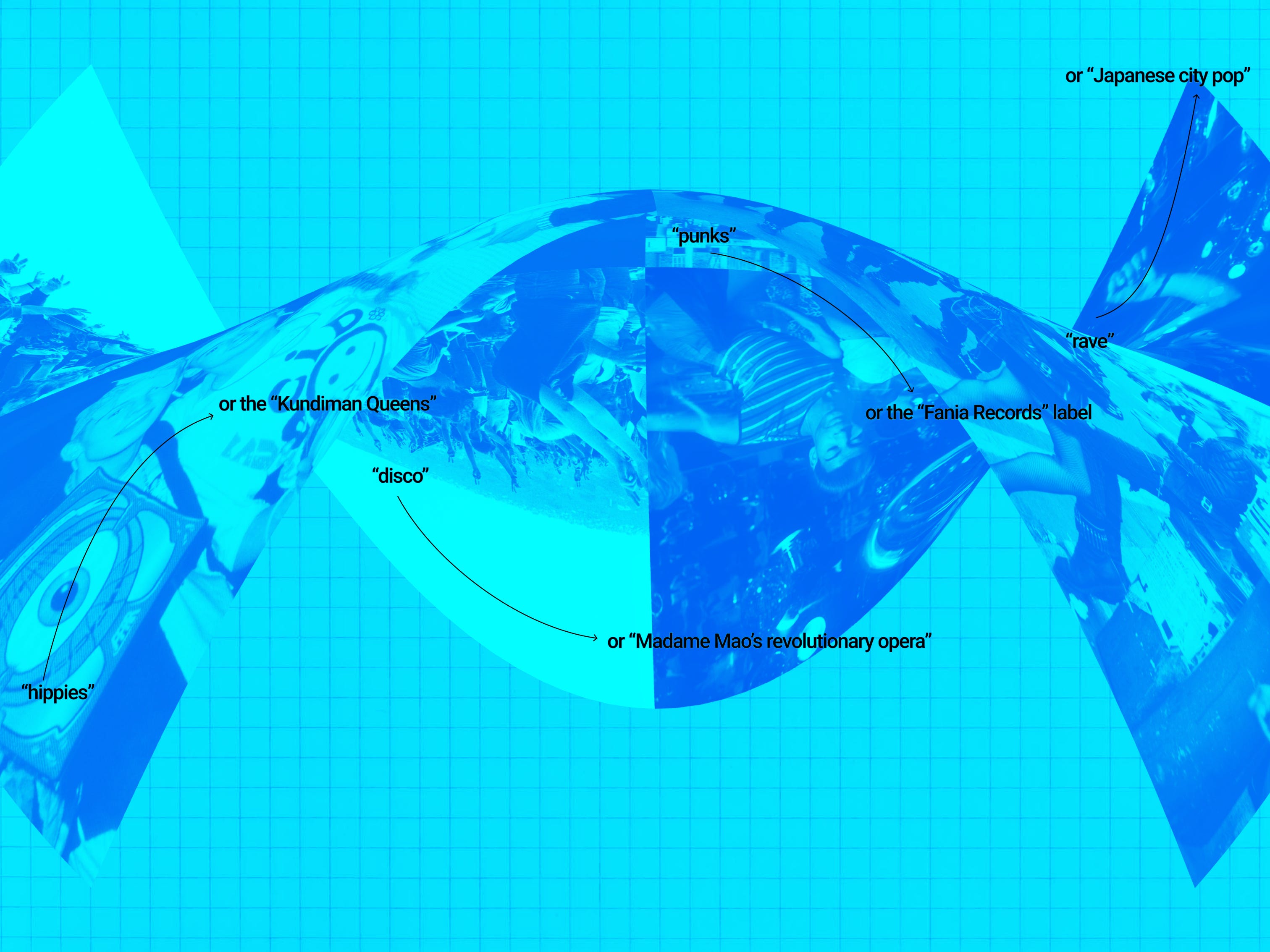
We may not have reached the end of history, per se, but the absence of a decade-defining sound remains a key cultural question of our time. Previous decades of music, as Matty Healy once argued in Joshua Citarella’s Doomscroll, “were so overtly articulate in their time and who they were”: “If I said to anybody ‘the 60s, 70s, or 80s,’ the first thing you would think of was the cultural producers… 60s: hippies; 70s: disco and punk; 80s: rave.” Today, it’s unclear how the 2020s will be remembered sonically, as Gabriel Szatan argues in a recent feature for RA. “Each passing decade of the 21st century feels as though less is breaking through,” he writes.
One year after Fukuyama declared the end of history, the music industry witnessed a “Cambrian explosion” of new sounds. The ‘90s were awash with a new, exciting cultural vitality. Scraping the iceberg of the decade’s mainstream, you witnessed the rise of R&B acts like Destiny’s Child and Mary J. Blige, of Brit-pop groups Oasis and Blur, the grunge of Nirvana, the boy-band as a cultural form a la Backstreet Boys. One could read the blossoming of new music genres as one big industry-wide party, celebrating the victory of liberalism, democracy, and free markets, shedding the baggage from the communism and fascism of the past.
But the party was bound to end one day. Now you can hear the totalizing, unquestionable reign of American capitalism in a music culture that’s grown stagnant, where the logic of the market is inescapable: streaming platforms and algorithms flatten taste, festivals partner with buy-now-pay-later-schemes, club entrance fees are priced too high for young people to enjoy. And as Szatan writes, without ideological opposition in the supposed ‘end of history,’ nothing acts as “a galvanising force [or] an antagonist to challenge.” Cultural motion peters out. Hence we return to this question: Where’s the sound of the 2020s?
History didn’t end. Humanity still wades through time and ideological conflict. And many have learned far too late that liberalism is a privilege that must continuously be fought for. But the progression of music, at least phenomenologically, seems to have come to a screeching halt. How was Fukuyama wrong about politics but right about music? I’ll bite: I think we lack a coherent decade-defining genre of music precisely because history did not end.
Towards the end of “The End of History?,” Fukuyama predicts that the world would only ever be divided between the “historical and post-historical”: states living in history, nostalgic for the heydays of communism or fascism, or states living after history’s end. But with America and China now head-to-head in the AI race, a lowercase-c communist country challenges the world’s exporter of liberal democracy (the “final form of human government”) for its status as hegemon. One is imagined as “the future” while the other has sat at the seat of global power for over 80 years. Which of them is still living ‘in’ history? Which lives ‘after’ it?
The distinction between the two grows fuzzier, especially since we aren’t yet sure which country’s narrative of history will emerge ascendant: Will America continue telling its story as the global power exporting freedom and free markets to the rest of the world? Or will China finally emerge from its “Century of Humiliation” into its National Rejuvenation? Perhaps, also, there is a secret third option, where the supposed Thucydides Trap—the historical tendency for war when a rising power threatens an established ruling power—will be avoided. Regardless, our ongoing timeline is one where multiple possible timelines co-exist.
Like these grand geopolitical narratives, the “decade-defining genre” is a construct of history. After all, music differs from other creative media, as Matt Bluemink argues in The Future is not Lost, in that it is how human consciousness is inscribed in time. Music, therefore, is how we perceive the natural flow of events and how we understand the past. And such a past is built exclusively on a Western understanding.
By this I mean that you can only argue that the ‘60s is hippies, ‘70s is disco, ‘80s is rave in a world where only the histories of the West matter. This clear, straight-lined “decade-ology” advocated by Healy (and others) applies only to the lived experiences of Western nations. Only their stories are reimagined as sound.
If you were living in Japan, your ‘80s might have been defined by City Pop. Rather than rave music narrating deindustrialization and the decline of cities like Detroit and Manchester, tracks like Mariya Takeuchi’s “Plastic Love,” as Real Japanese Aesthetics historicizes, reinterpreted American jazz techniques to portray “the shining future of capitalism, and the emptiness beneath it.” In China, your ’70s were more than likely defined less by the transhumanist fervor of Donna Summer’s disco, where “I Feel Love” effortlessly channeled a womanly sexual desire through a machine, and more by Chinese Communist revolutionary songs like “Red Sun in the Sky.”
Now the world continues to fragment. The unipolar Western order is fracturing into multipolarity. And cultural producers in London and LA are losing their monopoly on history. Whether that shift is cause for worry or celebration is another debate entirely. But with more timelines competing for narrative dominance, there is no singular story of the past—and so no unifying narrative of who we are, where we come from, and what it means to live today. No accompanying music genre comes to define the 2020s.
Working closely with electronic music scenes, I know for certain that great music is still being made. As Szatan writes, “The problem isn’t that electronic music has stopped producing quality. It’s an issue of quantity. There’s more than the culture can reasonably metabolise.” But such is the reality in a fragmented geopolitics, where the White House and NATO must compete with countries beyond the “developed” Western world to seize the narrative: As data from Luminate reveals, American listeners have been streaming less and less English-only music since 2023—making way for Spanish (9.5%) and Korean (1.1%) tracks. “In 2025, songs in 16 different languages reached Spotify’s Global Top 50 charts,” Loud & Clear reports, more than twice the number in 2020.
So, are you a Swiftie in Ohio who unflinchingly believes in American exceptionalism, or an anti-colonial Third Worldist who spends an afternoon listening to community radio in Thailand, Palestine, or Venezuela? Maybe, you’re listening to an NTS Guide to acid house because you’re tracing the economic decline of the UK, or better yet, you’re happily listening to gqom in South Africa or budots in the Philippines and don’t give two shits about “decade-ology.”
Yes, like my fellow cultural organizers and musicians, I mourn the resources and infrastructure our industry has lost. But I’m not given to mourning the death of the decade-defining genre. Because, as Fukuyama himself clarifies in the preface of In the Realm of the Last Man, “History, rather than ending, had simply paused on its way to an uncertain future.” Hence, we now resume. Let a hundred histories bloom; let every nation tell its own story through sound.
