


The ghost of Lee Kuan Yew is haunting the internet. The jumpscares are infrequent, but every now and then I see his face, the former Prime Minister of Singapore, cropped and flattened perfectly for the dimensions of a 6.1-inch phone screen. He appears pixelated, oftentimes with static fuzz of black and white, like the long-haired spirit in The Ring, with lines strung underneath his eyes, his face fixed in a tired frown. His voice, however, is stern and strong. In speeches, layered over ‘TikTok Sigma Male edit’ music, his apparition is clipped speaking into microphones with a grandfatherly ferocity. “Whoever governs Singapore… must have that iron in him,” he says. “This is not a game of cards—this is your life and mine. I‘ve spent a whole lifetime building this. And as long as I’m in charge, nobody is going to knock it down.”
On a Thursday mid-twilight, I’m standing on a concrete staircase outside an art gallery in Hong Kong, asking two Singaporeans why their former leader had come to haunt me: “There’s a running joke back in Singapore,” Rafi Abdullah, an art curator, says. “Once Singapore goes to shit, Lee Kuan Yew will rise from the dead and come save us.”
“You can never hold a dead person accountable,” Brandon Tay, an artist, adds. “His legacy is sacred and unchanging. I mean, just like with any state defined by so-called ‘Great Men,’ they’re always haunting the subsequent history. They’ve done their part, and they’ll be judging you forever from the grave like an Asian parent.”
It would be challenging to summarize Lee Kuan Yew’s legacy in one paragraph, but he is remembered for his strict, paternalistic, highly-effective governance. His “illiberal democracy” with strict rule-by-law transformed the poor, post-colonial island of Singapore into one of the world’s most prosperous and efficient cities. In Lee’s own words: “Over 100 years ago, [Singapore] was a mud-flat, swamp. Today, this is a modern city.”
Now a decade after Lee Kuan Yew’s death, Singapore’s story of rapid growth and transformation is becoming increasingly seductive in the West—and somehow the specter of the late Singaporean politician looms larger among crowds who were never meant to hear his speeches in the first place.
The ghost of Lee haunted the tech mogul Elon Musk, who, late last year, tweeted saying Singapore’s founder was “genius next-level” and “so based.” The ghost of Lee haunted an ex-friend of mine, a socially-awkward Jane Street trader born and raised in the American Southwest; he often confessed to me that Lee’s speeches had hypnotic powers, that the pull of his right-wing Southeast Asian politics was too strong. The ghost of Lee is—in present tense—haunting much of Silicon Valley: For the emerging neo-reactionary tech movement that plans to “exit democracy” and establish their own sovereign nations built on blockchain, Lee’s Singapore is a “proof-of-concept” for how to build an independent country from scratch, a “network state.” Lee is the false god hoisted on the altar of a venture capitalist, an optimized authoritarianism is his phony gospel.
Among futurists and technologists, this is only one of many recurring Orientalizing obsessions with Asia. Today, Singapore is fashioned as the model for the tech-right’s “network state,” but in earlier decades, Los Angeles in Blade Runner (1982) was inspired by Hong Kong and the ‘80s cyberpunk novel Neuromancer took place in “Neo-Tokyo.” Out of both fear and fascination, somehow the future we imagine is always “Asian.” Kanji dresses the Cyberpunk 2077 skyline, while D.C. technocrats and the think-tank industrial complex foresee the looming “Asian century”: the projected dominance of Asia in the 2000s, driven by rapid growth in China, India, and the ASEAN.
Nick Land, Silicon Valley’s hottest right-wing accelerationist philosopher and a key influence in the writings of venture capitalist Marc Andreessen, projected this future years ago. In his seminal 1994 essay “Meltdown,” he prophesizes, “A sino-pacific boom and automatized global economic integration crashes the neocolonial world system… Neo-China arrives from the future.”

The daylight overstays its welcome, and the two Singaporeans crack some cans of Asahi. We’re all waiting for Square Street Gallery to open for “HEX STATE SERVER,” an exhibition the pair had been working on: Brandon had traveled from his home in Shanghai for his first solo exhibition in Hong Kong, while Rafi curated the exhibit with the Institution of Niche, a bootstrapped side-hustle by local art curator Angela Liu that’s been slowly injecting post-internet art events into the city.
From what I could gather, “HEX STATE SERVER” was set to be the most widely-anticipated accelerationist art party in the city: Brandon’s installation pieces drew “parallels between Chinese divination and computation,” and featured an opening performance by welainej, an experimental musician making (what she calls) “transmutative dark ambient poetry” with obscure software and wearable controllers.
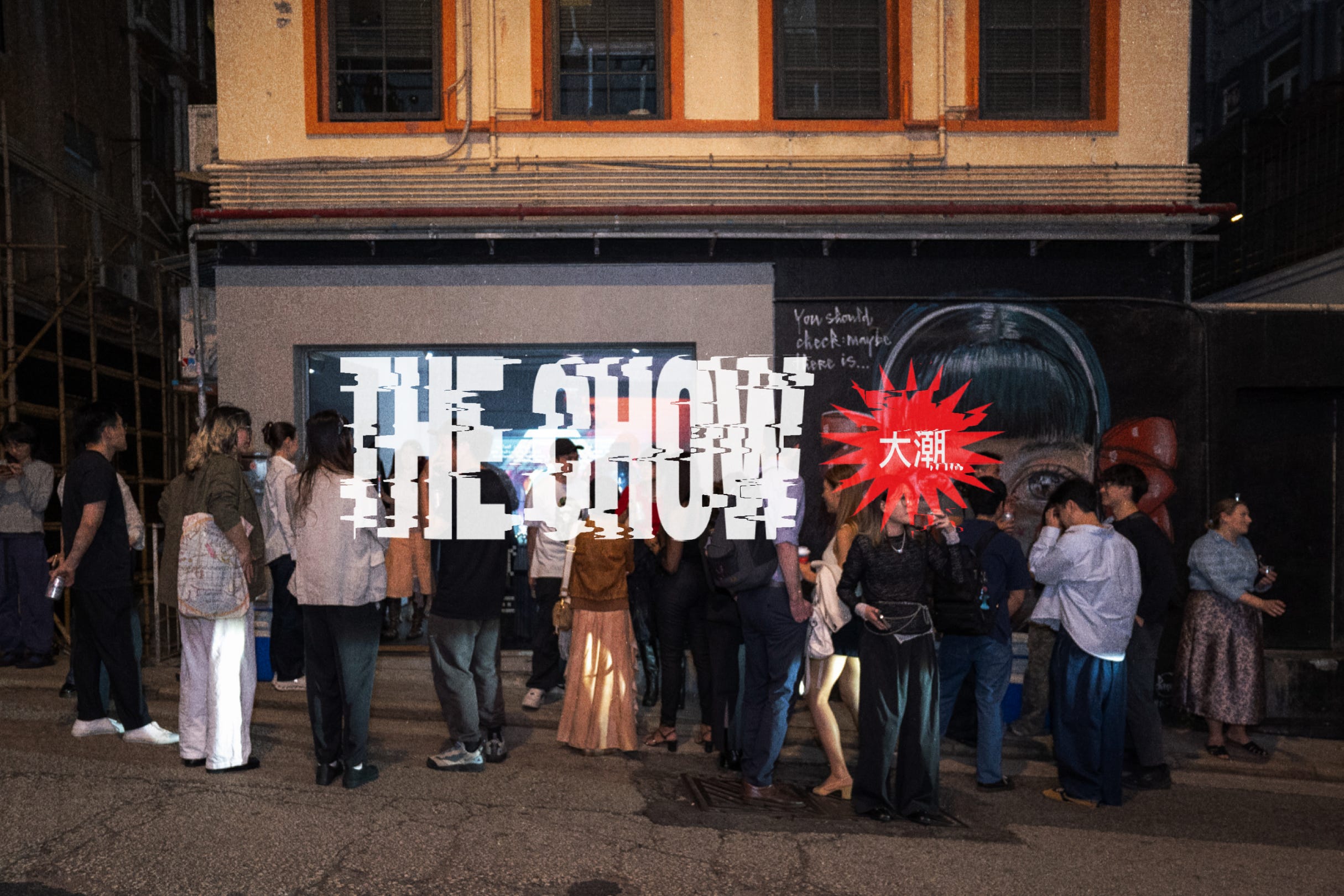
By 6:45pm, people are crowding the street. But with half the crowd in folk punk mullets, tabis, and baggy black jeans, and the other half dressed in work-appropriate suits, you can tell that not everyone is here for “HEX STATE SERVER.”
Four people in formal dinner party attire carrying violins and a cello walk in single-file on the steps behind me. From the corner of my eye, a short, stocky WASP in skin-tight gray slacks raises his arms, and in a thick Northeastern-American accent, says: “Good evening everybody! I am very honored to introduce the Romer String Quartet, who will be performing the first movement of Debussy’s String Quartet.”
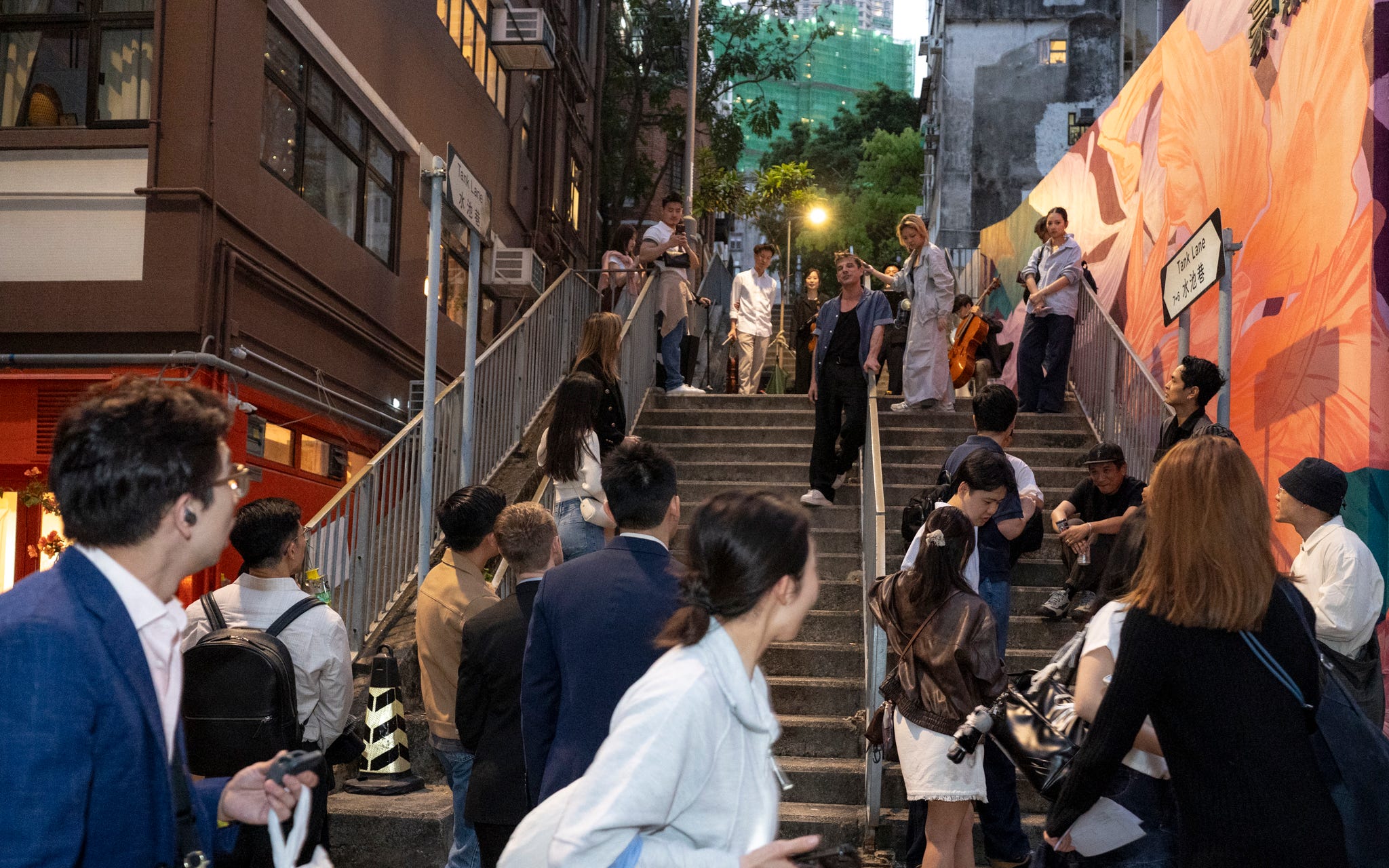
“You can’t make this up,” I whisper to the two Singaporeans, giggling. “A futurist art exhibit on Chinese computation run by Singaporeans is fighting for space with a white guy and some French music.”
The accidental poetry here is that East and West (which are really just shorthands for the US and China) are pitted against one another, caught in a never-ending battle for who will reign the future. But even when Elon Musk espouses the virtues of Singaporean governance or when Nick Land says “Neo-China arrives from the future,” life out East is not so blindly optimistic. Friends and colleagues in Hong Kong do notice a renewed interest and excitement in the region, but for a young person in the city, anxieties might not be all that different from their counterparts on the American coasts. Across the region, many of my friends in their 20s are either underemployed or see their white-collar jobs as dead ends. The rest are juggling three or so gigs on average, but in the back of their heads, can’t shake the paralyzing fear that one day they might wake up and be made redundant.
That is, “Asia is the future” or the “Asian century” are fun concepts at surface level, but with similar narrowing economic opportunities for the region’s youth, I doubt they clearly translate on the ground. The “Asian century” you imagine will not exist. And on display at Square Street Gallery’s party, Brandon Tay’s “HEX STATE SERVER” had explanations why.
“I’m very suspicious of apocalyptic narratives,” Brandon tells me, on the Friday after the party. A global collapse, the Protestant Rapture, or even “things like the AI singularity, I find them to be seductive, but kind of stupid.”
The idea that “Asia is the future”—whether China, Japan, or Singapore will one day rule the world—isn’t all that different; whether celebrated or feared, the narrative is a fixed, determined end-point that prophesizes West ceding power. In Chinese tradition, however, “the future” is not nearly as set. During China’s modernization in the 20th century, leaders like Liang Qichao and Lu Xun believed in the concepts of linear time and a straight-lined march towards progress, but this was a departure from the earlier Taoist and Confucian emphasis on cyclicality. Likewise, one current in “HEX STATE SERVER” is that rather than progressing forward, time is circular and history moves in cycles.
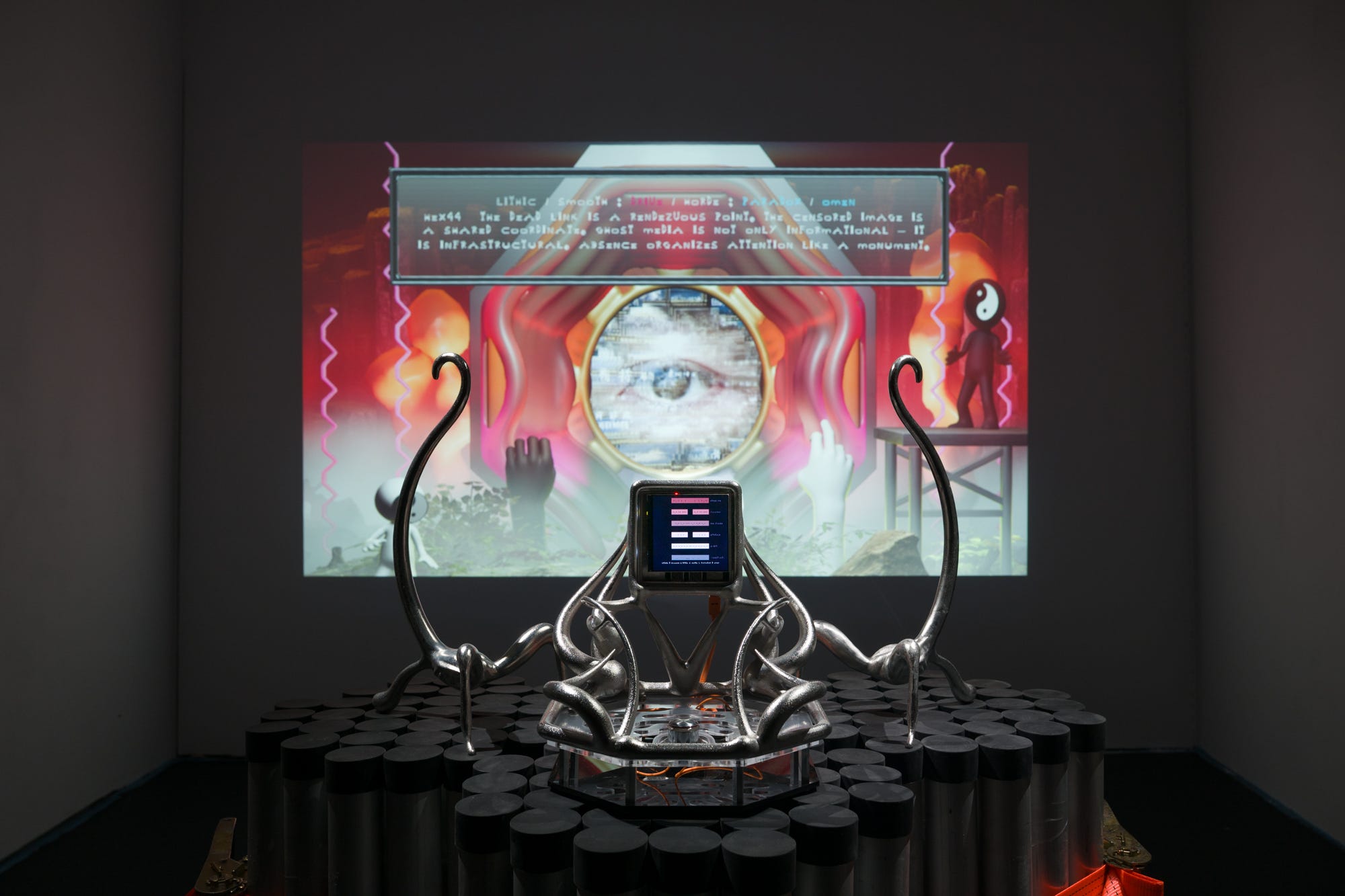
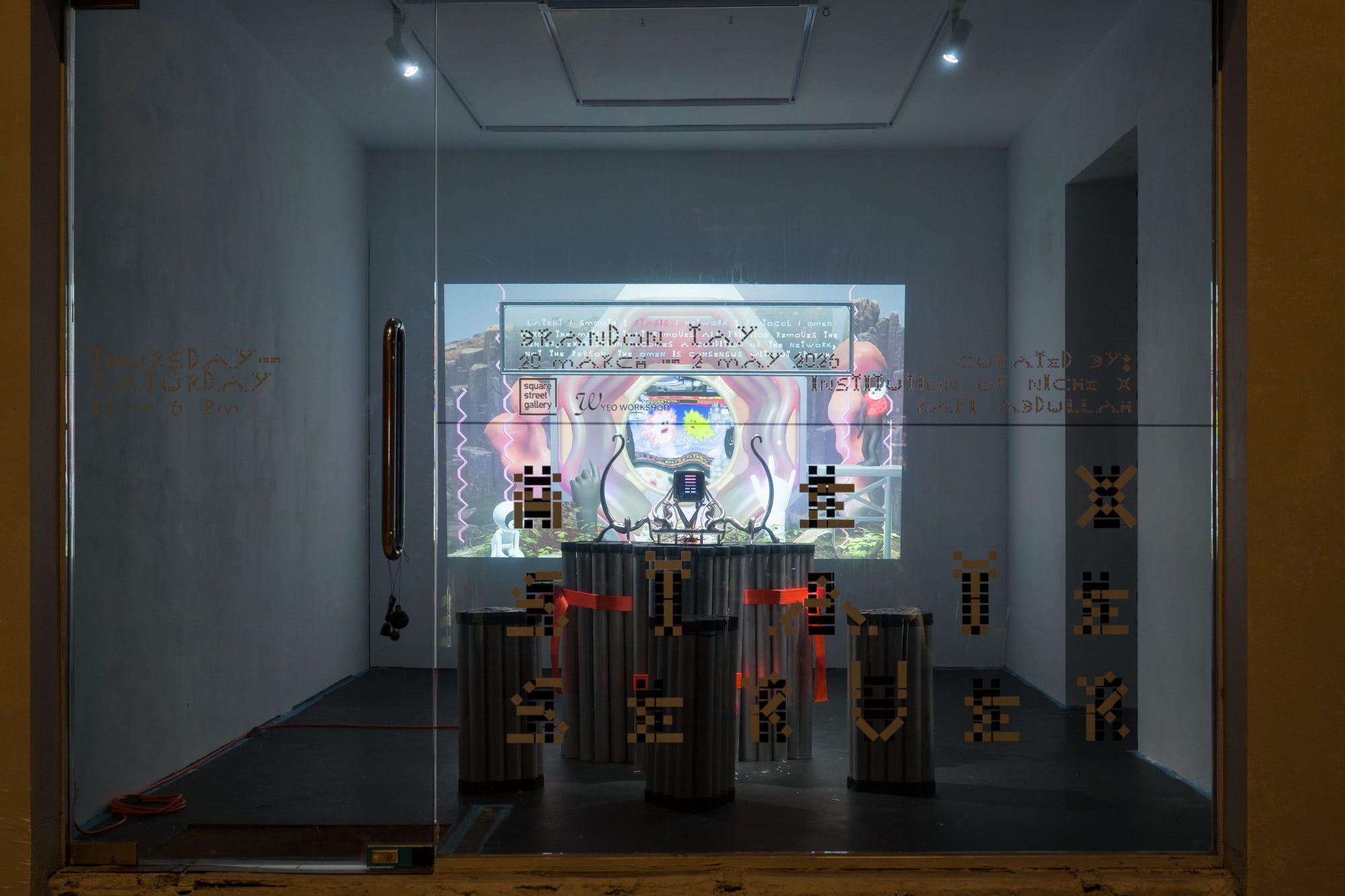
The main sculptural installation, sharing the same name as the exhibit, begins first as a small, GoPro-sized computer system, wrapped in metallic embroidery, standing atop a makeshift table of bound-together steel pipes. On the wall across, the computer projects an eight-sided portal (like if the New York-Dublin Portal were an octagon). Rather than providing a view into another city, the “HEX STATE SERVER” portal opens into 64 “hex-states”: “micro-fictions,” or stories and worlds with the goal of creating a “dreamlike, mesmerizing, monotonous quality that can feel a bit uncanny.” Every time a viewer presses a button on the GoPro-sized computer, a new “micro-fiction” appears at random.


“ There’s two hours of video in there. And through the process that reads the temperature of the CPU and the programs running at the time, and the computer picks a number out of 64 randomly,” says Brandon. “ It doesn’t spread out across averages. So sometimes you might get the same result twice.”
The logic of “HEX STATE SERVER,” Brandon says, draws from the I Ching, an ancient Chinese divination text that, much like the installation, points its readers to parables at random. By highlighting the randomness present in both systems—whether through Taoist clairvoyance or algorithmic approval—“HEX STATE SERVER” suggests that the algorithm and divination are deeply intertwined. A new technology repeats an old practice.
“The easiest frame to understand the truly unknown is through the frame of the very recently understood,” Brandon says. For him, works like “HEX STATE SERVER” belong to a longer tradition—one where technology does not accelerate us forward, but in fact, pushes us closer to the past.
New technology has always had magical qualities. Early telegraphs were used for seances and the first photographers claimed their cameras could capture ghosts. In New York, the writer Max Read argues that the internet is not too different, that spell-casting sigils and speaking to ghosts haven’t gone away—they’ve only been replaced by QR codes for Foodpanda and ChatGPT-induced psychosis. Read asks, “What if we aren’t being accelerated into a cyberpunk future so much as thrown into some fantastical premodern past?” And even as Asia is often described as “the future,” more often the region retreats towards the ancestral.
Asia’s rave subculture—despite its roots in imagining the future—is taking a sharp turn towards pre-modernity, with electronic music festivals thrown at colonial castles in Manila or temples in Taipei and Shanghai. “Ancestral Frequencies,” a widely anticipated art party in Hong Kong’s Eaton Hotel, combined “sensual trip-hop” with “voices, rhythms, movements, and mythologies sidelined by colonial and patriarchal histories.”
Nick Land should’ve written that “Neo-China arrives from the past.” What these emerging art exhibits suggest is that, paradoxically, humanity’s future is one of constant repetition. We are not hurling towards apocalypse or utopia, but recycling history—a process mapped in Brandon’s accompanying piece, “PHANTOM INDEX.”


Plastered as wall text in a room adjacent to “HEX STATE SERVER” is a “speculative timeline” of major events in Chinese history, from 1046 BCE to our present. Across this continuum, “PHANTOM INDEX” identifies seven “HEX STATES,” recurring themes “latent in Chinese computational thought.” Here, Brandon and his curators draw direct parallels between the nation’s past and present: China’s special economic zones are new configurations of 19th-century treaty ports; the modern Gaokao reincarnates the Sui Dynasty’s Imperial examination.
“One [HEX STATE] that feels most apparent to me is ‘PERMISSIONED REALITY.’ In China, everything you do is based on levels of access,” says Brandon. Introduced in 1958, China’s current Hukou system assigns citizens movement rights based on “urban” or “rural” status—but the Baojia system, a similar social sorting protocol, once existed in imperial China. Plastered on the gallery’s white wall, the piece reads, “These are not periods but conditions… history ceases to move as a single line and begins resolving in parallel environments.”
Ironically, it was Westerners who thrust the idea of a “Chinese/Asian century” into the mainstream. But the Sinofuturists, Brandon tells me, didn’t share these ambitions for global domination: “Sinofuturism [or Chinese Futurism] was more observational, and somehow it generated its own energy due to several different factors—cultural and political—like China-maxxing.” Now, with the nation’s continued rise as a global power, the narrative that China is “living in the future” is forced upon it, mostly from the outside.
More often, this sentiment feels increasingly universal across the globe. New technology is viewed with increasing suspicion. We’ve arrived at a future that most of us do not want. A dystopia thrust upon us against our will.
But if Brandon’s work suggests that time and history are cyclical rather than linear, that reads to me as an invitation: to see how we might short-circuit our current doom loop; to understand that futures are never fixed. “People say China is the future. But the future of China is always changing,” says Brandon. “Definitions about what Asia is and will be will always change, as ‘Asia’ and ‘China’ are constantly shifting. Like a hyperobject.”
In that sense, suggesting that “China is the future” or we’re “living in the Asian century” might not project a hypothetical end-point where East dominates West. It might be a tacit acknowledgement that the future—like Asia—remains open, free, full of change and possibility. And among an infinity of possible realities, what matters is the world we want to create.

This piece was so extremely fascinating to me, i was really enthusiastic about it. I also just reread “Meltdown” precisely yesterday, and I saw that Land had invented the term “singularity” about ten years before Kurzweil wrote a book about it of the same name, as he is usually credited for coining it. Also Land was really into the I-Ching, along with occult numerology. It’s creepy, I am writing a scholarly text on Land rn, but privately, I think there’s something kind of spooky about his prophecies and the CCRU. Also did you know that Kode9, who was in the CCRU and close with Land, technically coined “Sinofuturism”? (Which is to say that you’re correct, it was from the west and foisted onto the east.) Kode9’s debut album is titled “Memories of the Future” which feels really thematically relevant to what you’re writing. Also, Chinese cyclical time seems proven by America’s turning backward in time, and that no country—Rome, Germany, or the US—can lay claim to linear time, no exceptions. Emotions are really weird from within the US right now: I find myself rooting for China when I read the news, because I hate the US so much but it’s important not to let Land’s doomer charisma infect me and legitimize global violence by calling it cyberpunk.
It'll never be our time to rule!?