


“Oh my God?! Did they finally do it?” my friend, Leslie*, squeals. “Did Soho House finally become cool again?”1
We’re the only two people in a cold blue elevator ascending to the 30th floor of a skyscraper. It’s a little after midnight on a Friday in Hong Kong’s Sheung Wan neighborhood, and fresh from an over-extended pregame, our evening is bubbling with possibility: A new clothing brand by the name of valentyne—stylized as “V*******e”—was hosting a part merch drop, part launch party event in the infamous “pool room,” an events space at the top floor of Soho House Hong Kong. “It’s great up there,” alleged one videographer friend we ran into at the club’s lobby, just minutes before. Leslie, a member of Soho House, brought me as a guest. And we decided to crash.
The blue elevator doors open. A swarm of over twenty wrinkly, pointed-nosed white expats and their cake-faced Chinese girlfriends squeeze in front of me like rats. I extend my arm forward to shuffle Leslie and me through the crowd.
“Excuse me,” I say, pulling Leslie by the arm. Downstairs, the line to the elevator going up was empty. But on the top floor, a crowd is gushing towards it, racing back down.
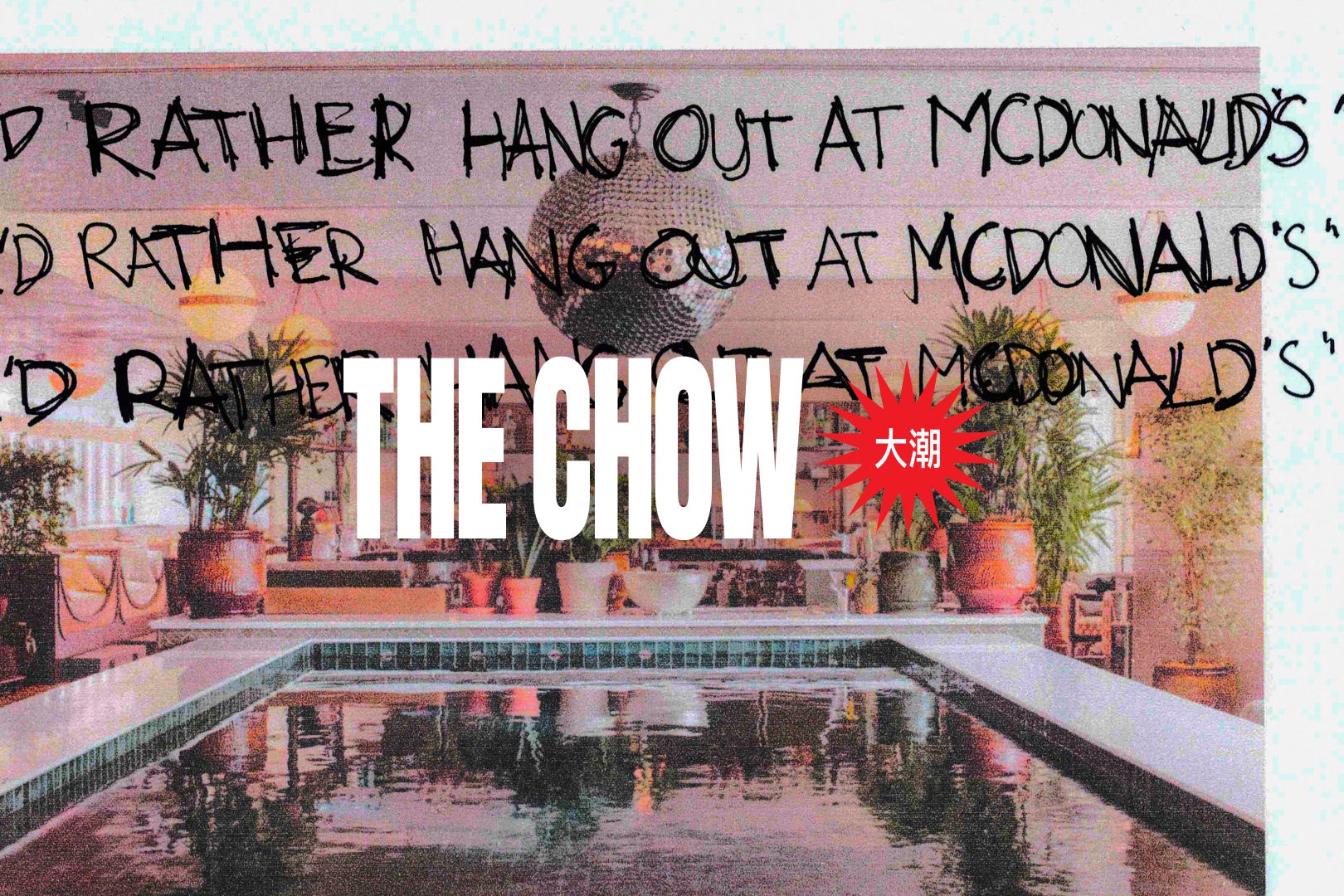
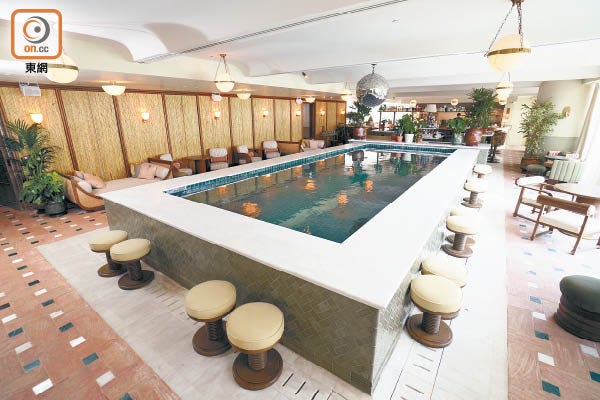
My vision clears, and the function room is cosplaying as an oasis. A ceiling of sandy beige hovers parallel to an oakwood floor. Potted plants cluster near the middle of the room—two kentia palms, two snake plants, one weeping fig—like guarded flora in the middle of the desert. Sandwiching the pots on one side is the bar, with liquor hanging on a dark beige, near-ceiling-high shelf. On the other side is a pool, though not the typical kind dug into the ground. This pool was built above the floor, with cement and ceramic shaped like an inflatable. It covered nearly half the room, and was no taller than my mid-thigh.2
This, after all, was the infamous quirk of the infamous pool room in Soho House Hong Kong. And I’d seen it before—in afternoon meetings or in one-off ice cream sandwich hangouts with friends; in the stories of an unfortunate number of status-anxious young people, usually around my age, who thought it’d be a good idea to strip down to their undies inside a room where the air conditioning is perpetually on full blast, hit record for the ‘gram, and jump into a pool only appropriate in size for a toddler.
Inside, most of the crowd circles the bar. Nobody is swimming. It’s hard to guess why the pool ever needed to cover half of the room, and what kind of partygoers it was ever built for.
More often I’ve started to hear a similar line of questioning around the city, except about Soho House itself. The club is a globe-spanning entity, providing a living-room meets co-working-space meets restaurant-cafe for an internationally mobile creative class, jet-setting between skyscrapers in Dubai, London, New York, Barcelona, and Hong Kong. That model is increasingly being scrutinized, and some are beginning to wonder, What is the Soho House brand even for? And who are their members, really?
Founded in London in 1995, Soho House had flipped the original idea of a private members’ club on its head. Once the domain of boarding school types with family crests, founder Nick Jones’ vision was for the cultural elite: he prioritized recruiting creatives to Soho House’s ranks more than the professional class with pockets full of cash.
“Unlike most of the members clubs … that are crowded with the super-rich, we are not looking for that,” Tim Geary, a British novelist and early Soho House committee member, once told The Observer. In the early 2000s, The Guardian notes, the club successfully recruited trend-forward types with jobs in advertising, film, and the early internet boom, and often hosted screenings with emerging documentarians and launch parties for novels. In its 30-year history, Soho House rarely turned a profit. But that was always secondary to the world it was building: a global creative elite united under an exclusive roof, governed by a meritocracy of cool.
But what happens when that cool is lost, or even called into question? When asking both scene and industry friends their thoughts on Soho House’s Hong Kong branch, responses aren’t always aligned with the brand’s original vision, to say the least. Recently, an events organizer told me she canceled her membership because it “just wasn’t worth it,” while a designer admitted that in the last year she “only used it to grab coffee with Patrick” (a.k.a. me).3 “It’s not that useful,” a tech founder once told me in passing, adding that only the club’s Lower East Side branch really came in handy, during his business trips to New York. Two curators at a large gallery told me it’s primarily functional—that they like to “sit and talk” and “people watch” there—but don’t actually care to engage with the other clientele. Another friend, a member who frequently visits Hong Kong, told me “I don’t know if Soho House is cool, but maybe it’s just not uncool?”
“Is Soho House still cool?” is an impossible research question to operationalize. But you can piece together fragments of an answer without surveying the club’s members. In Shonda Rhimes’ Netflix series Inventing Anna, con artist Anna Delvey is asked if she was rejected by Soho House in episode two. She replies, “I’d rather hang out at McDonald’s.”
Soho House clapped back in possibly the least cool way imaginable: by publishing an opinion column in their magazine calling Delvey “a poor little faux-rich girl” and “a spoiled rich trophy girlfriend.”
Another more recent, more widely circulating meme is more scathing than the fictionalized Delvey: “[I] recently invented the word chubai, which is when something is both chopped and spiritually dubai. examples: soho house.”

Back in the pool room, only pink strobe lights crowd around the DJ booth, and the space in front of the man on the decks is empty of dancers. Dressed in a baggy white T-shirt of Uniqlo proportions, he cycles between Calvin Harris’ “Feel So Close” and Peggy Gou’s “Nanana,” with more volume and pitch changes than any mixing.
valentyne is a streetwear brand, but most of the crowd at the launch party consists of aging European millennials in checkered dinner jackets and Gucci Horsebit loafers. Standing in front of Leslie and me, they gather in a horizontal line for a photo, faces bored like apes.
Leslie jolts back. “Please dear God, I can’t have my picture taken here,” he says to me. “I can’t be seen at this party. Everyone is a cheugy Dubai European.”
No one else looks like they live in this city. Not the pale, bleach-blonde woman in a tight, brown cocktail dress, speaking to the bartender in a vaguely Eastern European accent. Nor does the photographer, with one-shade-darker-than-golden skin and curly TikTok-style broccoli hair, who, all of a sudden, decides to snap a photo of me scribbling my observations into the ripped pages from a Moleskine.
I decide that if he’ll catch me secretly reporting the party, I might as well talk to him.
“What’s your name?” I ask.
“Kareem,” he replies.
“Oh, like the guy who does Subway Takes?”
“Yeah, exactly like the guy who does Subway Takes.”
“Where are you from?”
“Dubai, but I’m Egyptian and Lebanese.”
“You got lucky then, leaving before the war,” I say.
Leslie chimes in, “Are you Catholic?”
“No, I’m Muslim,” Kareem replies, before taking a large gulp from a pink cocktail in a curved drinking glass.
I gasp, form my index finger into a wag, and say in disapproval, “That’s haram.” Kareem’s face flushes red. He laughs, walking away coyly to his friend behind him.
There is a language for places like these—where ethnic or religious identities like “Egyptian” or “Lebanese” or “Muslim” all melt into a blob of amorphous “global” identity. Kyle Chayka, tech critic at The New Yorker, used the word “AirSpace”: places across the globe “that share the same hallmarks everywhere you go.” AirSpace describes cafes, bars, and members clubs for rootless cosmopolitans. AirSpace is the world in which people with ambiguous origins and little to no cultural values find most comfort, filled with a “profusion of symbols of comfort and quality, at least to a certain connoisseurial mindset.”
When Soho House scaled and exported its “meritocracy of cool” across the globe, it created an AirSpace. With over 40 outposts in 19 different countries, the brand needed to maintain legibility and palatability to an estimated 194,000 members (as of 2024). That meant creating a brand universe that coalesced into a lower quartile of good taste: muted brown interiors, cream and beige walls, dark oakwood chairs, and warmly toned sofas. A room in Soho House, to me, is colored like a film camera photo—always idyllic, never offensive and never out of place, even when exported to cities as varied as Nashville, São Paulo, or Mumbai. “The homogeneity of these spaces means that traveling between them is frictionless,” Chayka continues. “Changing places can be as painless as reloading a website. You might not even realize you’re not where you started.”
Walk into any Soho House and it looks pretty. But they’re hard to describe as “tasteful.” Actual taste, or “aesthetic cultivation in response to one’s individual circumstances” (as the trend forecaster Sean Monahan argues), is antithetical to Soho House’s mission of scale and of creating a globe-spanning members club.
Indeed, Soho House is incredibly successful at chaperoning a global creative class under its roofs. But at the party, this is achieved through flattening, by melting all cultures, ethnicities, and identities away into a formless blob. And in 2026, it’s becoming increasingly clear that good culture is antithetical to scale and antithetical to an unfettered globalism.
Because when Soho House Hong Kong does host cool parties (in fact, they regularly do), locality is often part of the selling point. Yeti Out, one of the city’s most popular local music collectives, regularly uses the club’s spaces for parties that hybridize genres like Cantopop and UK Grime into one. Once, Soho House hosted ¥ØU$UK€ ¥UK1MAT$U, the internet-viral DJ rising from the Osaka-Kobe club circuit, for a packed, sold-out event. Neither act, however, seems tied to the same formless globalism that curses a course-selling Bali bro or “influencer” in Dubai. Both are deeply embedded in scenes, subcultures, or universes only partially scraped by the internet.
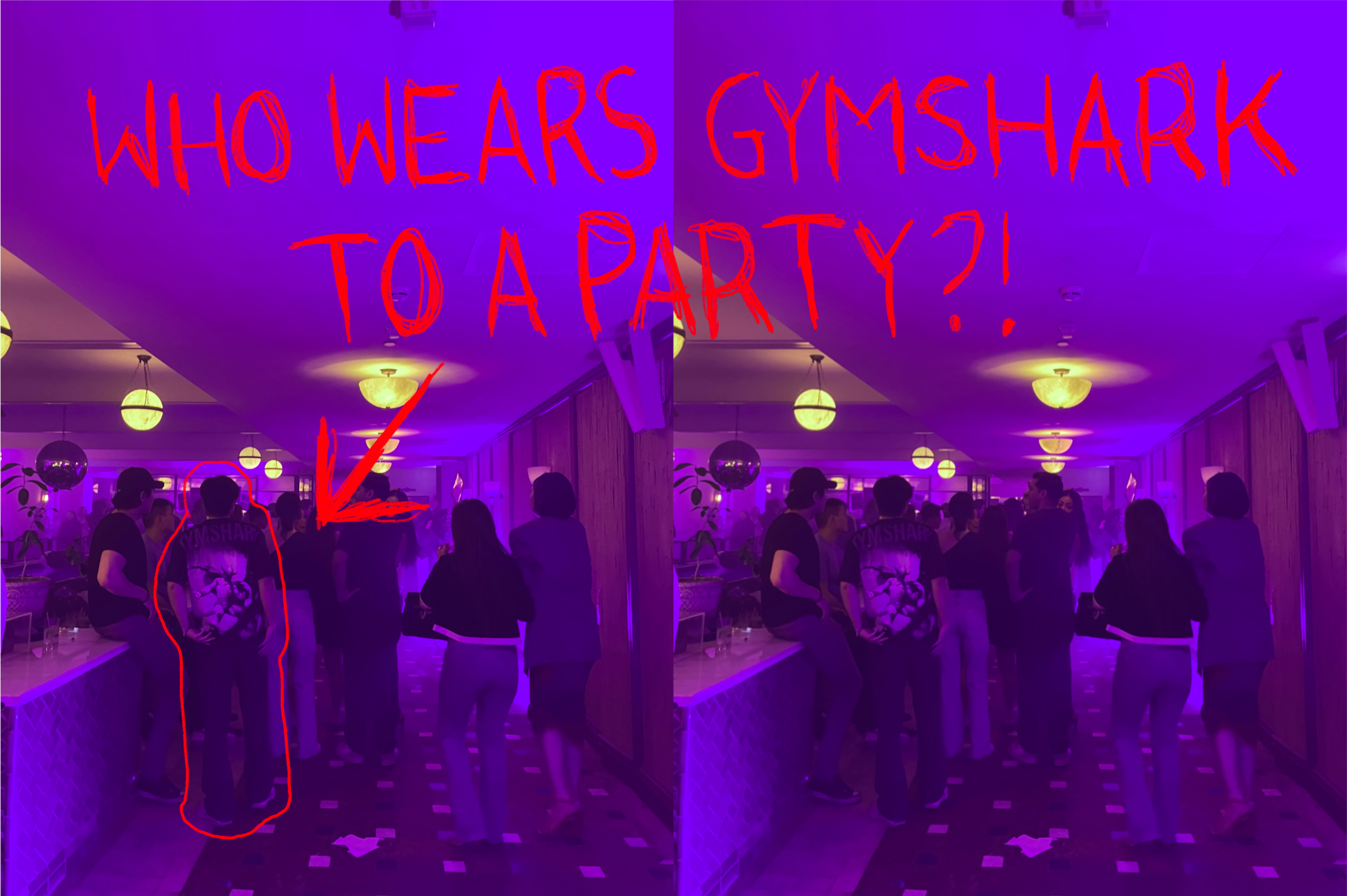
Leslie and I spend our remaining time at the party exchanging notes and people-watching. But the unnamable, formless blob grows less interesting to observe by the minute: Broccoli hair. Instagram face. Little top big pants. Accents that betray little to no cultural origin. By 1am, we’ve been around for less than an hour, but it’s time to go somewhere else. Walking back towards the elevators, we see a man in a black Gymshark tee.
“Who the fuck wears a Gymshark shirt to a party?” I say to Leslie.
There are still thirty or so (different) people crowding near the elevator. I start to feel like eating McDonald’s. But before I can propose the idea to Leslie, he says to me, “I think I’m gonna cancel my membership.”

“Leslie” is a pseudonym.
From Oriental Daily, see:
As of the publishing date, said designer canceled her membership.
EVERYONE SHUSH MY FAVOURITE WRITER IS HERE
gymshark and soho house in this modern day now go hand in hand and i think that’s all thats needed to say about SH