
Listen around you. Does everything sound the same? Does every chart-topping track follow the same structure, engineered for virality on TikTok? Maybe you’re at a club hearing the thousandth remix of a song from ten years ago, or hearing, once again, that same song chopped up and twisted as the opening sample of a new release?
This is the landscape of popular music in 2026, where many “new” songs follow a virality formula, build on old musical structures, or rely on sampling—the literal recycling of the past.
There’s a term to describe all of this: “hauntology,” popularized by the late theorist Mark Fisher in an essay for Film Quarterly, and immortalized in his book, Ghosts of My Life. Hauntology first described a predicament Fisher saw in electronic music: tracks composed mainly of archival recordings, leaning into nostalgia over novelty. But today “hauntology” is used by culture critics to describe the stagnation of the music industry writ large: new songs reproduce popular styles or sample older hits, creating a feedback loop where nothing truly new can ever be made.
This issue might seem trivial. But as Matt Bluemink argues in his book, The Future Is Not Lost, music is how humans inscribe their consciousness into time. It’s how we perceive the flow of events, and by extension, perceive our march towards the future. Earlier genres like disco and techno had often been a key way in which humanity imagined its progression towards a more utopian, more just society. And as Fisher warns, music’s regurgitation of the past signals a “deterioration of a whole mode of social imagination: the capacity to conceive of a world radically different from the one in which we currently live.”
With no new music, there is no way to map humanity’s progression through time. With no new music, there would be no future.
That is the prevailing wisdom of the moment if you’ve been reading what all the culture critics have to say. And many of them are right when they argue that the 2020s lack a clear, unifying genre that defines the experience of the decade—at least not in the way that, say, “poptimism” defined the 2010s or “indie sleaze” and “recession pop” defined the 2000s.
But that doesn’t mean that music is not evolving. For one, with the decline of a totalizing, Western narrative of history and progress, and the shift towards a multipolar world, perhaps there won’t be a “decade-defining” genre for the 2020s, but instead a transition towards a networked, hyperlocal music culture.
So, to challenge conventional wisdom: can music still have the power to imagine a new cultural future? Music is not evolving in the way we expect it to. But it’s still transforming in ways that are unique and particular to the 2020s.
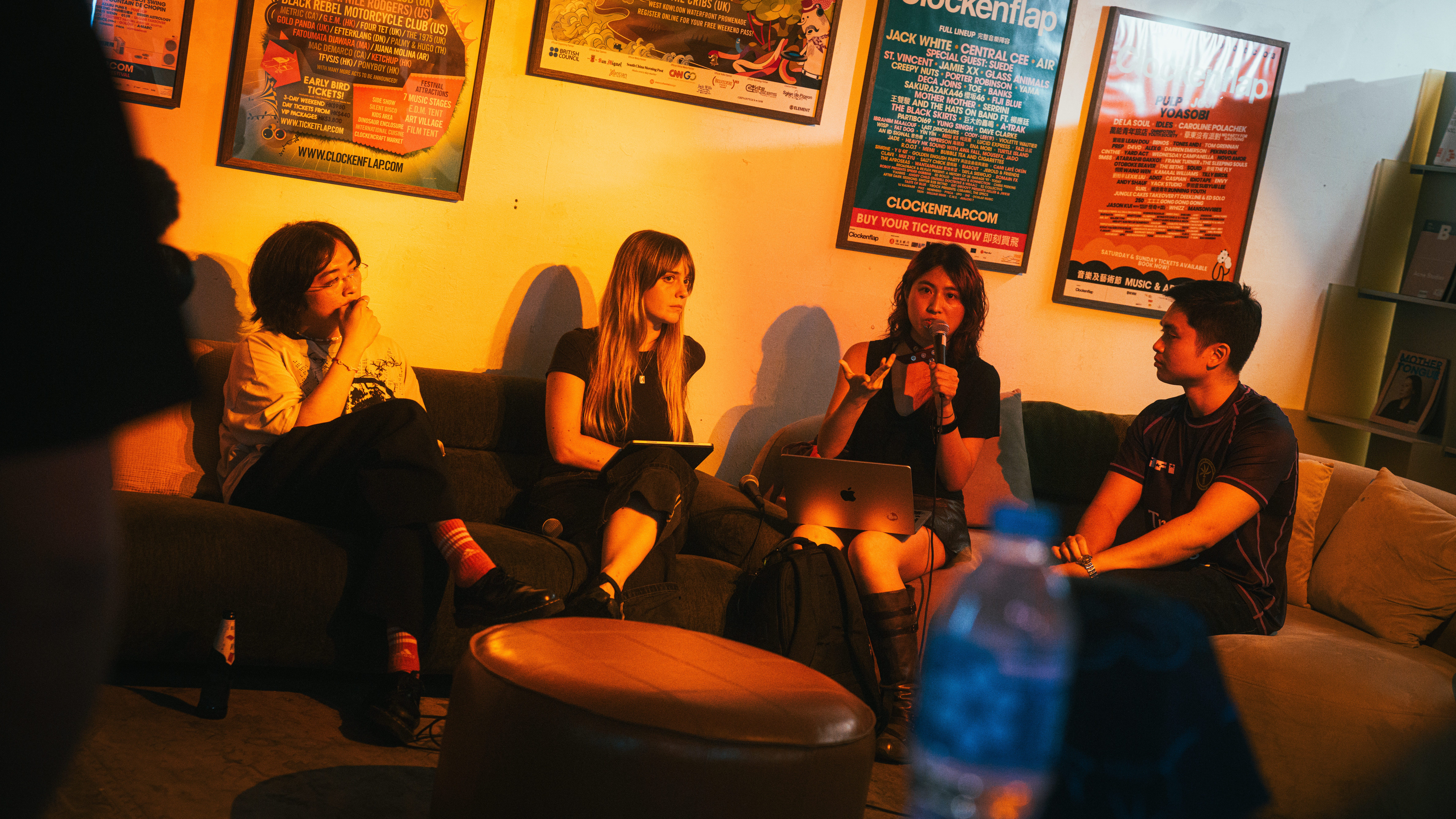
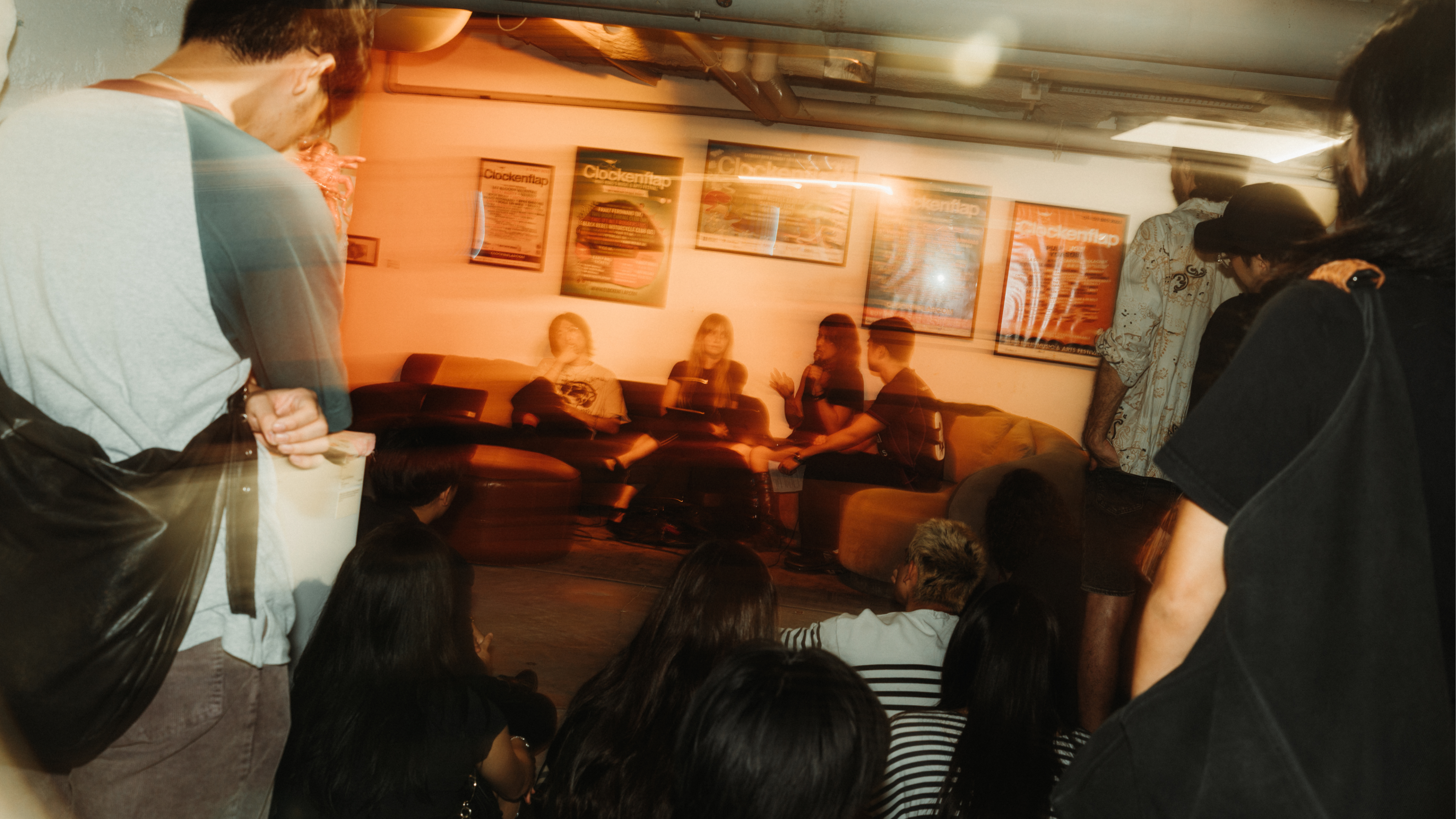
I moderated a talk from a dingy basement in Hong Kong last Saturday, titled “WHY THE FUTURE WAS NEVER LOST.” My panelists—art curator Angela Liu, journalist Salomé Grouard, and DJ/producer Marcus Lam/Voel—all said that music culture was definitely not stagnating, and that somewhere—in the “ethernet” or real life—there are musicians, DJs, and producers actively imagining new sounds that articulate what it means to live today.
“We’re also living in the Age of Aquarius,” Angela Liu said, “which is full of technological innovation, and we’re all pretty excited for what’s to come.” We talked about the new trend cycle re-commodifying cringe in electronic music (some good examples: trance, budots, vinahouse, manyao, and more), organizations both local (Hong Kong’s Panic Library, Kindred Spirits, Exit Entry) and international (CTM Festival, FWB Fest, Mira Shintendo) paving the way for innovation through sound, the best techniques for actually finding new music, our very hyper-referential era, and among other things, the seven ways electronic music scenes are still imagining a new future:
1. “You can find innovation in music outside of music.”
[00:12:42] Marcus (Voel): For me, newness doesn’t stop at the sonics. What’s very important to me—and something I’m trying to experiment with—is how you present sounds and music. And I think it gets really segmented: the artist on the stage versus the audience “down there.” That’s one of the things that needs to go, or has to change. New dynamics have to be introduced. One of the best shows I’ve ever seen—actually the best show I’ve seen live—was at Eaton Hong Kong, by a guy called FITNESSS. What he did was create a suit with his controller mounted onto it, everything controlled over Bluetooth, so he didn’t need to be on the stage at all. He was just rolling around in the crowd, bumping into people, rolling on the floor, with lasers in his hands. That was the best show I’ve seen in my life. And a huge part of it came from how he presented his music. Maybe he wasn’t even doing anything with the music. Maybe he just pressed play. But it doesn’t matter, right? The way it was presented—that worked.
[00:13:58] Salomé: I think you’re touching on an interesting point, which is that you can find innovation in music outside of music. You need to look at tech, you need to look at art, and at all the institutions that invite music in through other industries.
[00:38:50] Marcus (Voel): I’m seeing a lot of my peers—sound designers, and also visual producers—starting to work with dancers. A lot, actually. Some of you might know him: Fursk. He was working with a group of tap dancers, and they made a pair of tap shoes with sensors in the metal plates, so he could send signals to his synthesizers. I think a lot of innovation now comes from collaborating with practitioners from other fields, like dance. I think that could be the new thing.
2. Innovation is happening in hyperlocal networks. As genres like trance, budots, vinahouse, and more rise in popularity, “cringe” is being reappropriated in these settings as we enter a new trend cycle.
[00:22:50] Angela: When I observe what’s new, I understand ‘new’ not in a phenomenological sense, not as a feeling of newness, but as how current music responds to the failures or the cringeness of the past. Because for me, new and old are trend cycles: it’s what’s cool and what’s cringe.
[00:22:25] Angela: Trance is also making a comeback. I think it started with Evian Christ in 2020, when he first extracted the most melodic—and the cringiest, moodiest—elements of trance and really amplified them, confronting the cringeness of ‘90s trance.
[00:29:36] Angela: The reason younger producers are drawn to these local hyper-rhythms from the early 2000s—Budots, Vinahouse, Funkot, Taike (台客), Manyao (慢搖)—is that there’s a callback to something really kitschy. To quote the music writer James Gui, it’s a very betel-nut-chewing, bass-boosted, hyperpop-before-Gen-Z-did-it kind of music. It’s a very kitschy kind of consumption. But rather than kitsch in a mass-produced way, it’s kitsch as a subaltern or postcolonial practice—people reclaiming or looking back at their local context. Things that were often previously regarded as vulgar, excessive, too sweet, too campy or too gaudy are now being re-celebrated. I think that also reflects the times. Honestly, I don’t want to be cliché, but… recession indicator. Every time there’s a recession-indicator phase, things go a little more maximal, a little more kitschy.
[00:24:32] Angela: Asian Dope Boys is the collective by Chen Tianzhuo, and what he does is work with a diaspora network of artists who ground their whole content and music in Southeast Asian and East Asian grassroots folk elements almost, reinterpreting them and creating this very trans-experience that’s steeped in geopolitics and very local folklore and lore. Thinking about that, and about how this whole idea of cringe—this whole idea of very localized music from Southeast Asia in the 2000s—is a cringe element that has been recycled for the 2020s to consume and produce.
3. The death of a “decade-defining” music genre represents the decline of a totalizing, singular Western narrative of history and progress.
[00:27:43] Marcus (Voel): Whenever you talk about what kind of music represents an era—okay, what represents the 2010s? We think about Katy Perry and Justin Bieber. Back in the ‘90s, we think about Whitney Houston and Michael Jackson. And as great as they are, I feel like it just comes down to which artists the labels are pushing the most, which artists exist in the consciousness the most. It doesn’t bring any inherent value with it. And these days, human consciousness is so scattered by the internet that everybody’s part of different tiny pockets and radicals and tinfoil hats.
[00:28:38] Salomé: Something interesting you just mentioned is that all these artists representing the ‘90s and the ‘80s are all American—except, technically, Justin Bieber, who’s Canadian. I think it shows that what used to work when America was still regarded as a soft power supremacy just doesn’t work anymore. The world is so multipolar that I think we need to get a bit more [honest] about it.
4. Yes, there is a way to use AI to create new music. But it won’t be through a complete surrender to LLMs, or through Suno. Instead, it is leaning into the unique idiosyncrasies of generative tools to create new forms.
[00:34:45] Marcus (Voel): I don’t think we need more tools. We have way more than enough tools… In the past decade or two, I feel like we’re getting less and less human experience in the process of a creative practice. Every tool is trying to make creation better and faster. And of course, the prime example, the elephant in the room, is Suno—when it comes to music, you don’t even need the process itself anymore.
[00:33:47] Angela: …playing with the machine, learning to talk with it and play with its hallucinations, and understanding how to generate datasets from the very first prompt—creating your own signature style and your own dataset, to the point where you no longer have to take primary source material from the machine, and instead have a whole range of archival material you generated yourself that you can keep inputting and keep generating from. I think that’s one of the coming trends for image-making, fashion and design that I’ve observed.
5. When a machine can generate anything, novelty shifts back towards presence and the human body.
[00:20:42] Salomé: These days I’m actually trying to pay attention to non-electronic music.
[00:20:53] Marcus (Voel): Same here, actually.
[00:20:56] Salomé: I think I’m spending my life surrounded by tech at the moment. Conversations about AI have affected me a lot personally, and the whole concept of reality, of originality and of creativity has been a challenge—at least for me. So my way to disconnect from that is to reconnect with something I find profoundly human. And for some reason, for me, that’s percussion—because it’s also something that grounds me in my body.
[00:21:34] Salomé: I don’t know if it’s the same for anyone else here, but these days I’ve been feeling much more of a need to feel the music with my body and to have a full experience. So live music works a lot for that.
[00:35:00] Marcus (Voel): I wish we could just have an occupation shuffle. If we threw musicians into being, I don’t know, construction workers for a while, I actually think that would be good for us. I think we need more human experience outside the art and music world… So I feel like you just need to touch grass, artists.
6. Thinking (and making music) through a post-European lens will allow us to create “the new” in a multipolar, fragmented world.
[00:37:22] Patrick Kho: The Hong Kong philosopher Yuk Hui… argues that to innovate in culture, or to move through the world as it is now, we need a kind of post-European thinking. By that he means not doing away with what Western frameworks have taught us, but learning about Eastern traditions and frameworks without returning to them entirely: borrowing from both and bringing them together in surprising ways to do things in a new and interesting way. And where better to do that than the one city in the world most clichéd as ‘East meets West’—Hong Kong, right?
[00:41:40] Salomé: Hong Kong is hyper-focused on what sells. So at the end of the day, I think what brings innovation are the spaces that aren’t money-driven—and usually that comes down to cultural spaces and museums. And, as we’ve been mentioning a lot in this talk, the places that blend different industries together. We’re talking about dance; I was mentioning technology earlier. Maybe grants, maybe research that can blend all of that.
7. We’re arriving at a fluid, networked future. Our music is just a reflection of that.
[00:43:35] Salomé: …I hope we’re creating a future where identity isn’t fixed—where you don’t have to define something at the end of the day. Something that can be playful and colorful and change shape and form. And, talking about the commercialization of music and movements: the music scene in particular has become more and more vocal about being co-opted [aka they express when they don’t like it and fight against it], and that’s something we should enable and cultivate more.
[00:44:28] Marcus (Voel): [Unlike throughout history], I don’t think there will be any trends stemming from music itself. Music, fashion and everything else is going to follow the internet, wherever that goes.
[00:44:47] Angela: I think [the future will] go in the direction of smaller pockets—more underground gatherings and networks of curation, selection, community. I think that’s where you’ll find the trendy music circulating. And also queer folks making music. This whole ambiguity of genre translates across into ambiguities of identity, queerness and community.
[00:45:26] Patrick Kho: Is that fragmented, hyperlocal, networked, fluid future brighter than the one we have today, or is it bleaker?
[00:45:50] Salomé: It’s just following us, right? It’s what we are.
[00:46:05] Marcus (Voel): I think it’s going to be bleaker. Although, of course, we always project the future as something worse than what we have right now; we always think we’re at the worst point in history… I think everything’s moving toward a more cyberpunk-ish future, from everything we’re seeing. When it comes to music, maybe it does rebound.
[00:46:49] Angela: People can be optimistic about the accelerating direction, but we’re also living in it right now—so I think only historians in the future will tell.

Shoutout to CRITICAL MASS for platforming the talk.