


For me, hip-hop is the only music genre that captures a coming-of-age experience in the 2010s.
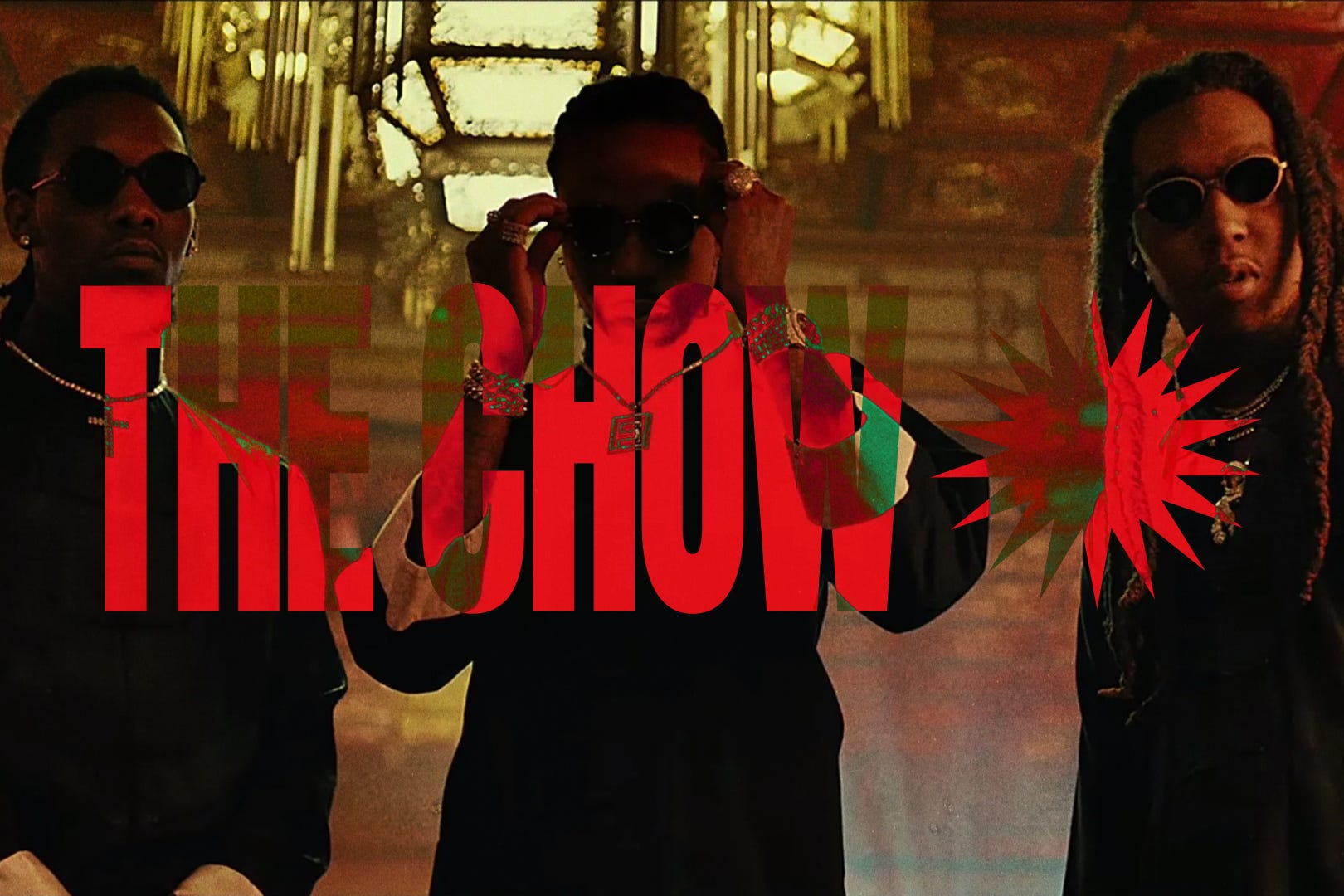
Most often, I think of albums like Migos’ Culture (2017), where the beats are woozy and drooping in a way that sounds a lot like the high school house parties of the decade. That may be because my function-hosting friends would cycle through the group’s singles like “Bad and Boujee” or “MotorSport,” on speakers where the bass was set to max. But Culture’s sloppy melody reminds me most of the deafening smell of vodka, the kind sprayed all over under-buttoned chests dressed in blue shirts, soaked on necks wrapped up in black chokers, or splashed on sweaty bodies I’d come into contact with, on the dance floor or when greeting my friends upon an hour-late arrival.
The rap verses had the kind of ditziness that felt endemic to the 2010s: “Slippery (wow), ‘scuse me, please me (please) / I’m up (up), oh, believe me, believe me (believe me) / Get beat (beat), ‘cause I’m flexin’ ‘Rari’s (skrrt),” Migos’ Quavo raps in “Slippery.” This was the era of mumble rap, where the verse was enunciated so poorly that it bled into the beat, where hip-hop artists overcompensated by generously littering their tracks with ad-libs. It was not cool to take anything seriously back then. So nor was it cool for the rappers to properly pronounce their lyrics.
In 2017, I was obviously too busy living on Snapchat to ever read The New Yorker, but back then Carrie Battan, a music writer for the magazine, confirmed my suspicions: “Everything [in Culture] slows to a self-assured ooze, lines drawn out and accented with irreverent takes on ad-libbed parentheticals.”
Keep in mind that most of this craze for the Atlanta-based hip-hop trio happened between house parties in my hometown, Manila, the Philippines, where Migos’ “irreverent takes” “oozed” in near-40°C tropical heat, under backyards with palm trees and swimming pools, in village homes meshed between Catholic churches. The simple and lazy explanation for all of this is that it’s just one of the many afterlives of American cultural influence on the Philippines. But hearing similar stories from former rap-obsessed kids who grew up in Hong Kong, Malaysia, Korea, and Singapore, it seems that more of it was to do with the kind of world hip-hop in the late 2010s imagined. Or, how hip-hop of this era felt so deeply familiar to kids in Asia, even if they lived halfway across the world.
There was plenty of borrowing “Asian” culture from American hip-hop artists at the time. Take Nicki Minaj’s “Chun-Li”: a 2018 track named after the famed Street Fighter character, which features repeated banging of a gong and lyrics that borrow from “Asian” motifs. “Bitch, it’s King Kong, this is King Kong / Chinese ink on, Siamese links on,” Minaj says in the song’s second verse. The music video for “Chun-Li” opens like a Chinese noir film—black and white, with Chinese subtitles and two guards dressed in closed-collar Zhongshan suits. When Minaj herself appears, roughly a minute later, she is wearing a qi-pao wrapped in red neon signage, with a neon light stick holding her hair in place, remixing Japan-inspired cyberpunk tropes with Chinese dressing.
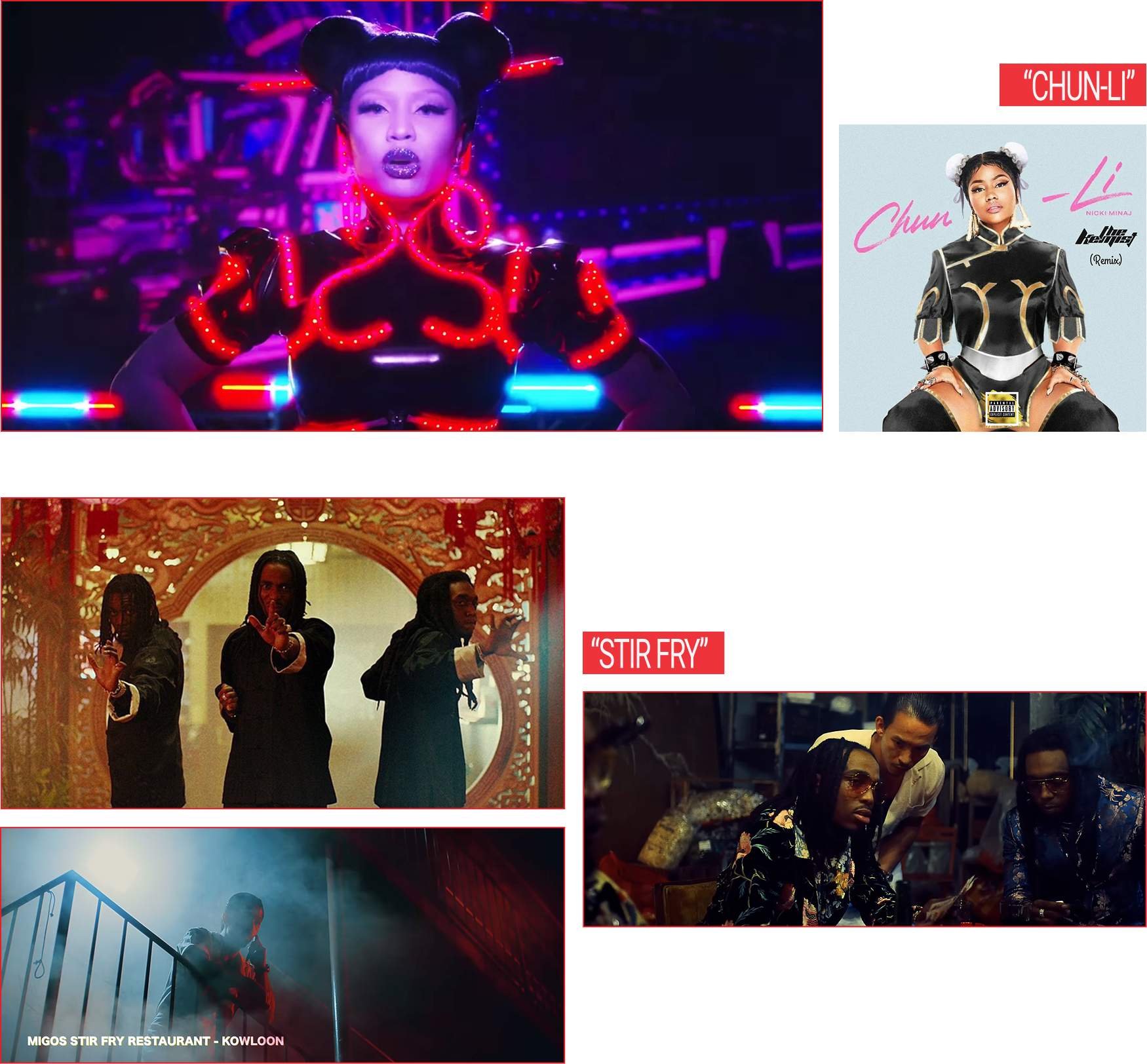
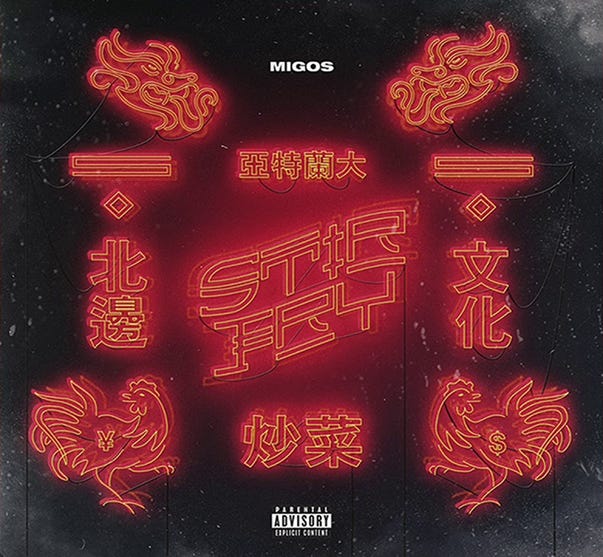
Only a few months earlier in 2018, Migos had a similar undertaking with “Stir Fry,” a track that used the Asian cooking style as a euphemism for making drugs. This line of thinking—borrowing “Asian” motifs and symbols to describe their own lived experience—seemed to drive the rest of the creative direction. Neon Chinese characters cover the album cover: “亞特蘭大” and “北邊,” meaning Northside of Atlanta, pay homage to the group’s origins; the track title “炒菜” (“Stir Fry”) and album title “文化” (Culture) are plastered on the side, and roosters—it was the year of the rooster in January 2018—occupy the bottom corners. Even the music video, set in the fictional “Migos Stir Fry Restaurant” in “Kowloon,” riffs off of Wong Kar-wai, with soft blue-toned shots, scenes in smoky back kitchens, and gangsters playing mahjong, very much like the kind you’d see in the assassination scenes of Fallen Angels (1995). At the video’s end, there’s a very poorly choreographed martial arts fighting sequence in a characteristically Chinese-red restaurant.
“Stir Fry” still had the “Triplet Flow,” a rap style popularized by Migos, where a single beat is divided into three notes instead of their usual two or four. The structure dominated much of popular hip-hop during the latter half of the 2010s—in Cardi B’s “Bodak Yellow” or in 21 Savage’s “Bank Account”—but that beat structure somehow found its way to Asia.
Three years before Culture’s release, you could hear traces of the Migos-inspired “Triplet Flow” in “It G Ma,” a 2015 track by South Korean rapper Keith Ape, featuring Korean and Japanese artists JayAllDay, Loota, Okasian, and Kohh. The song represented a new shift in Asian hip-hop: Like the African American artists who would soon borrow from Asia, these Asian artists were copying from Black culture too.
“It G Ma” had the same oozing, wandering echoes as a Migos track, with a sharp, staccato-like trap melody that may have been imported straight from Atlanta. In the music video, the rappers had the same gold-plated grillz often donned by Quavo and Travis Scott. Keith Ape, however, was far from alone in his attempts at mimicry of Black culture. Indie rapper Chow Mane, for example, used a moniker reinterpreting Gucci Mane’s name as a Chinese dish. Or, take Rich Brian’s original, infamous debut as Rich Ch*gga, with a trap-inspired song “Dat $tick” as his first release. The Higher Brothers, perhaps the most well-known group to emerge from the trap scene in Cheng-du, China, once cited 50 Cent, Kendrick Lamar, Migos, and J. Cole as direct influences.
Not all of this borrowing was done in great taste. A lot of it wasn’t. With rap aesthetics so ubiquitous in Asia, I knew too many private-school-educated Asians who embarrassingly tried to act “hood” in their teenage years. But the frequent borrowing and remixing did at least make for interesting culture.
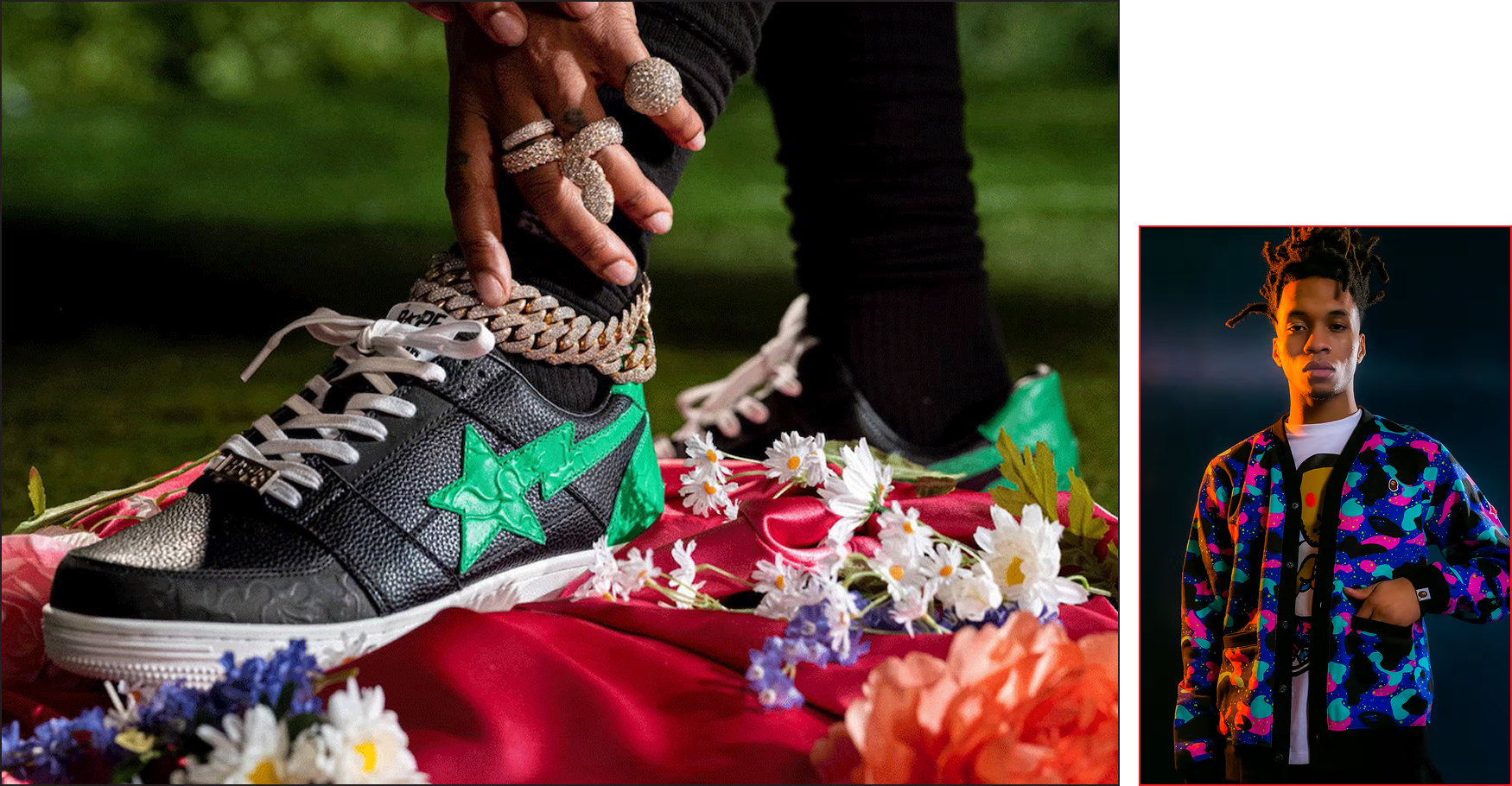
Immerse in this era of hip-hop, and you might guess that African American and Asian rappers were making psychic-level coordinations with one another, seemingly borrowing from one another’s regional motifs to create cool new shit. These coordinations soon permeated into other parts of culture, through rap’s love affair with Japanese streetwear brand A BATHING APE, where the loud, mosaic ape-shark hoodies became a genre staple. BAPE collaborated with Gunna and Kid Cudi, and appeared in the lyrics of Juice WRLD (R.I.P.), Cardi B, and Trippie Redd. “It’s loud, it’s colorful, it’s brash,” hip-hop artist Pusha T once told Pitchfork. “I don’t think any brand says hip-hop culture more than BAPE.”
You also saw the same kind of intermixing in the world of Hypebeast, the Hong Kong-based sneaker blog that slowly became the global authority on street culture. Looking back today, the magazine’s early issues brought names from both Asian and Black street culture together into one legendary archive. The K-pop star G-Dragon, basketball player Michael Jordan, and designer Virgil Abloh were all cover stars at one point, forming an oddly cohesive universe between the alleys of Gangnam, Causeway Bay, and Chicago’s South Side.
One possible explanation why Asian and Black street culture mixed so well was that both originated from cities. Streets in, say, the Bronx and Sham Shui Po more closely resembled one another than the townhouses in the Hamptons or in Greenwich, CT. This kind of vaguely similar lived experience was conducive to shared borrowing between Asian and Black artists, who seemingly ignored white EDM counterculture of the 2010s in favor of one another. But another explanation is a longer, shared history from before the 21st century.
After all, it was the Wu-Tang Clan, the American hip-hop group formed in Staten Island, that named themselves after Shaolin and Wu Tang, a 1983 martial arts film from Hong Kong. In one interview, GZA, a founding member of the group, compares rap to the Taoist martial art Wudangquan: “Wu-Tang represents the sword style of rhyming. We are lyrical or verbal assassins. We are fully aware that the tongue is symbolic to the sword.”
Even earlier in 1974, the Jamaica-born British singer Carl Douglas released “Kung Fu Fighting,” the iconic disco track that eventually became one of the biggest-selling singles of all time. The song’s opening featured a Chinese flute, as well as “Hurgh! Hurgh!” exclamatory ad-libs as a kind of rugged, more masculine “Hai-ya!” In the “Kung Fu Fighting” music video, Douglas is seen donning an “Oriental” get-up while performing generic chopping moves. All of this did reek of capital-O Orientalism, but there is a genuine earnestness in how Douglas apparently was inspired to create the song after seeing youngsters doing mock-kung fu moves in the street. Chinese martial arts were, to him, simultaneously distant yet familiar, alien yet aspirational.
Indeed, there is a longer, often-overlooked history of Kung Fu in Black communities. “African Americans loved [Hong Kong] Kung Fu films because their themes often reflected their own social and political oppression,” the South China Morning Post argued in 2021. Underdog stories in titles like Fist of Fury became easily translatable to their own lives, and many Black youths in the ‘70s came to love Bruce Lee: “The fighting spirit and prowess of Bruce Lee made us aware of what we were lacking as men,” the Alabama-based martial artist Donald Hamby told the Black-led publication Andscape. “Bruce Lee strengthened the Black man’s manhood. His philosophy of life and combat was ahead of his time.”
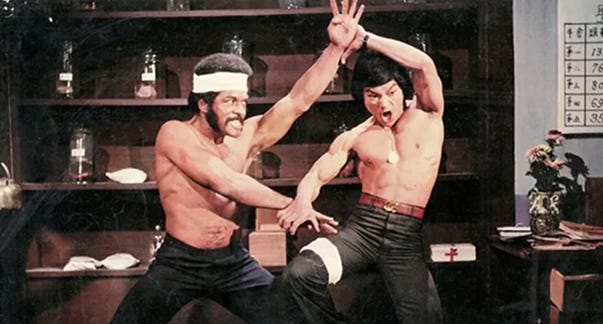
The “fighting spirit” of Kung Fu inevitably wound up shaping Black radical political praxis. As Richard Raya documents in the Tapestries journal, Bruce Lee’s thought influenced the Black Panthers’ philosophies of reactive self-defense and the balance of forces, and anchored their work in a shared anti-Western struggle—against systemic racism in America and against British imperialism in Hong Kong.
So where is this long creative lineage left today? Afro-Asian hip-hop was unlucky enough to grow at the peak of cultural appropriation discourse, back when a white girl in a qi-pao was enough to cause a firestorm on Twitter. The cultural climate led to some “cut fruit poetry diaspora” types thinking that Minaj’s “Chun-Li” was racist, as well as plenty of fighting between Black and Asian communities over who could borrow what: Could the NBA’s Jeremy Lin wear dreads? Could Kenyon Martin—another basketball player who called Lin out on his dreads—have tattoos of Chinese words that he doesn’t even understand?
The movement may have stalled in the last few years, but there are some hints of Afro-Asian hip-hop’s revival. A sneak peek of North West’s (Ye’s daughter) upcoming song features a sample of Chief Keef’s “Love Sosa” with a Japanese anime voice squealing “North-chan!” at the opening. For me, this rings as good news. Afro-Asian hip hop—and its antecedents in disco, in martial arts, and in activism—always unearthed what was possible when the world was left open: that familiarity can be found even in the furthest reaches of the map.
