


I’m no scientist, but the parties definitely get stuffier in the summer. By mid-July, when Asia braces for monsoon season, when the air gets thicker and slower to wade through, no amount of air conditioning can de-layer the sweat cloaked over bodies on the dance floor. Sound travels faster because there’s more moisture and more molecules in the air, so everything is glued by the atmosphere. Sweaty palms rub against wobbly basslines without friction. Again, I’m no scientist, so maybe I’m completely, embarrassingly wrong, but when I accompany Trin* on her smoke break outside, on the seventh floor of California Tower in Lan Kwai Fong, the bass reverberates so hard that even the tables on the balcony begin to shake.
A booming soundquake travels from the DJ booth to the dance floor to the bar to the glass windows dividing us—near the balcony’s glass ledge—from the club. A girl, probably around nineteen, wearing a bedazzled top, asks her friend, “Wait, are The Twins on right now?” But instead of responding, that friend is leaning his leather boot heels on the table stretcher, combing his mid-part fringe against the reflection from his phone screen, playing a livestream of Canada vs. Morocco in the World Cup Round of 16, which, on Sunday at 2:00 a.m. HKT, has just begun the second half.
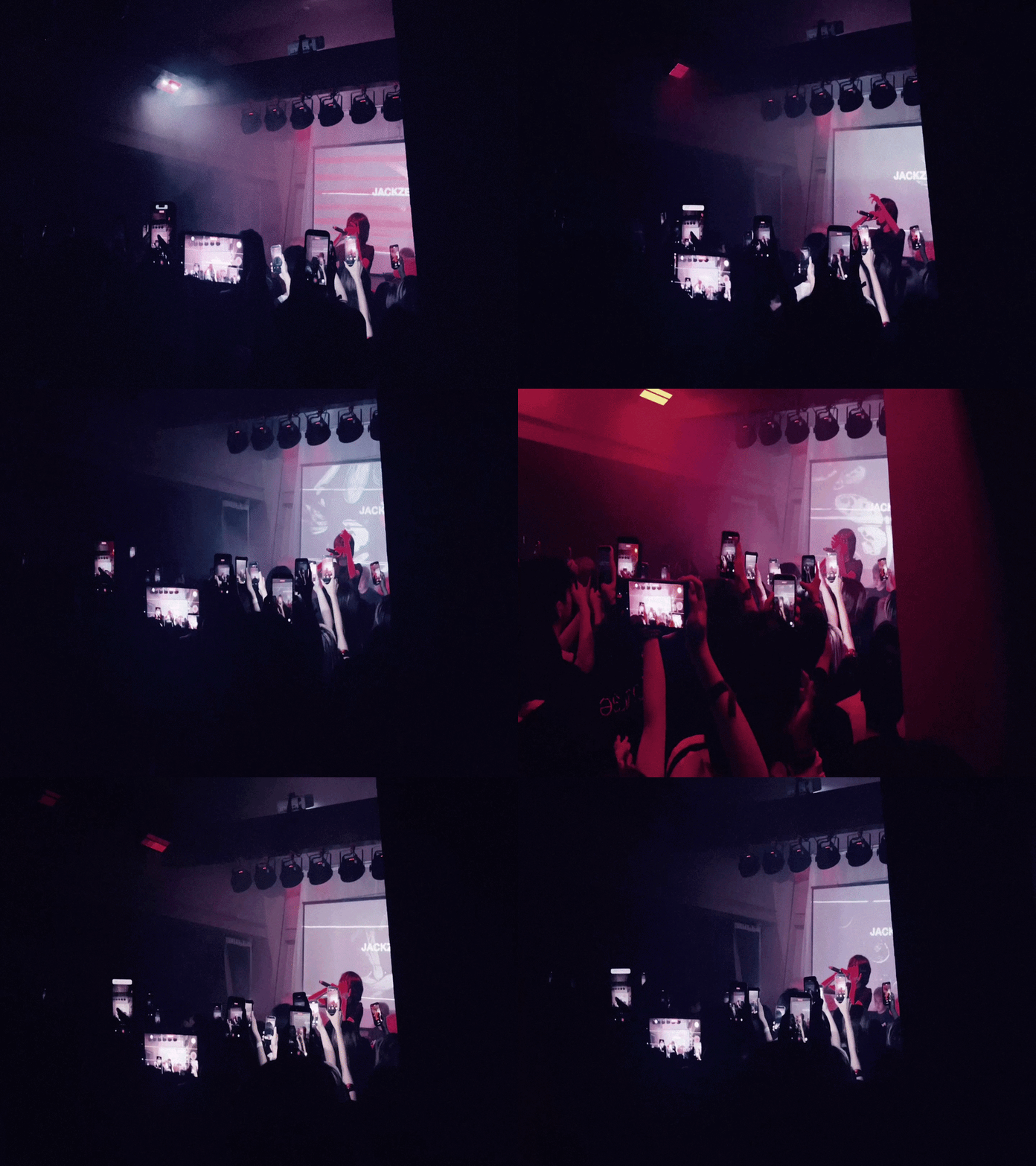
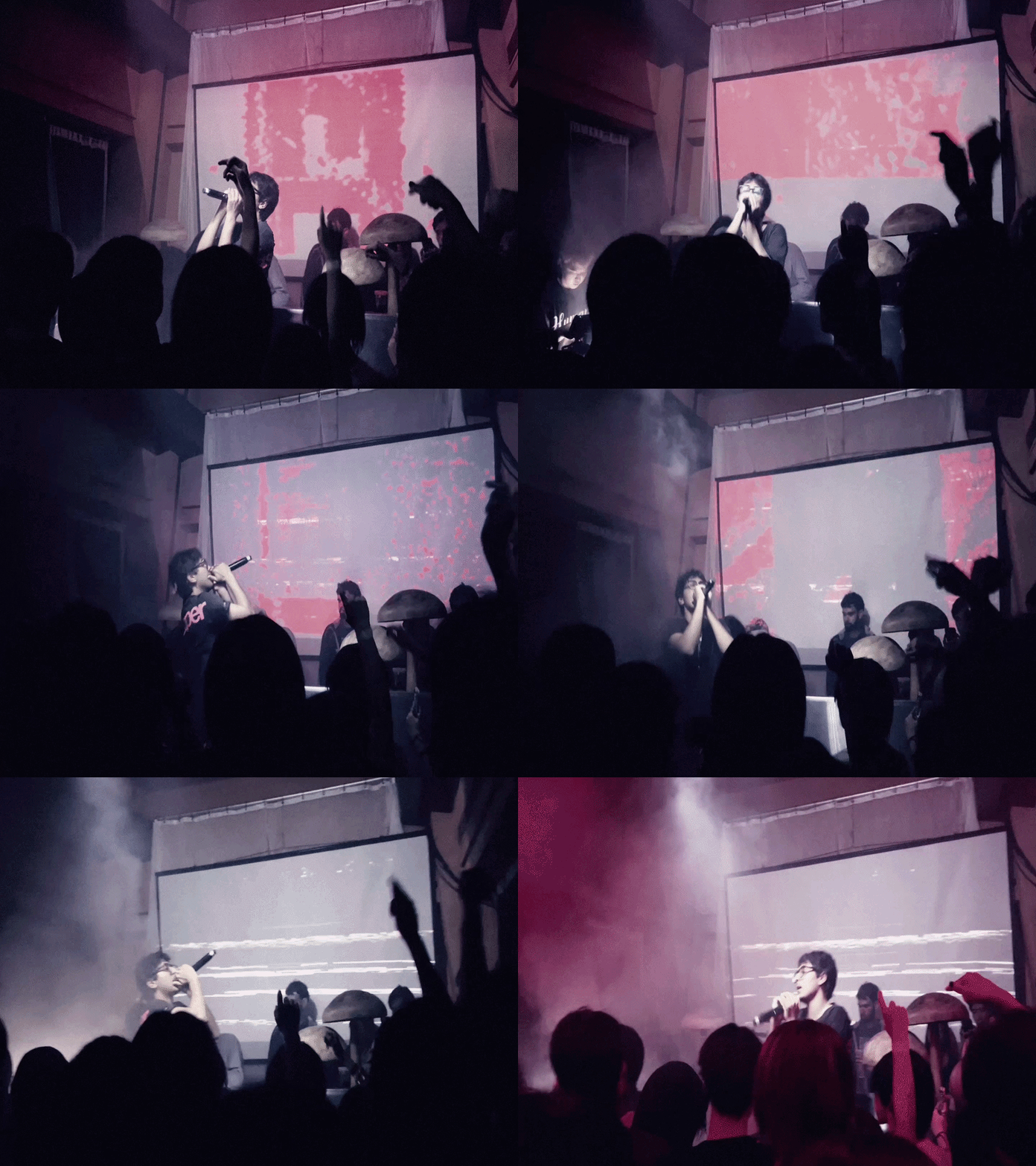
That girl is wrong, because from the balcony Trin and I can still hear garbled, deadpan mumble rap verses that could only belong to jackzebra, a 24-year-old rapper from Chengdu, crowned by netizens as the Chinese alternative to Bladee. He enunciates Chinese verses in what Pitchfork once described as “an Auto-Tuned slurry that leaves even native Mandarin speakers scratching their heads,” in a “listless, soupy” texture, almost oracular in the way that it renders “a certain Chinese urban ennui palpable across language barriers.” jackzebra is a fixture in China’s cloud rap scene and the global internet underground. But here in Hong Kong, he’s the opener for tonight’s event: the “GOTHIC” Tour, an intermittent album tour—hopping from Shenzhen to Taipei, and finally arriving at a mushroom-themed nightclub called Mushroom HK—for the release of local hyperpop rapper dlwindle’s latest album, GOTHIC.
When jackzebra’s more icy, mellow SoundCloud-style rap ends, Trin can tell dlwindle is now on the stage when we hear the twinkling synths of “Liberty,” GOTHIC’s opening track. In an instant, she stops talking to me about the trippy dreams she’s been having lately and pulls me back to the club.
As the synthesizer moonwalks between octaves, our way back is marked by a few sights: a man dressed in black jeans, straight-cut but leaning baggy, with an exposed belt, and a gray T-shirt with diagonally cut sleeves and a faded print—a fit that looks less like a collection of thrift store finds and more like Taobao Americana. A Supreme shirt armors another male partygoer, but replacing the classic red-and-white imprint in the front is the brand name on the back, in a stenciled, geometric, military-inspired typeface. Others in black tank tops—mostly men, too—adorn themselves with apocalyptic jewelry from BLACKHEAD, Chrome Hearts, or off-brand stores on Taobao. From far away, I catch a glimpse of a Chinese man who looks like one of the Frost Children: dyed orange hair down to the waist, covered in a cream beanie, wearing a collared T-shirt with alternating stripes of neon green and light gray, paired with flared acid-washed jeans neatly flowing over a pair of black sneakers. (Later, I find out this is Billionhappy, the figurehead of Nu China, or Chinese underground rap.)
I don’t exactly remember when goths started listening to more electronica than punk, or dyed their hair orange instead of jet black. But I’m not the only writer in the 2020s struggling to make the subculture a tangible thing. In The New Atlantis, Robert Mariani offers one vision of the “diner gothic”: a messy combobulation of “Hello Kitty ketamine” ravers, downwardly mobile furries and anime lovers, “Tumblr alumnus,” “alt-prole girl-autism,” men in dark gray graphic tees listening to Bladee or Ecco2K. This 2020s gothic, Mariani argues, gathers various “alt” internet aesthetics into a new messy monoculture, and the phenomenon is uniquely American: when economic stagnation leads to worsening futures for youths outside major cities, the internet becomes a more functional “third space” than an underpopulated provincial downtown—and “Discord becomes more real than [the] cul-de-sac.” This goth, living in this post-post-industrial decline, is less a specific identity, and more a convergence of references from anime, online forums, fetish Discords, and SoundCloud rap, all serving a “downwardly mobile mass aesthetic.”
Mariani’s view isn’t wrong, just limited, because Discord can feel “more real than the cul-de-sac” even if you live in a populated metropolis. Subcultural “alt” internet aesthetics, for example, are likely used about as often in content from fitness influencers in Hong Kong or content creators in Guangzhou as they are by the “transgender assistant manager at CVS.” Mariani is right, however, when he says that the “goth” is increasingly a “lazy shorthand for alternative aesthetics.”
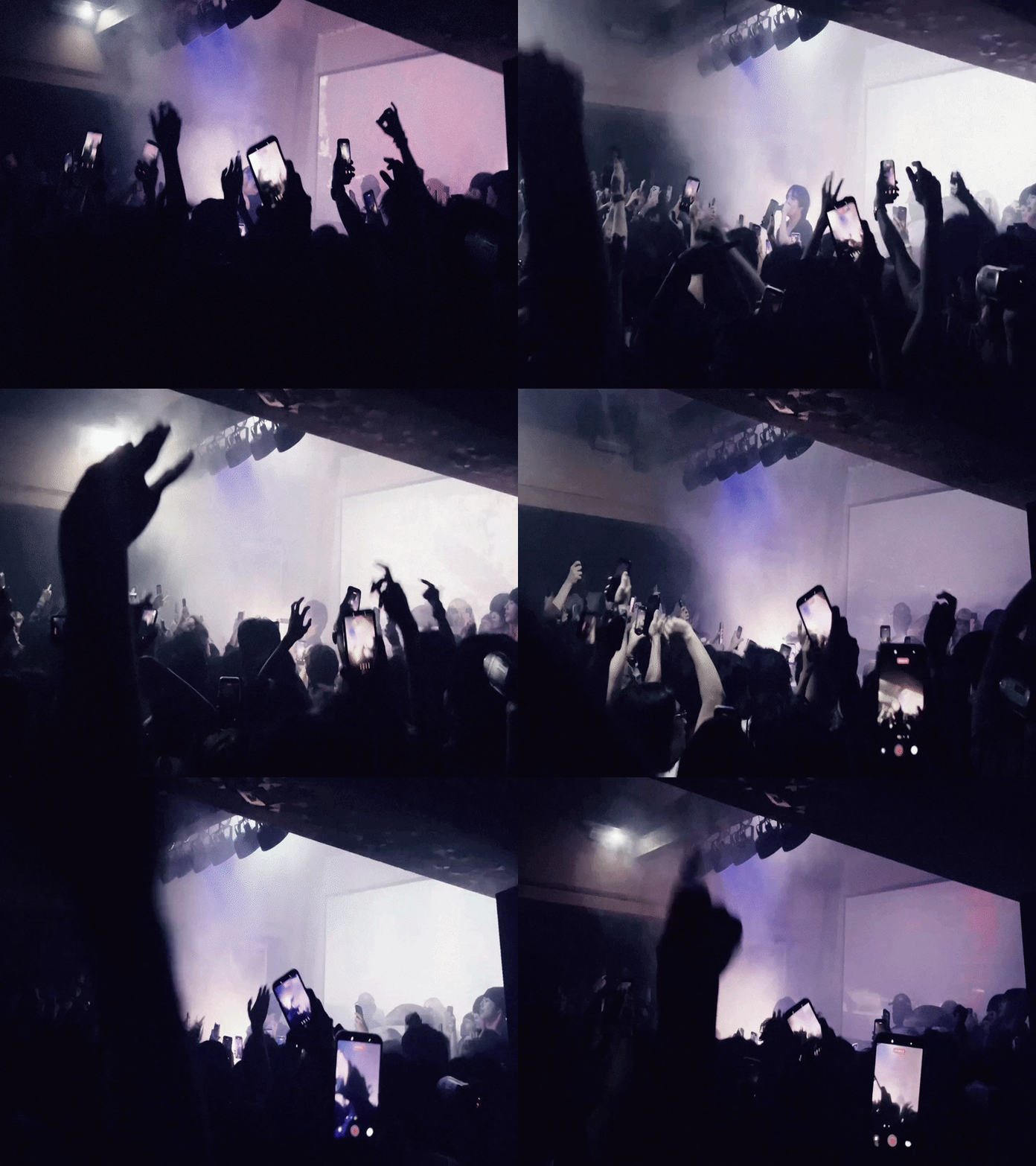
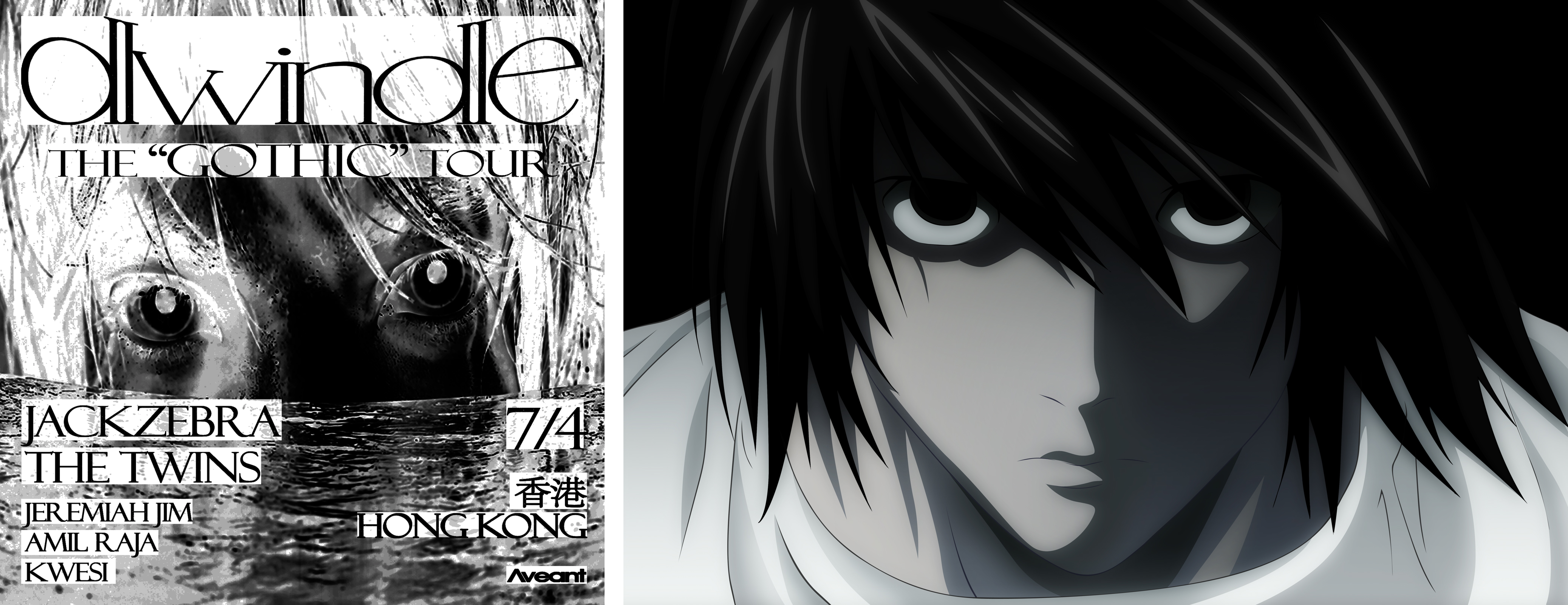
Back at “GOTHIC,” the bass pulsates and thumps like an alien heartbeat—a Xenomorph rhythm pushing blood towards its vitals at 180 beats per minute, yet jittering and feinting a step or two every so often; when its vitality travels downstream, from the DJ booth to the dance floor, through the red LED matrix panel on the ceiling, to clubbers clustered, wet like cells, and jumping up and down in unison to “FRANTIC” (dlwindle’s garish, abrasive mid-album track with record scratching), Trin and I can hardly see anything because it’s a little dark and our view is obscured by more bodies, more waving arms, more dark smoke, and more cameras flashing back and forth between the stage and the crowd. Somehow, between the cracks, we do get a glimpse of dlwindle himself, singing with autotune set to max, head in a sloppy bowl, fringe hovering downward-diagonal, wearing black square shaped glasses like the alien from The Disastrous Life of Saiki K.. A few meters to my right, I can, vaguely, make out the image of a man dressed in a characteristically striped e-boy long-sleeved shirt, accompanied by dark navy-purple pants. Bold choice for a party in mid-summer, maybe, but more sensible when the party is named “GOTHIC,” with promotional materials depicting dlwindle like a ghost-incarnate version of L from Death Note.
The goth in “GOTHIC” can still be prole-ified, anime-pilled, and chronically online without being provincial: in one concert, you can listen to jackzebra rap about doomerism of urban Chinese youth and watch as a sequence of digital occultism-style animations play on the screen behind dlwindle as he performs. But perhaps this resistance to taxonomy might suggest novelty: these artists’ discographies have more in common with new-gen electronic acts like fakemink, underscores, 2hollis, and Ninajirachi, all of whom fuse a mix of sonic references from rap, indie sleaze, and electroclash, and pull from “alt” internet aesthetics to create a new genre of music straddling “underground” and “mainstream.”
And as one essay for Dazed points out, no one knows how to name this new genre. One proposition is “sleazepop,” but when I bring it up to Trin on our smoke break, she thinks that name is a little too lazy, a little too derivative of “indie sleaze.” “Today’s digital age makes it harder to identify distinct genres than ever before,” Solomon PM, the journalist for Dazed, writes. “Where previous movements like hip-hop had a clear origin story rooted in a particular time and place… space and time on the internet are often warped in ever-hybridising ways.”
It’s a (largely) correct and often-repeated argument that pulling aesthetics from the internet obfuscates their real-life origins—the “goth” rises from the ashes of a Pinterest board, not the historic F Club or the Batcave. But can there still be a way to understand the goth in the 2020s? Perhaps it’s easier to start with its antithesis: prep.
In the 1980s, preps were juxtaposed with punks and goths. But just like the modern goth, “prep” in the 2020s is undergoing a definitional shift. Once associated with “old money,” the Ivy League, Oxford shirts, J. Crew, and Polo Ralph Lauren, today’s “prep” (according to trend forecaster Sean Monahan, the Aesthetics Wiki, and a number of TikToks) now prioritizes frilly bright colors, athleisure from alo and adjacent brands, maximalist accessories, and expensive skincare from Sephora. “The aesthetic is characterized by conspicuous consumption,” one entry in Aesthetics Wiki notes, “and a specific set of “status symbol” items, such as Stanley tumblers and Lululemon belt bags.”
As with many aesthetic movements, the styles and symbols were only shorthands for a deeper, widely-felt sentiment. And if new-gen preppy is conspicuous consumption and the pursuit of “status symbols,” then how does the goth, its greatest antithesis, react?
Maybe it’s through rejection. In Hong Kong, at least, the rise of this new-gen, hard-to-name “prep” is equally matched by a rise in a new-gen, hard-to-name “goth”: for every matcha pilates coffee “rave” with strivers in Lululemon, exalting traditional status codes and the virtues of conspicuous consumption, there is an equal pushback in alt-zine launches where all the artists and editors have raccoon-dyed hair, piercings in odd places, and clothes only in black. Maybe the 2020s “goth” will one day coalesce into a moodboard that makes sense, but for now it begins with a feeling—a big fat “NO” to brand-driven social climbing and lifestyle flexes, from anywhere between the American heartland to Southern China, from the cash registers of a run-down CVS to a mushroom nightclub in Hong Kong, and instead an opt-in to a loosely defined subcultural “alt” wardrobe or an MP3 library of alt-internet music.
Actually, that might be more in line with the original goth’s ethos. Gothic writers—the goths before “goth” was a subculture—didn’t exactly pull from a particular moodboard. Their fictions and their prose tapped into Medieval superstitions and barbarisms, rejecting the reason-based intellectualism of the Enlightenment.
The Twins finally come on at around 2:00 a.m.. A Pakistani-British electronic music duo from London, they’re fresh off the release of “FUCKERSBY,” a track featuring breakout star fakemink. According to internet music news page Trending Raps, The Twins belong to a long list of contemporary electronic music duos (Bassvictim, Brutalismus 3000, MGNA Crrrta, Frost Children, Femtanyl, The Femcels, EQ, and more) “pushing the internet’s new electronic underground wave forward.”
One of The Twins dances with a popular local fitness influencer, frequently seen in gothic clothing, while the other is mixing a high-pitched synth-pop remix of Ke$ha’s “Tik Tok” back-to-back with “2” by 2hollis. That girl in the bedazzled top is jumping up and down in excitement—my vision of her is clearer now that most of dlwindle’s fans have left and the crowd has thinned. But the dance floor in the mushroom-themed nightclub remained heavy with sweat, something new was emerging.
Mushrooms, since Anna Tsing wrote The Mushroom at the End of the World, symbolize the “possibility of life in capitalist ruins.” Beyond clubs, I’ve noticed mushrooms appearing more often in subcultural, vaguely gothic, vaguely anti-prep spaces—at art galleries and creative communities where fungal life offers an all-purpose icon for the alternative, for what lies outside existing systems. Here at the mushroom-themed nightclub, in the monsoon season, you can feel it. Again, I’m no scientist, but when the air grows thick with moisture, particularly after heavy rain, mushrooms absorb the surrounding water to inflate their cells and rise above the destruction.
Far too many critics like to say that the 2020s are devoid of new art and music. But perhaps, the true newness can be found in what we’re struggling to name.

Millennial me thought The Twins were talking about cantopop duo 阿娇 and 阿Sa 😭 At least I know Jack Zebra RIP
Fascinating read with a provocative nod to Tsing's Mushroom at the End of the World. Good stuff.