


There’s a man with a buzzcut lurking in the corner, standing behind a plastic table with freshly sliced vegetables on a wooden chopping board, blankly staring at the audience. He grabs a red apple and takes a bite, nears his lips towards two microphones, and starts chewing with his mouth open.
Like ocean waves crashing against weathered rock, the SLURPing, GURGLing, CHOMPing, MUNCHing echo from four speakers standing on each corner of the room. I hear the fruit fibers tearing and the squeaking squelching of hard enamel colliding with apple juice, and Frank*, standing to my left, lets out a chuckle. “Sorry, I just can’t stop fucking laughing.”
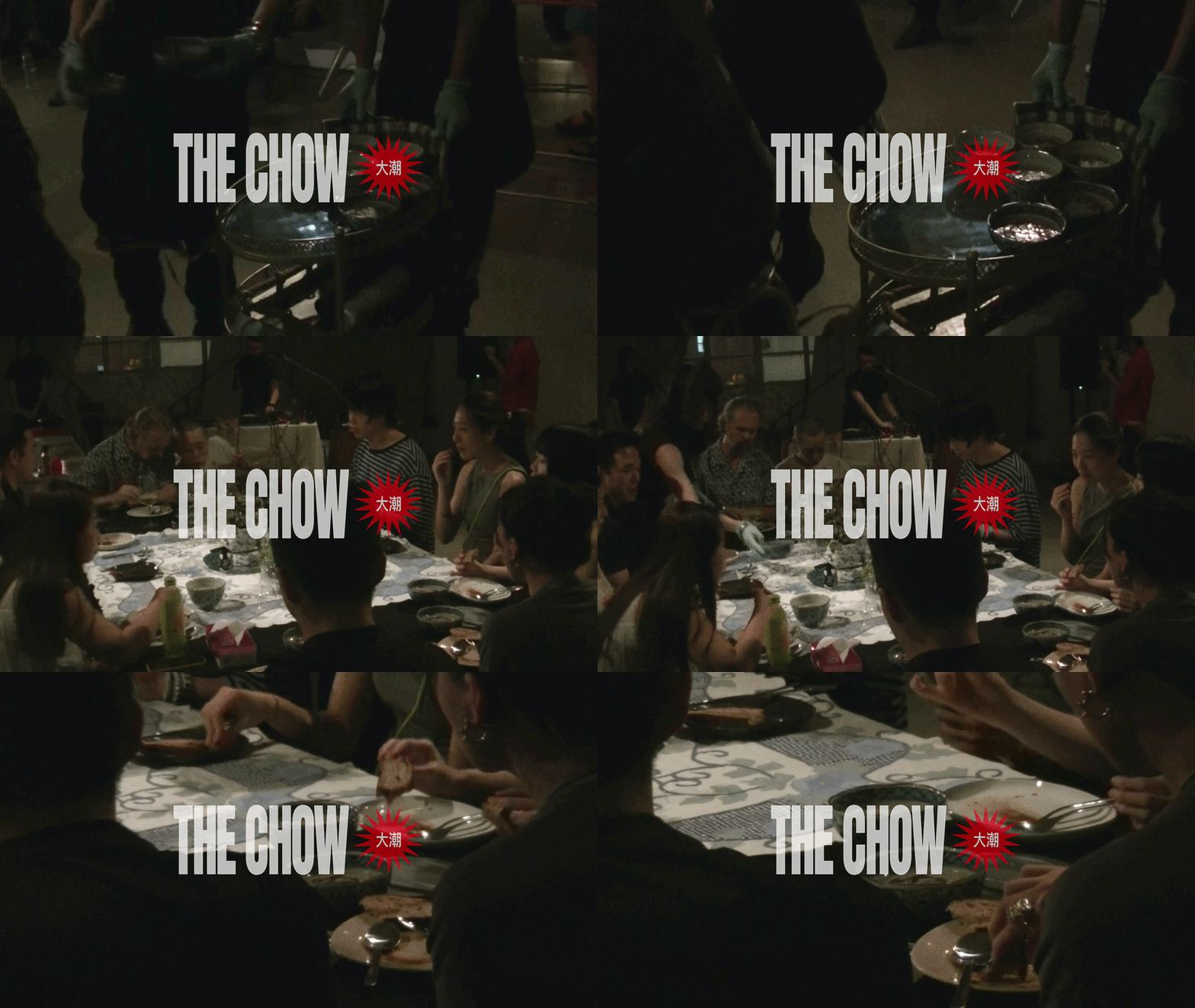
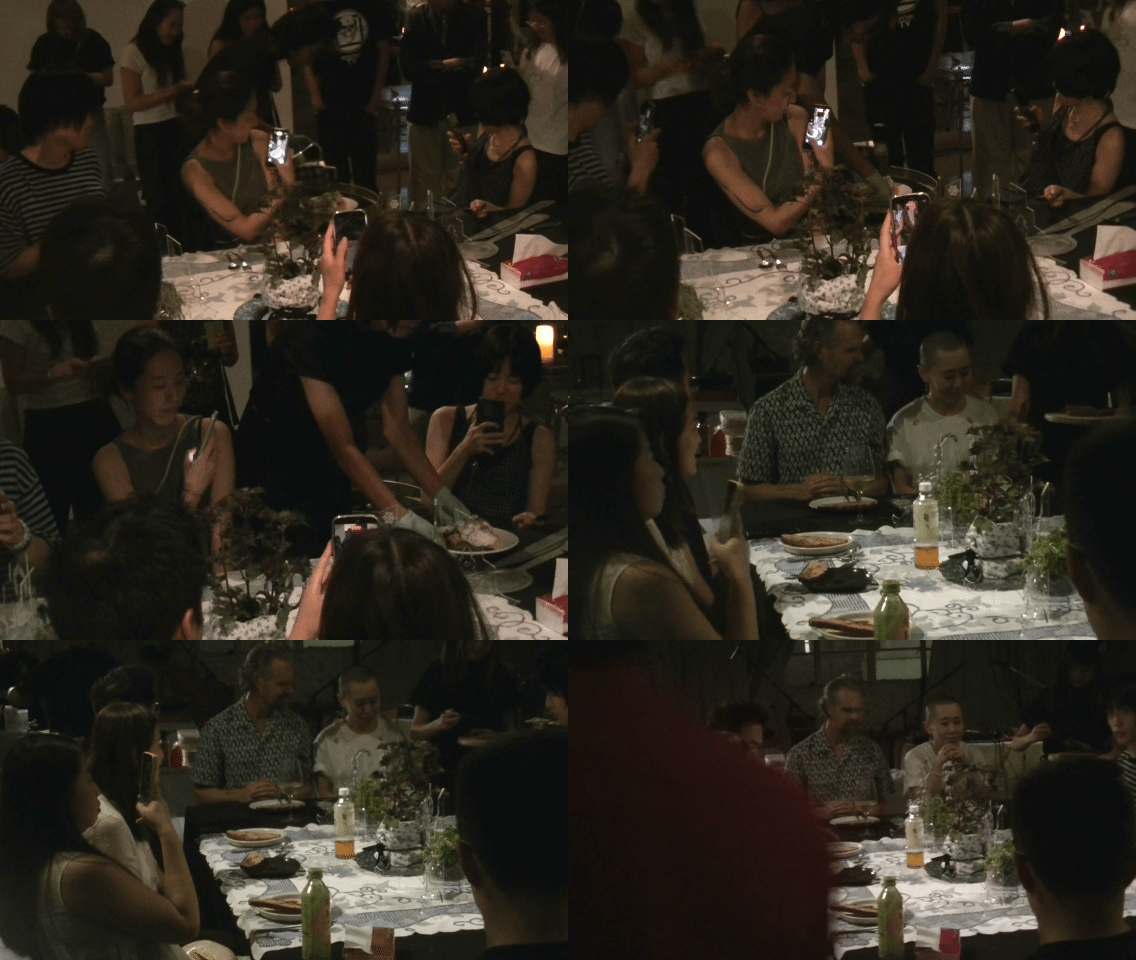
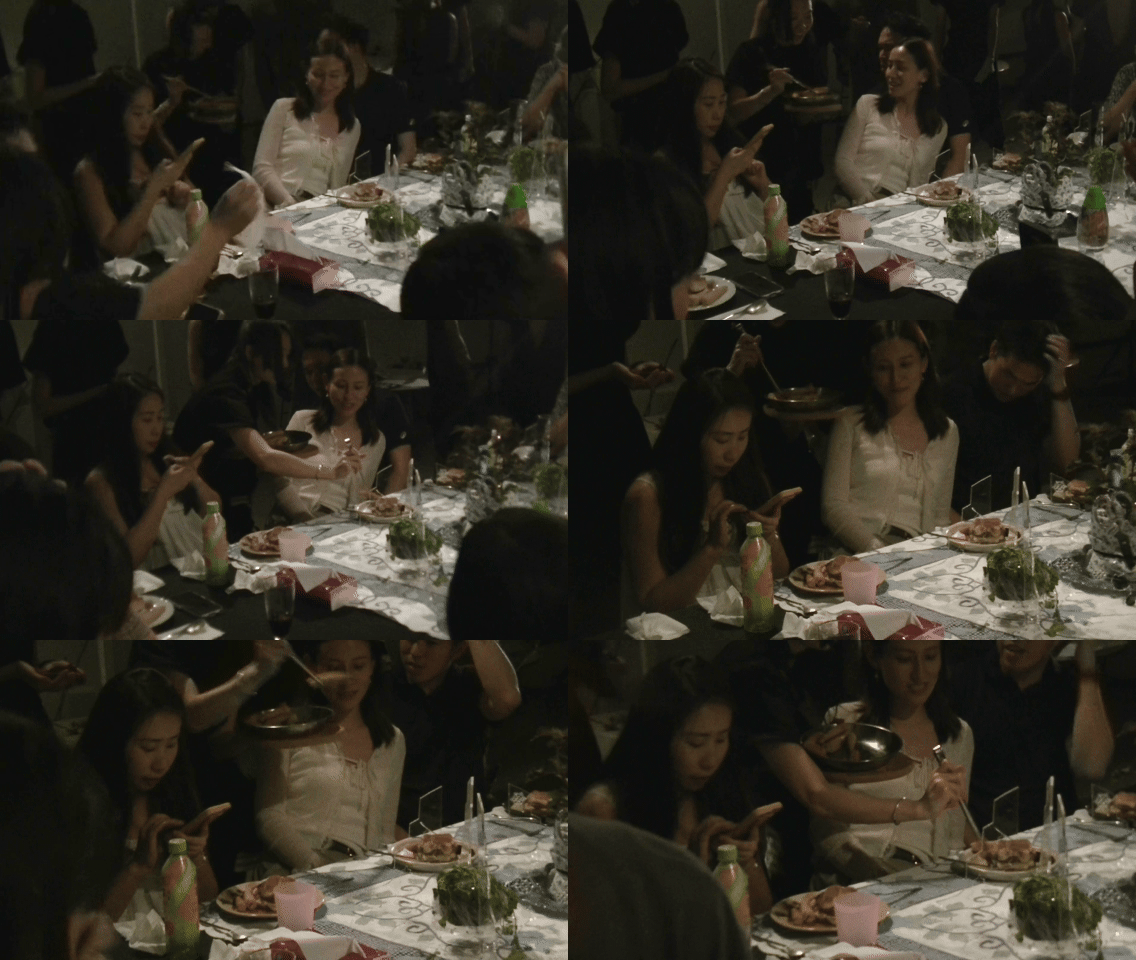
The apple chew-er is a surprising headliner for tonight’s event: “Ultima Cena,” a dinner meets sound art night with live cooking and DJ sets, promising the fusion of “sound, performances and even scent” to reimagine “what food and dining [really] mean.” A group of around 10 diners are sitting at a rectangular table in the middle of Current Plans, a multidisciplinary exhibition space in Hong Kong, and at 8:30pm the appetizers are served. Plates are stacked with slices of toasted sourdough, while the rest of the audience—a crowd of thirty or so who paid for cheaper tickets—is not here to eat.
Frank and I are among them, standing near the dining table’s left as the meal unfolds, indulging every sense except taste: SEEing diners stuff their faces with shiso and alfalfa and mint, pulled from plants sitting in the table’s center, creating a makeshift, hand-to-mouth salad; HEARing the high-frequency whirring of a pasta machine, as a microphone near the kitchen table amplifies the making of the main course; and SMELLing the salty, buttery umami of red shrimps and garlic, stir-frying into a sauce.
Every ten minutes food is distributed from a metal trolley, pushed by a kitchen staff member dressed in an androgynous jumpsuit uniform: a back-exposed top connected to a wide-open skirt, and paired with black leather boots, like if you made all the Iron Chef contestants non-binary. A loose microphone in the cooking station falls into a bowl of fresh water, projecting a DROOP across the room. The man in the corner pulls the microphone out, licks it like it’s a cone of ice cream. As if that will fix it. Now we’re listening to the SCLOORPing TSKing twisting of his tongue and Frank just keeps on laughing.
I asked exactly four other friends if they wanted to come to “Ultima Cena” with me and all of them said no. Excuses ranged from It’ll be one thing too much for me this weekend! to Don’t think I’d be up for it this Sunday but thanks for the invite and This looks SO INTERESTING and SO WEIRD. Transforming food into sound and performance art is not for the faint of heart, because some of the first to do so were a band of fascists.
I am talking, of course, about the Italian futurists, the art movement that sprouted from Milan in 1909 and lasted through most of World War II, which maintained deep ties with Mussolini and championed fascism. They deified humanity’s triumph over nature, worshiping speed, technology, youth, violence, and industrial era machinery like the car and airplane. They disavowed old artistic and political traditions, with Filippo Marinetti, the movement’s ringleader, passionately declaring “We want no part of it, the past, we the young and strong Futurists!”
Somewhere along the way a yearning for tomorrow morphed into a hatred for… pasta, a meal they believed caused lassitude and laziness. In The Futurist Cookbook (1932), a polemic manifesto that reads like a 20th-century shitpost, Marinetti declares, “No more spaghetti for the Italians.” These words neatly coincided with Mussolini’s Battle for Grain, a propaganda campaign decentering the foreign- and import-dependent pasta as the carb du jour in favor of domestically grown rice. But as historian Carol Helstosky writes, The Futurist Cookbook’s main goal was to “transform Italians from pasta-eating brigands and mandolin players” to active makers of tomorrow. “If these people have been heroic fighters, inspired artists, awe-inspiring orators…” Marinetti writes, “it was in spite of their voluminous daily plate of pasta.” All those carbs—the lunchtime equivalent of shooting up a food coma—were not gonna cut it.
So they sped up the languorous Italian meal, remaking dining into an accelerationist art project. As recipes in The Futurist Cookbook indicate, diners would be served mouthful-sized portions of food in rapid succession. They deterritorialized culinary traditions, enraging the public by crossing quasi-sacred, predetermined boundaries of flavor: mortadella could be served with nougat or pineapples with sardines; trout could be stuffed with chopped nuts, fried in olive oil, and then wrapped in very thin slices of calves’ liver. And like at “Ultima Cena,” meals were not just about taste: end-products were not always meant to be eaten, only smelled and seen.1
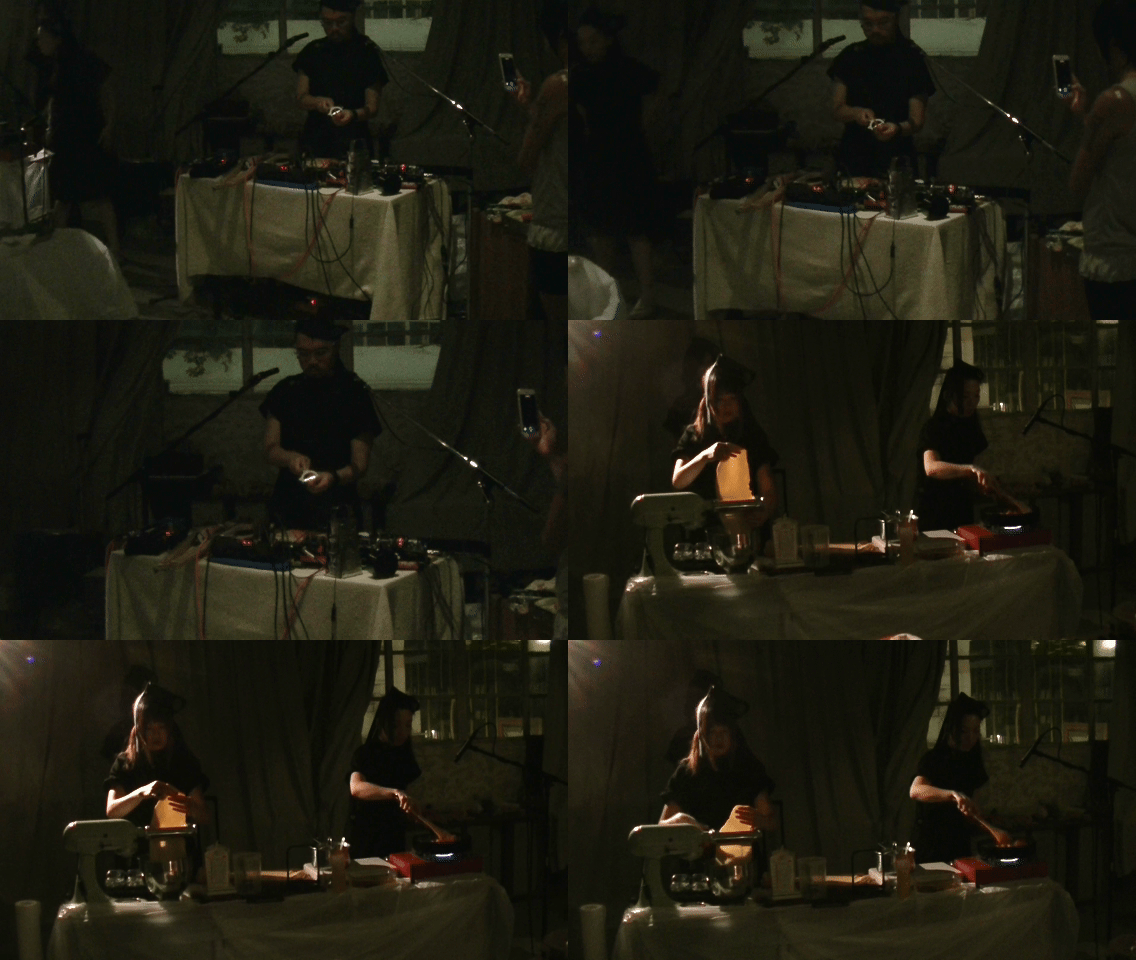
Back at the show, the man with a buzzcut is shaving skin off a carrot and drilling holes through the middle, creating a makeshift recorder. (When he’s done and finally blows into the instrument, I can only hear a sad, high-pitched fart.) Ambulance noises are ringing around the room, but with the deafening sound of the cooking I can’t tell if they’re coming from indoors or out. When the noise gets all too loud, Frank decides to take a smoke break on the balcony, and my other friend Lisa* pulls me aside to say the whole show feels a little dystopian. “It’s like the rich people who got the expensive ticket are eating,” she says. “And then we’re the plebs watching.”
To be clear, “Ultima Cena” was organized by local punk magazine Mau1 and Chinese underground music outfit Ginseng Museum—groups with zero inclination toward fascism. But like the futurists before them, they’re creating a new wave of edible art accelerating us back to our senses.
Such a task has grown increasingly necessary in a world of AI-generated marketing campaigns and psy-op bands like Geese. LLM-generated influencers and astroturfed clip-farms are crumbling nearly any conception of base reality, particularly on the internet, creating what a RADAR trend report describes as “post-reality.” “We lost trust in institutions a long time ago,” Anu Lingala wrote for the Business of Sociology this month. “What happens when we stop believing our own eyes?” I think we return to our other senses.
When I return to Current Plans on Friday afternoon, the dining table and the speakers are cleared from the room. A French artist-in-residence named Louis Danjou is stitching together the early skeleton of an incoming installation later this month: an apocalyptic edible art sculpture serving French liver pâté fused with Sichuanese peppercorns. Like “Ultima Cena,” it’s part of a larger push in Hong Kong’s avant-garde for sensory-driven artwork—“decentering” vision, engaging with smell, touch, taste, and sound, and bringing us back to our bodies.
The sensory has always been part of Current Plans’ programming, says founder and director Eunice Tsang. As one of the only contemporary art spaces with a large, fully functioning kitchen, the space has seen community dinners fast become an important element of its practice: for example, meals hosted on Chinese holidays for people without family in Hong Kong, or private dining experiences in collaboration with the bi-continental culinary studio détail. But why is a gallery cooking so much?
Unlike with visual art alone, “There [are] things that you can’t really visualize or see, but when you can taste or experience it, it kind of leaves a much stronger connection,” says Eunice. “Even a smell, it can mean different things for you or me. Like a durian”—repulsive to some, nostalgic to others—“[there’s] all these different interpretations.”
“That also creates really engaging spaces and engaging exhibitions,” says regular Current Plans co-organizer Paola Sinisterra. “It’s also a practice of presence… more like, how do we gather together?”
The new wave of avant-garde edible art, Eunice and Paola say, is an expansion of this practice. “When you have the basis of cooking and community, how do you push it further, in a more radical, experimental, and crazy way?” Eunice says. “There’s also this constant negotiation of what is art, what is food, but it’s more [about] the production, and the process of working and experiencing together. Sometimes it gets complicated.”
“When you have AI and a screen, everything is glossy and flat. But [with food], you have to think about who do I sit next to? Do I eat this with a fork or chopsticks? It’s motor-related, sensory, but it makes you slow down and find things out,” Eunice adds. “After you eat, you need to wash up. It’s messy, and you also have to deal with the consequences.”
Despite all its differences, Italian futurism was similarly unshy about consequence. A line from The Futurist Manifesto reads, “We intend to sing the love of danger, the habit of energy and fearlessness.” Their reverence for early Maserati cars, for example, was practically a thirst for annihilation: With these hoodless vehicles you could accelerate at maximum speed along highways, feel tousling wind brush through your hair, and on your skin, the gentle kiss of Mediterranean sunrays. Switching gears on manual was like rearranging limbs; brakes were hard and not electronically assisted. Steer the wheel slightly in the wrong direction and you’d crash, meet your demise in an instant.2
Innovation, then, was imagined through how it might leave the body ruptured, destroyed. But while today’s AI accelerationists hold equal enthusiasm for new technology, their vision hinges on a surrender to the will of the machine. Regardless of whether he foresees techno-utopia or is resigned to the technopocalypse, today’s mainstream futurist encourages a starving and satisficing of our senses, the complete erasure of the human body through technology: our grips on steering wheels lost to the driverless car, fingers grazing over flat keyboards and touchscreens instead of piercing fine soil and sand, our eardrums vibrating in mimesis to the sedating monotone of the Gemini. “[Modern accelerationism] is [not] willing to look the real realm of technics in the face—to see the potential, to see the actual horror, and to lean into it fully,” as philosopher Johannes Niederhauser noted last year. “There is no feeling [of] the machine, no getting in touch with the elemental that could be there in speed itself.”
Indeed, a group of 20th-century far-right Italian artists and the punks of the Hong Kong avant-garde have little in common. But both, by championing art and innovation that is sensory—seen, but also heard and smelled and tasted—understood that our imagination of tomorrow must sing the glory and terror of life in a human body. These dreams of the future could be so vivid, so wild and boundless that you could be picturing your own annihilation before jolting awake—“Death, domesticated, met me at every turn,” Marinetti writes, “gracefully holding out a paw.” You’re still there, a human. The dream is still yours.

Information sourced from eScholarship, Artforum, Wikipedia, The Marginalian, e-flux.