


At a certain point, a bodybuilder can amass enough muscle and cease to look like a human entirely. After years of training, the accumulation of digested protein and anabolic steroids tends towards monstrous irreversibility. The pectorals start to feel less like flesh and more like stone; the washboard abs transmute from their wooden or plastic feel into hard obsidian. When the shoulders and chest stack on hips, quads, and calves, the whole is far greater than the sum of its parts: a beast whose face is obscured entirely by the large curvatures of muscle.
Watch a bodybuilding competition, where men stand side by side, bodies flexed under stage lights, and all human physiognomy melts away in the mass of dehydrated muscle. He could be White, Black, Asian, or Latino, but with all the layers of spray tan, with the facial muscles squeezed to perfectly match the flex, that ceases to matter. The golden-brown dihydroxyacetone erases any resemblance to natural skin color, and the nose, cheeks, and mouth are stretched beyond recognition.
At its highest level, bodybuilding can dissolve race, ethnicity, and physiognomy into a mushy mix of spray-tanned muscle. I’d imagine it’s one reason why it’s so easy for men to see themselves in bodybuilders, no matter how different they might be from them in culture or circumstance. Ask a man at the gym if he sees a small part of himself in Arnold Schwarzenegger or Frank Zane or Chris Bumstead. The color of his skin or the country of his origin will not matter because, chances are, he will say yes. He could have been born in Moscow to Kurdish parents from Armenia, moved to the suburbs of Sydney, Australia at age four, spent most of his adolescence as an insecure, skinny teenager attending Catholic school, spending long stretches of the weekend playing World of Warcraft, and, chances are, he will say yes.
That was the case for “Zyzz,” the internet alias of Aziz Shavershian, the late bodybuilder, model, and stripper known as the world’s “first looksmaxxer.”
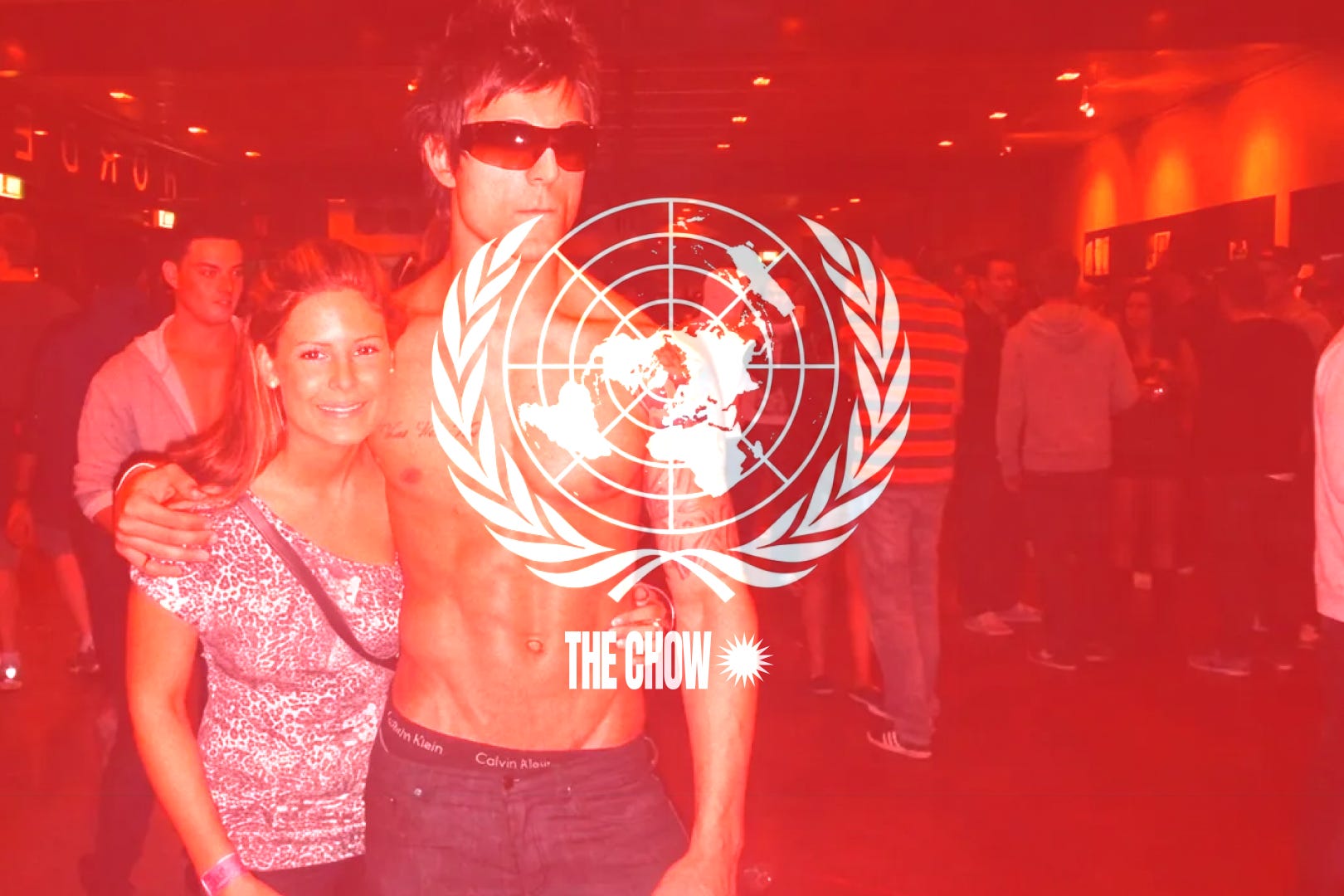
Zyzz rose to fame in the 2000s, posting videos of himself filmed on a Nokia phone onto YouTube during the platform’s infancy, where he’d dance and prance around in public, flexing a chiseled body hyperstitioned from Michelangelo’s most lurid wet dreams, wearing nothing but spandex tights. He would flick and shuffle in a hypnotizing contortion, voguing like the male-to-male drag kings of JoJo’s Bizarre Adventure. On the outside, he looked like an oversized postmodern contrapposto, with hair fixed in a shaggy mullet and his body covered in a skin-tight Anytime Fitness tee, but his inner self was more like an internet troll: he’d ragebait other users on Bodybuilding.com and 4chan forums with his own universe of vernacular, accusing devoted haters of “mirin’” (translation: admiring) his body and being “jelly” (jealous).
Aziz’s online persona of shirtless flexing, however, had little in common with the gentle kid his family knew. He graduated top of his class in secondary school, where he’d spent his formative years as a shy, skinny teenager who loved video games—“Zyzz” was just a LARP, an elaborate, multi-year performance art project that started once Aziz’s older brother, Said, convinced him to finally hit the gym and steadily gain muscle.
But that total eclipse from “skinny” to “bulky” was exactly why he gained an audience. By the early 2010s, he’d amassed a cult following—young men desperate for a transformation like his, patient enough to sit through speeches recorded on a dangling 480p webcam where he’d urge them to seize life “by the balls,” hit the gym, “get shredded,” and have fun. “You gotta be a ripped cunt. You gotta be a shredded cunt. You gotta go to the gym,” Zyzz once said. “You gotta not give a fuck. Because that’s what we do bro, that’s what the Zyzz cunts do. That’s what the revolution is.”
That lasted until August 2011, when Zyzz was found dead at age 22, in a sauna while on vacation in Thailand.
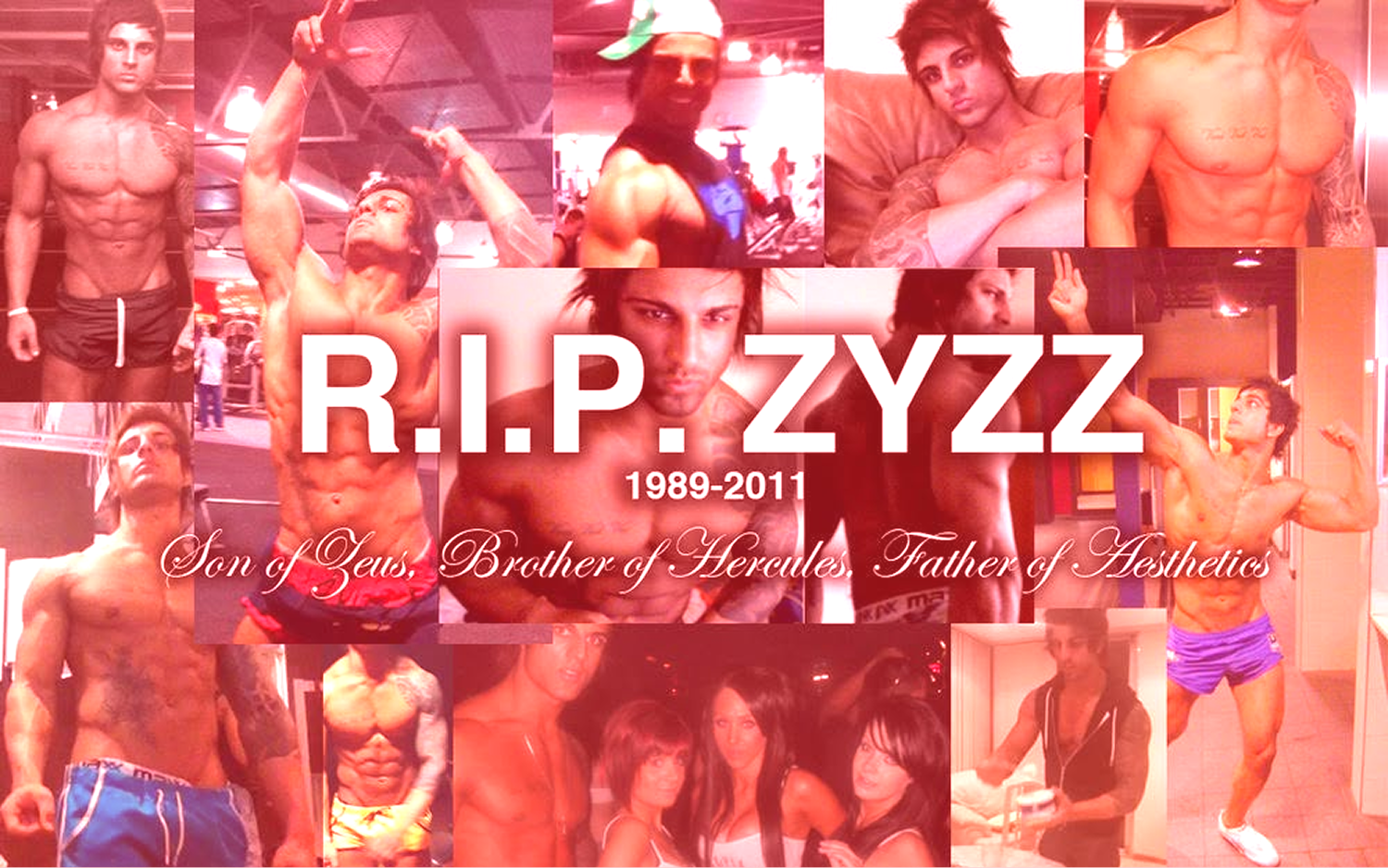
Zyzz’s short-lived fame is often read as an early prototype for looksmaxxing, the internet subculture obsessed with improving physical appearance through any means necessary. He is credited with popularizing bodybuilding for aesthetic reasons; he recklessly used anabolic steroids despite his family’s history of heart disease and, reportedly, traveled to Thailand for a nose job.
These factors might explain why WIRED describes him as the “original looksmaxxer.” But while there are parallels between Aziz’s story and contemporaries like Clavicular and Andogenic, Zyzz’s body politic is far more universal.
Modern looksmaxxing castigates the ugly in its project towards “ascension.” Its apostles are not afraid to call average-looking men “chuds” and “sub-5s.” Its leaders measure facial beauty through mathematical proportions and geometric angles, favoring metrics benchmarked against Eurocentric beauty standards. Phrases like “race-mog” and “skin color-mog” denigrate non-white looksmaxxers—no surprise then when TikTok’s “first Black looksmaxxer” was told by members of the community to “jbw” (Just Be White), and that he “was a monkey.”
Zyzz’s ideology, in contrast, organized around collectivist rallying cries: “We’re all gonna make it, bro,” he would say to fans—today, it’s an oft-repeated aphorism among masculine hopecore subcultures online. And by the time Zyzz’s internet popularity had peaked, his LARP could be applied to anyone. That juiced-up, muscular frame could be co-opted and reappropriated by fans around the world: “It’s just a fucking act, there is no Zyzz… You’re a fucking sick cunt if you want to be brah! So stop being a fucking sad cunt, alright?” he said. “There’s a bit of Zyzz in all of us.” No matter who you were, where you were from, or what you looked like, you could be a Zyzz too.
How did Aziz’s project so easily transcend difference? Was it from the years of bodybuilding, when the layers of tan and muscle melted away any defining phenotypes, transforming him into an ethnically ambiguous, post-race, post-national figure? Was it because he fashioned himself a “god,” blasphemously selling merch like the “Zyzz Bodybuilding Bible” or “Protein [powder] of the Gods,” offering ascension beyond shallow human limits like “race” and “nationality”?
Few can answer these questions, but even as Zyzz fans linger on the internet today, their politics are pluralist and universal, a direct antithesis to looksmaxxing. Search “zyzz pose” on Instagram and bodies of Caucasian, Chinese, Indian, Arab, and Wasian men flex in a similar position—right biceps curled, left arm flexed towards the sky, thumb, index, and middle finger pointed upwards—along rows of three in 9:16 frames. Still, there is “a bit of Zyzz in all of us.” And when the men of diverse origins appear flexed on the screen, I’m reminded, vaguely, of PLUR, the raver mantra of “peace, love, unity, respect,” coined by Frankie Bones, DJ and the “Godfather of American rave culture.” As Bones recalls in his personal blog, “PLUR was created for the movement” of the ‘90s underground party scene in New York, where genres like techno, progressive house, drum ‘n bass, and trance grew in popularity.
It just so happens that Zyzz, the world’s “first looksmaxxer,” loved trance music. And one speculative explanation for his utopian, universalist politics is that he learned it at the rave.
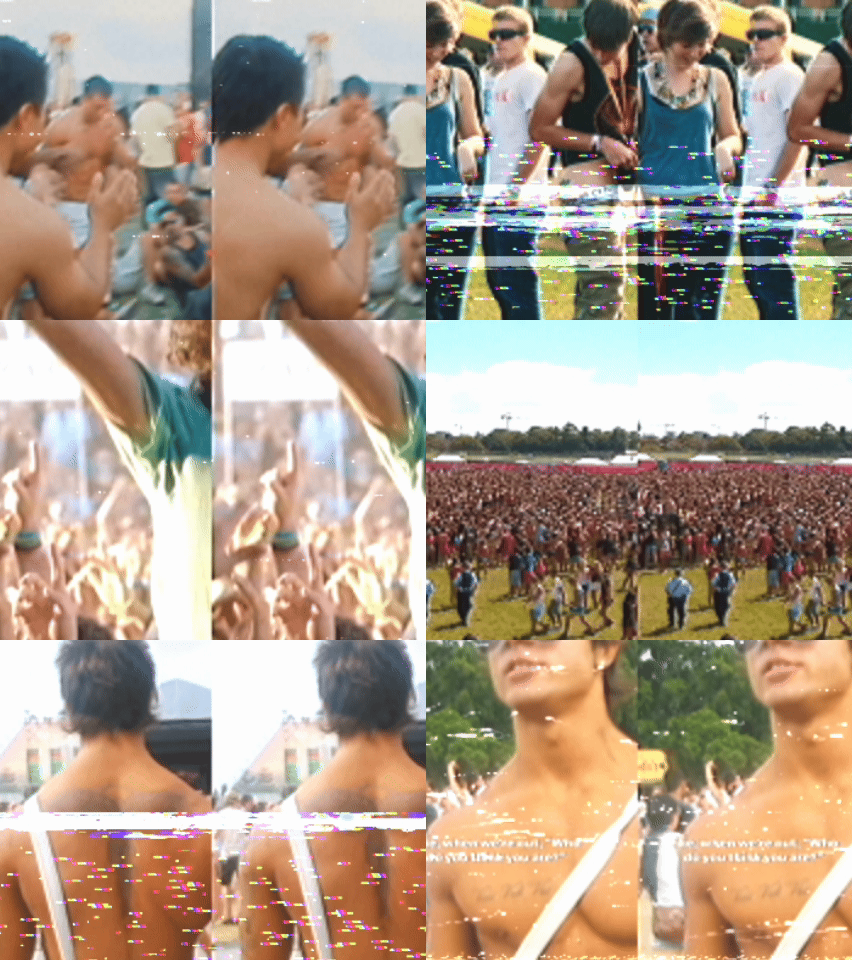
Archives of Zyzz’s Formspring, an anonymous Q&A website, show Zyzz discussing his music interests just days before he was found dead in Thailand. He told fans he was planning to attend the Australian outpost of the Godskitchen music festival, that he often looked through welovetrance.com for new music, and that he was a huge fan of “gabber,” a music genre and subculture prevalent in Sydney during the 2000s, with large, muscular men dancing with a bravado that matched his own.
Across several posthumous accounts of his life, raving plays an important part in Zyzz’s mythology. nine.com.au wrote that Zyzz “ruled Sydney’s festival circuit.” A clip from a new documentary, Poster Boy: Becoming Zyzz, reveals Sydney’s trance music scene was central to his transformation. Friends claim he was the first straight guy to attend a rave in his underwear—braving catcalls and homophobic critique at first before inspiring legions of other half-naked copycats. You can still see that side of him on YouTube, contorting his body in outdoor festivals, skin overexposed, with “Stereo Love,” a Eurodance/trance track by Edward Maya and Vika Jigulina, playing in the background.
“Stereo Love,” with its yearning, reaching verses and looping melodic drops, popularly evokes an endless summer—the kind that Zyzz embodies today, forever remembered in his youth. On Formspring posts, he’d regularly feature trance and progressive house tracks like “The Blacksmith (Klauss Goulart Remix)” by The King & The Thief, “Pressure (Alesso Remix)” by Nadia Ali, Starkillers & Alex Kenji, and “Sun 2011 (4 Strings Remix)” by Slusnik Luna as “song[s] of the day”—all of which reverberate with slow, regulated upscales, echoing Zyzz’s projection towards transcendence or the looksmaxxer’s pursuit of “ascension.” Before his activity on Formspring went dark, likely the day he was found unresponsive in a sauna, Zyzz shared that “when I die an untimely death,” “Only A Few Things” by Above & Beyond feat. Zoë Johnston should be “played at my funeral.”
Granted, Zyzz did not perfectly embody Bones’ principles of PLUR. According to Vice, he was a “muzza,” a subculture of muscular male ravers in Australia, “commonly of Southern European or Middle Eastern background,” that balanced “extremely metrosexual ideals” with a “hunger for violence”; that married “getting ripped at the gym and raving.” Accounts of the subculture are few. But one study presents muzzas both as terrorizing raves across Sydney, dancing brashly at parties after crossing cocaine with steroids, and as targets of xenophobia from older, White ravers.
I’m convinced, however, that raving did teach Zyzz a few lessons about pluralism. As rave critic Geoffrey Mak writes, the fleshiness of the dance floor requires a confrontation of difference, where we might be taught “the meaning of a civic body more or less constructed by randomness, of how to embrace the annoying diversity at the heart of the commons.”
You cannot ask a dead man to confirm whether or not he agrees. But you can dig through his legacy and see if there are any parallels.
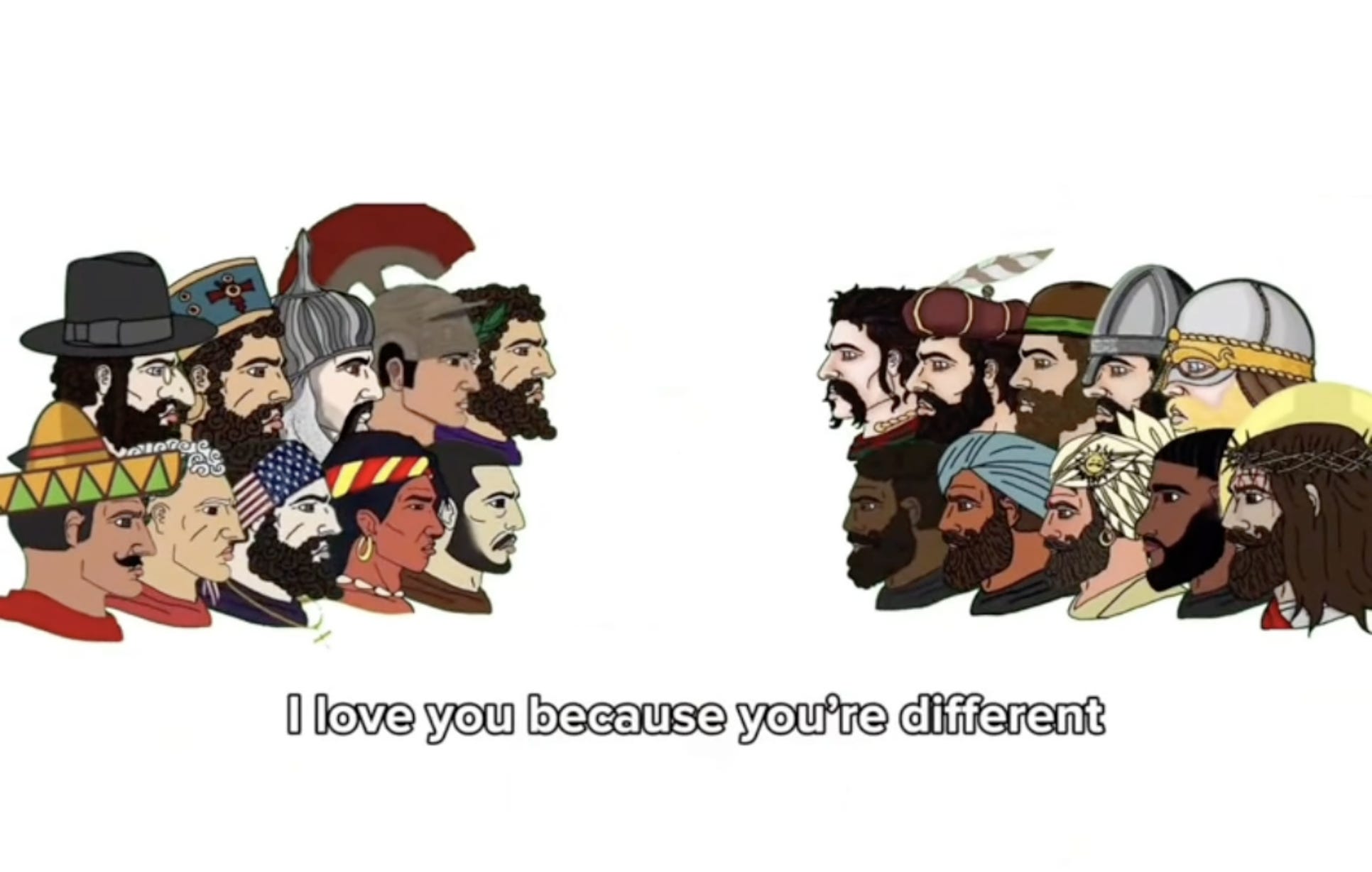
Today, “Zyzz hardstyle” (also known as “Fuark style”) is a new genre of internet music created by fans to memorialize Zyzz. The sound is a closer sibling to gabber and hardcore than to the melodic, progressive trance that Zyzz shared with his audience. Unique to “Zyzz hardstyle” is the remixing of acclaimed girly-pop songs like Charli XCX’s “Break the Rules” or Rihanna’s “Only Girl (In the World)”—accelerating the track beyond a recognizable BPM, layering heavy reverb kicks and smashing basslines. By adding an abrasive, brash, hypermasculine quality to hyperfeminine tracks, a new kind of genderless sound is imagined. Songs from the genre feature in universalist “hopecore” videos that envision a cooperative, pluralistic society where diversity is harnessed as strength. One clip depicts varying wojak “chads”—a Native American warrior, a viking, Jesus—above the text, “I love you because you’re different.”
Meanwhile, when the modern looksmaxxer is not smashing his face with a hammer, he is far more at home at the commercial club than the rave. His fixation on appearance as value thrusts him into nighttime venues governed by status-signalling and wealth-flexing. In January this year, for example, looksmaxxing poster boy Clavicular streamed a night out at Miami’s Club Vendome. Fellow right-wing content creators like the Tate brothers, Myron Gaines from “Fresh and Fit,” and streamer Nick Fuentes were in attendance. From their table, they nodded, barely danced under red and purple strobe lights, while OnlyFans creators fawned over them and DJs played Ye’s infamous Nazi anthem, “HH.”
Zyzz, it seems, was less interested in the rules of status-maxxing. He was more interested in beauty, pursuing aesthetics for their own sake. “Beauty isn’t interested in rising to power or gaining capital. It’s just interested in pleasure,” Mak writes. And like beauty, the project of building community, on local, national, and international scales, “can be about pleasure, too, in its highest forms.”
Perhaps Zyzz learned this at the rave.

woww, such an interesting piece, couldnt ignore it..
the idea that extreme bodybuilding can make the body less individual really stuck with me!!!!! it made me wonder if the same logic applies to makeup too, when most people are following the same beauty standards, at what point does self expression start making us look more alike?
but I really loved the contrast you draw between the same obsession with the body creating either hierarchy or belonging, such an interesting tension. Maybe a subculture can actually teach people to accept difference simply through shared physical experience, even when it was never explicitly about politics or tolerance..
aaand that made me think about how internet subcultures have changed: they used to feel like places where people could find an identity and a community. so I keep wondering, what makes one subculture turn difference into belonging, when another turns it into a hierarchy?