


The opening line of Neuromancer, William Gibson’s seminal cyberpunk novel, describes the skyline of Chiba, Japan: “The sky above the port was the color of television, tuned to a dead channel.” You might imagine fifty-or-so years from now to have flying cars, rogue AIs in humanlike flesh, body alterations merging muscle with machine, or an internet that functions like ‘cyberspace’—but when imagining “the future,” Gibson knew to direct his attention to the streets and skylines. After all, the city is frequently the first site of exploration for what the future will look like, and often, that vision has looked something like this:
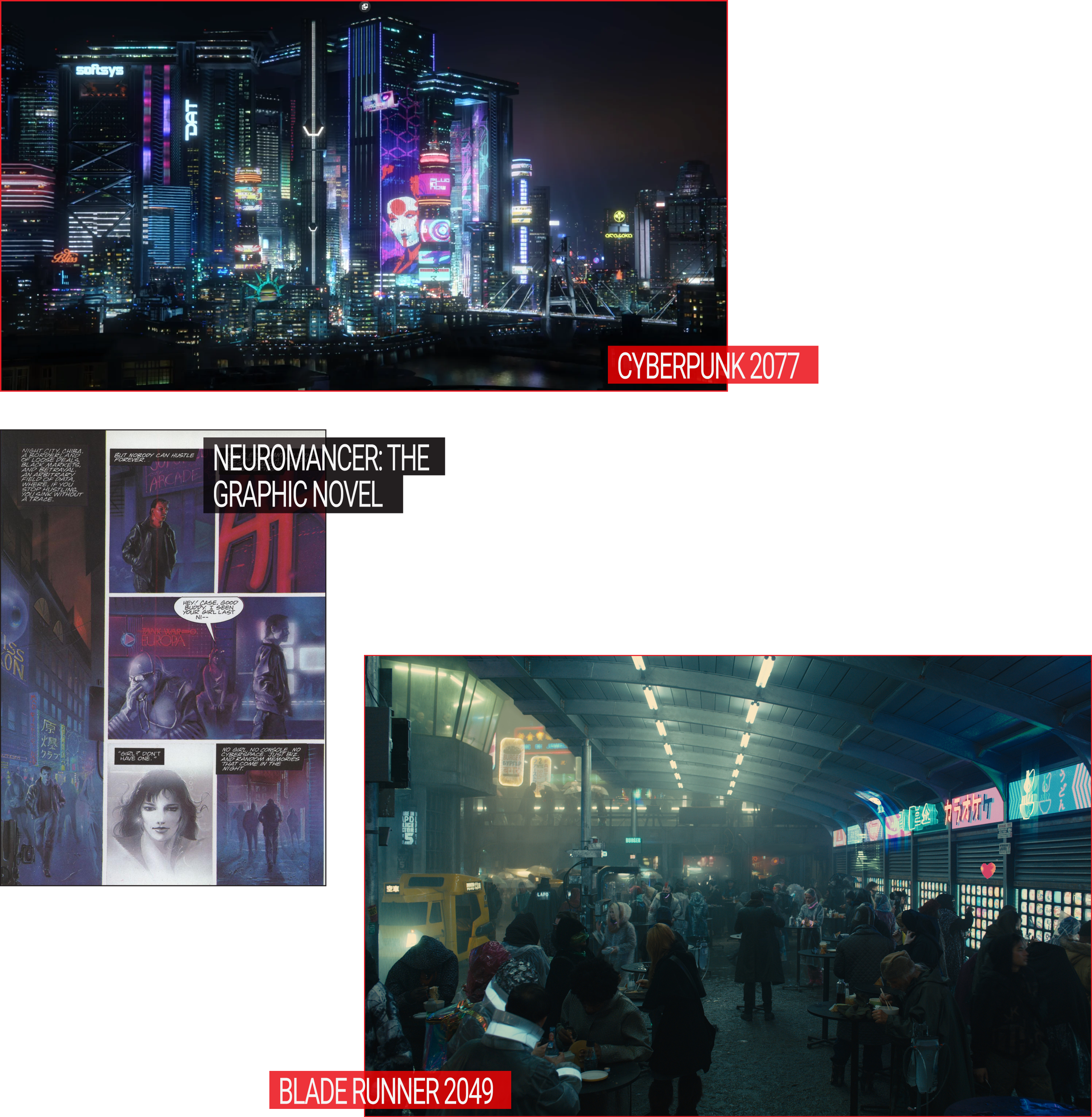
Towering skyscrapers shrouded in gloom, a sky forever kept dark and dreary, like “the color of television, tuned to a dead channel.” Day-to-day life here would probably get you down, if not for all the bright, colorful neon lights.
This “low life, high tech” society is how cyberpunk authors, filmmakers, and artists like Gibson imagined the future. Its visual language hinged on contrasts—bright and colorful despite the darkness, dirty alleyways at the gaps in between luxury skyrises, quadrillion-dollar companies and obscene wealth versus poverty on the margins, a messy fusion of high tech and the analog—all to consider who and what are left behind in a world of unbridled economic growth and technological development, in pursuit of “the future.” You can find the same dark cities and rogue AIs in works like Blade Runner and Ghost in the Shell, but even four decades after the genre’s heyday in the ‘80s, it’s hardly a stretch to say that cyberpunk remains one of the dominant visions of the future. “High tech, low life” and the never ending glow of neon are still found in contemporary sci-fi anthologies like Love, Death and Robots or in a 2025 film like TRON: Ares.
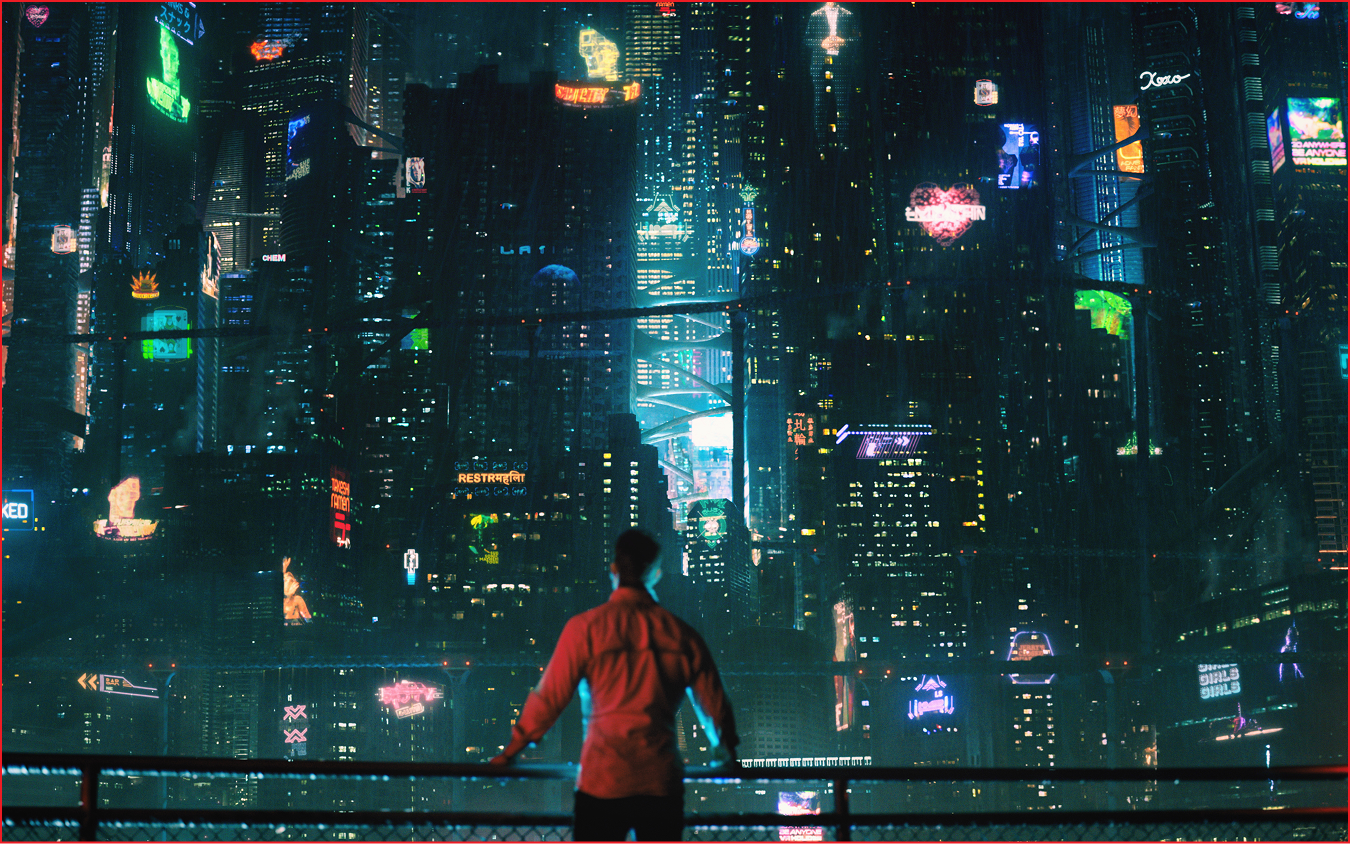
Indeed, there’s an allure to cyberpunk that maintains its staying power. A frame in the TV series Altered Carbon, when the protagonist Takeshi Kovacs (Joel Kinnaman) stares at the dystopian metropolis of Bay City, might capture this best: Here, a lone renegade is seen hypnotized by company logos and bright colorful ads. Living under complete corporate rule and insatiable capitalism might induce terror, but who knew that billionaires and monopolies could make a society verging on collapse look so sexy?
“The aesthetics of Cyberpunk are incredible btw,” Elon Musk once tweeted in 2021. That was in reference to the art direction in CD Projekt Red’s Cyberpunk 2077, but it underscored an important idea: cyberpunk is terrifying, inviting, alluring, all at once.
But if you consider that none of the new tech-elite have the taste codes or creative vision to create a dystopia so visually appealing, the idea of cyberpunk starts to feel dated. On a social level, that’s the case too.
Cyberpunk’s visual codes borrowed from punk and hacker subcultures and fused them together. Both groups already shared a DIY-ethos and anti-establishment politics, but when a hacker’s scrappy computer tech merged with the dark anarchy of punk, rebellion became the language of the future. Think: Cyberpunk 2077’s V taking down immortal executives at trillion-dollar multinationals, or cyberhumans like Motoko Kusanagi tearing down government conspiracies, as in Ghost in the Shell. Most cyberpunk stories are “stylized revenge or power fantasies,” Sam Chen (Ghost In The Sam) observes in a video from 2025. And we like them not because we fantasize about obeying corporate power, she adds, but because “[we] fantasize about rebelling.”
Punks and hackers haven’t kept their staying power through the 2020s, and their rebellious ethos has failed to keep pace with the $1.4 trillion or $423 billion market caps of Tesla or Palantir. Cyberpunk promised us that rampant inequality and a capitalism without limits would turn us into cool netrunners, underground biohackers, or marksmen clad in neon armor. But now in a world with an accelerating divide between the rich and the poor, we have gooners, men with gambling addictions, and urbanites on ozempic. “The future is already here,” as William Gibson once wrote—it’s just filled with AI porn and prediction markets.
Cyberpunk is no longer a fair or accurate vision of the future. But what actually comes next? Reflecting on these questions towards the end of 2025, I visited one of the birthplaces of “the future” to find out.

Akihabara, a district in central Tokyo, has over 20 consumer electronics stores on a single 500m-long stretch. It’s known as the city’s “electric town,” with several seven-plus-story buildings selling everything from laptops, cameras, and computer chips. But somehow, the untrained Western eye always looks at this electronics hub with fascination: “It’s equal parts Blade Runner, The Fifth Element, Ghost in the Shell and, well, just about every other sci-fi movie you can think of,” as one CNET travel guide described Akihabara in 2010. For some, Tokyo’s “electric town” is a prototype of the future, an on-the-ground forecast of what the world might look like in a few decades.
Even some Japanese might be inclined to agree. In an essay for Gentosha, cultural theorist Kaichiro Morikawa argues, “In a way, Akihabara was a place where people came to buy symbols and idols of the future.” The district was always in the vanguard of emerging technology—selling washing machines, refrigerators, and televisions post-WWII, and shifting to computers in the ‘80s. One blogger claims that engineers in Akihabara “pioneered the radio boom,” bringing one of the earliest mass communication channels to Japan.
Today, there’s still traces of that futuristic promise in the district. Walk out of the subway station at 6pm, the lights start to shimmer as the sun begins to set: thick, blocky signs attached to buildings, brightly colored blue, red, yellow, or orange with the help of a backlight; bright LED signs carve out store logos in a glow.
Akihabara is characteristically “cyberpunk”—there are neon lights and large billboard-sized screens with glossy-skinned women advertising skincare products, much like what you’d see in Blade Runner. But now a quarter through the 21st century, when almost every East Asian metro is a “futuristic,” “high-tech” “smart city”, Akihabara—the original cyberpunk “electric town”—leaves much to be desired. It doesn’t feel all that different from Tokyo districts like Ikebukuro or Shibuya. You could even say the amount of light and color here are underwhelming when compared to districts in rival Asian cities like Chongqing or Seoul.

Perhaps this is all just a distraction from what Akihabara is really known as: the mecca of Japanese anime and the center for otaku subculture.
It might as well be known as the anime town. You can easily make this conclusion from the district’s many anime billboards and maid cafes, which possibly outnumber the electronics stores; or because Animate, a Japanese manga retail giant, has two towering branches in Akihabara sitting within 180 meters from one another. But you need not look that hard. The unkempt Westerners dressed in sweats and circa-2016 Adidas running shoes (one of whom, I heard, said the words “I gooned too hard!” in public) and the lingering stench of body odor at each store already make one thing obvious: the Japanophiles and the “weaboos” are here to play.
On the hunt for Christmas gifts for friends, my siblings and I found ourselves in the same vicinity. My sister had directed us to a store to find Hunter x Hunter figurines, but by some mistake we landed at the fifth floor of GIGO, an arcade, only to find that the escalators could only go up. We were trapped with rows and rows of claw machines and glossy gaming music, where every thirty seconds there’d be an adlib of a girl squealing “onegai” (which is Japanese for “please”).
It took us fifteen minutes to find the back entrance, which eventually led us to Akihabara’s main crosswalk. Pinned on each corner was an office building with reflective glass, a second-hand home goods store, a flagship branch of a consumer electronics retailer, and anime maid billboards with low-hanging, unnecessarily-visible cleavage. All context—work, home, tech, hentai—collapsed here, because, as Morikawa continues to observe in Gentosha: “Akihabara has come to be more an extension of private space, an otaku room blown up into the city,” where “the classic notion of ‘public’ is invalid.” On the main street, cute Pokemon stuffed toys for kids sit right alongside cardboard cutouts of “CGI-hentai-girl-golems”—or the kind of technologically-generated women that would make Twitter tech bros froth in the mouth.
My sister finally finds Hunter x Hunter figurines at a figurine store named amiami. But on the same floor, we’re greeted first by hypersexualized versions of characters from anime titles that had finished years ago. A figurine of Lucy from the widely-popular shonen series Fairy Tail was selling for 40,000 yen (255 USD). And for a similar price on a nearby shelf were “goon-ified” versions of Mikan and Celestia Ludenberg from the murder mystery video game series Danganronpa. I’m surprised by the latter because Danganronpa is not sexual at all—it was a niche series in the 2010s and had a wider reach in AO3- and fandom.com-adjacent internet circles. But here they were: old IP zombified back to life, repurposed as merch to be squeezed to the last yen—it’s as if the tumblr-users and fan theorists have moved on, and the only group left to extract value from were the gooners.
That may well underscore the difference between a future imagined by cyberpunk and by Akihabara. The untrained Western eye would see both as similar, as projections into “the future,” but a closer look will reveal they are anything but.
Cyberpunk imagined us as active agents in the making of the future—renegade marksmen, netrunners in cyberspace, or bio-hackers challenging The System. But look at Akihabara, an early inspiration for futurism, and you arrive at an important lesson. The district is a consumerist spectacle, where context, the divide between accepted and taboo, public and private, seem to dissolve—all to adhere to a messy swath of wants, pleasures, and impulses.
Here, we are buyers and customers, not citizens. In Akihabara, the dystopia will not be cyberpunk—instead, we are left as nothing except for our most baseless desires.

Thx for the nod 🙂↕️ and I’ll never tire of this topic and how we can’t seem to imagine a new aesthetic for the “dark tech” future beyond 80s retrofuturism. Unfortunately, more and more I think it probably looks like an arid field of dust al la interstellar. Less sexy for sure.
I do think the genre always been about passive consumerism on some level just based on how so many of them feature “cheap pleasures” (prostitution, drugs)
Excellent piece and love how you sprinkled in the visuals, Patrick!
I'm curious how the Neuromancer series for Apple TV will approach the underlying social commentary aspect of OG cyberpunk. It's set to drop this year, so your post couldn't have come at a better time.
I wrote a lil something myself about our "dystopia as aesthetics" era. Would love to get your eyes on it: https://mutantfutures.substack.com/p/006