


Three months post-release and I still can’t listen to Charli XCX’s new album.
Towards the end of the summer, the internet was asking what would the alt-pop diva behind Brat do next? Expectations were high for the singer-songwriter-DJ who, two years ago, introduced Becky and Vivian from Human Resources to SOPHIE-style hyperpop. In May, the pre-release single “SS26” emerged as an answer, building momentum towards August’s Music, Fashion, Film, but also posing a more existential question for the creative industries at large: in a wave of shrinking budgets and revenue streams for cultural institutions, of “AI-powered creativity” and major fashion houses cozying up to feudal tech lords for cash, will the world still have a place for the arts? Singing on the chorus of “SS26,” Charli is not optimistic: “When the world is gonna end, no hope for any of it / Yeah, we’re walkin’ on a runway that goes straight to hell / Nothing’s gonna save us, not music, fashion or film.”
As death knocks at the doors of musicians, designers, and filmmakers, ready to pull them by their heads towards Gehenna, Charli melts into a passive resignation, even as her entire world crumbles before her eyes (she told Rolling Stone in June, “I Don’t Fucking Have Hobbies. [Music] Is My Life”). No longer the mezzo-soprano on “Track 10,” “Sympathy is a knife,” or “Unlock it (Lock it),” the Charli in “SS26” is talking and not singing: robotically droning the same lyrics throughout the song’s 2.75-minute runtime. Near the close, a syncopated guitar riff feebly attempts to break the monotony, but the sonic effect instead is a limp-dicked lifelessness, a docility as the future is surrendered away.
I know I’m being harsh, because reviews say Music, Fashion, Film ends on a lightly optimistic note. But too many are bemoaning the corpses. Our alleged “creatives” are too fixated on death, and Charli is not alone.
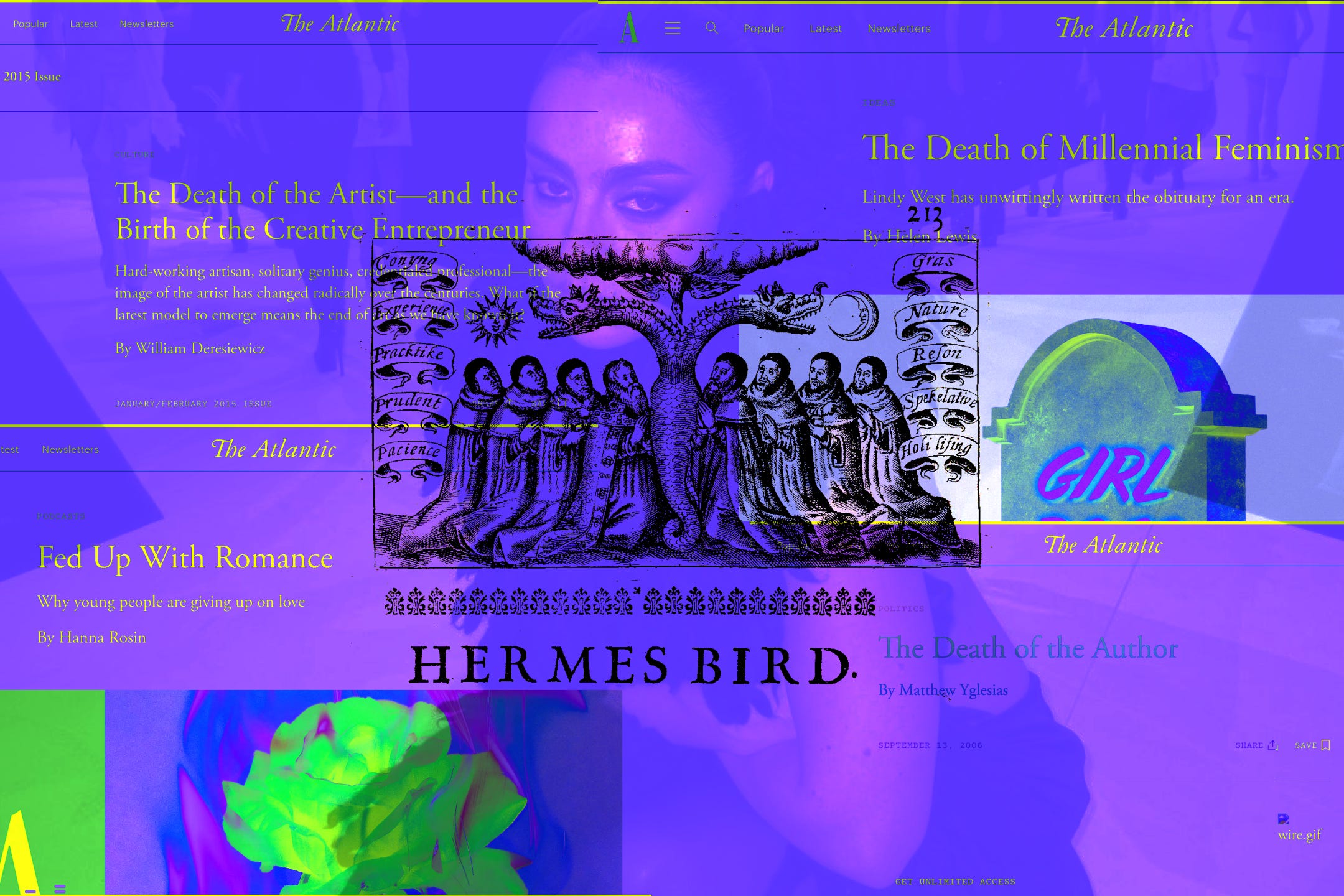
“Are subcultures dead?” The New York Times asked in August, even after already posing the same question and answering it (incorrectly) two years ago. A single magazine can print op-eds around “the death of [THING WE LIKE]” with the speed, scale, and precision of a Shenzhen factory—the pages of The Atlantic alone mourn feminism, reading, authors, the public square, dance criticism, books, even the very idea of “greatness,” and now Instagram infographic-slop pages are copying, telling audiences of over 2.5 million that “nobody has taste anymore.” Obviously that’s false. But what’s true is that plenty of the mainstream would rather cry at an imaginary gravestone, say art, music, fashion, film are “dead,” than imagine new worlds where they might still matter. Some even make a ton of money in the process: The Devil Wears Prada 2 wails about the private equity takeover of a storied fashion magazine, weeps “journalism still fucking matters,” and makes US$693 million.
Times could be better for the creative industries, but I’m not here to repeat the thoughtful reporting that’s already been done on the subject. I have (more than) a hunch that most high-signal culture workers and thinkers do not share the mainstream’s fixation on the corpses. Writing an essay on THE DEATH OF [A THING] is a lagging indicator. Chances are its author is a late adopter.
Besides, trudging through the cultural graveyard doesn’t have to be all bad. After all, the world has its origins in putrefaction.
That was an old saying from alchemists in the Middle Ages. The scientists of the medieval era rightly understood that without decomposition, without the decay of corpses, life itself would not be possible: if bacteria and fungi couldn’t break down organic matter into soil, then how would new flora grow?
Accelerationist philosopher Reza Negarestani traces how this line of thinking is useful for artists, musicians, and filmmakers. In his essay “Undercover Softness,” he writes that decay is a subtractive building process, “intensively negative and extensively positive,” because when an older (cultural) system rots or shrinks, new forms and new ways of living are born. And in the wake of the supposed decay surrounding us, how are cultural institutions changing? What new lifeforms are emerging? One answer is the Dark Forest.
First coined by Metalabel founder Yancey Strickler, “The Dark Forest Theory of the Internet” described a shift among digital subcultures in response to a decaying mainstream internet: for those seeking escape from rage-bait, spam and scams, annoying growth hacking, attention psyops, and normie pedestrian takes across popular social media platforms, the natural prerogative was to retreat into private online spaces. Not the dark web, but “walled gardens” like private Discord servers, Signal groupchats, or paywalled newsletters that circumvented the tyranny of short-form content and the cultural decline misdiagnosis essay. Here, connection mattered more than frivolous engagement metrics.
But any form of online organizing, as internet folklorist Günseli Yalcinkaya reminds us, will ultimately bleed back to real life. Now, the dark forests are sprouting IRL. A “scene-y” nightclub can close down and force a city’s rave circuit to organize more one-off events at improvised venues. Or, with the decline of usable third spaces, social communities forgo a physical address in favor of decentralized operations: namely, events hosted in different venues across a city that attract a regular set of people. In Hong Kong, these changes have happened already. Last year’s closure of nightclub SLAP has taken away a stable “home” for the city’s rave scene, and youth-focused creative communities like Critical Mass now host parties between underground malls and cafes.
Now, that tactic of nomadism is trickling upward. As online and IRL subcultures plant new dark forests, leading cultural institutions are following suit.
In September, Para Site, Hong Kong’s oldest non-profit contemporary art institution, announced its departure from its location in Quarry Bay, in the city’s Eastern District. Across 2027, the institution is seeking a new space for its operations. During that period, it will be fully nomadic.1
“Para Site could have very easily stayed in Quarry Bay,” says James Taylor-Foster, Para Site’s director. “But I think it would’ve led to a repeating of things, which I think is dangerous.”
Para Site’s new dark forest-style modus operandi is opening new opportunities to explore different ideas. “It’s a moment to ask, What if we do this or that?” James says. Lessons from this brief period of nomadic, experimental programming will feed back into Para Site’s future as an institution: “The next year is about testing where the institution actually resides, and building a brief for what kind of space is needed,” he says. “Temporarily releasing ourselves from a fixed site allows us to treat Hong Kong itself as an institutional space in and of itself.”
That’s already manifesting in an imperative for new, disruptive art across the city. Para Site’s new series titled “Elsewhere in Me: Live Art in the City” experiments with one-off pop-up-style exhibits that explore the concept of space, creating “portals for embodying new ways of moving, connecting, and finding meaning between ourselves and our surroundings.” So far, these traveling exhibits have featured Taiwanese performance artist River Lin’s “My Body is a Para Site,” where the artist sleeps in public parks and lobbies to challenge preconceptions of the ‘private’ and ‘public.’ In September, the series also included the Chongqing-based Tong Wenmin’s “Towards Solace,” featuring an installation built from random found branches and leaves to create a dark forest-like site for collective ritual.
“All institutions survive through repositioning and responsiveness,” James adds, “whether they’re big or small.”
Indeed, responding to decay has always been how artists and culture workers stay relevant in a changing world. Para Site itself was founded by seven local artists in 1996, on the eve of Hong Kong’s handover from Great Britain to China, when the city was perceived as a “cultural desert.” Naturally, adapting to disruption and change was etched into the space’s DNA.
Now in transition to a quasi-dark forest era, Para Site adapts again, reminding us of an important question: Will you be part of the lagging, soon-to-be-forgotten mainstream, perishing side by side with the “dying culture” they are so eager to diagnose? Or, will you do the work to keep your art alive? In the face of the decay, will you let new life sprout?
“It’s important to open up an alternative way of operating, because that’s when you start to understand what an institution can be. I’m wary of giving examples,” says James. “I’ve noticed that whenever I say something precise, people suddenly anchor onto it. And that’s not the point right now.”
He adds, “The point right now is to keep it open and keep testing… [To keep] experimenting, or even attempting to define what ‘experimental’ means right now for the artists, for writers, for thinkers—every facet of what it takes to make a Petri dish of culture.”

Click here for more information on “Elsewhere in Me.”
One interesting point about about Para Site is that nomadism has always been inscribed into its being: “From Kennedy Town to Sheung Wan to Quarry Bay, Para Site’s journey has unfolded across many homes, responding to the needs of the moment.” See this article on e-flux.
Yes! I love this. Death means REBIRTH. And the old world needs to die let's face it.