


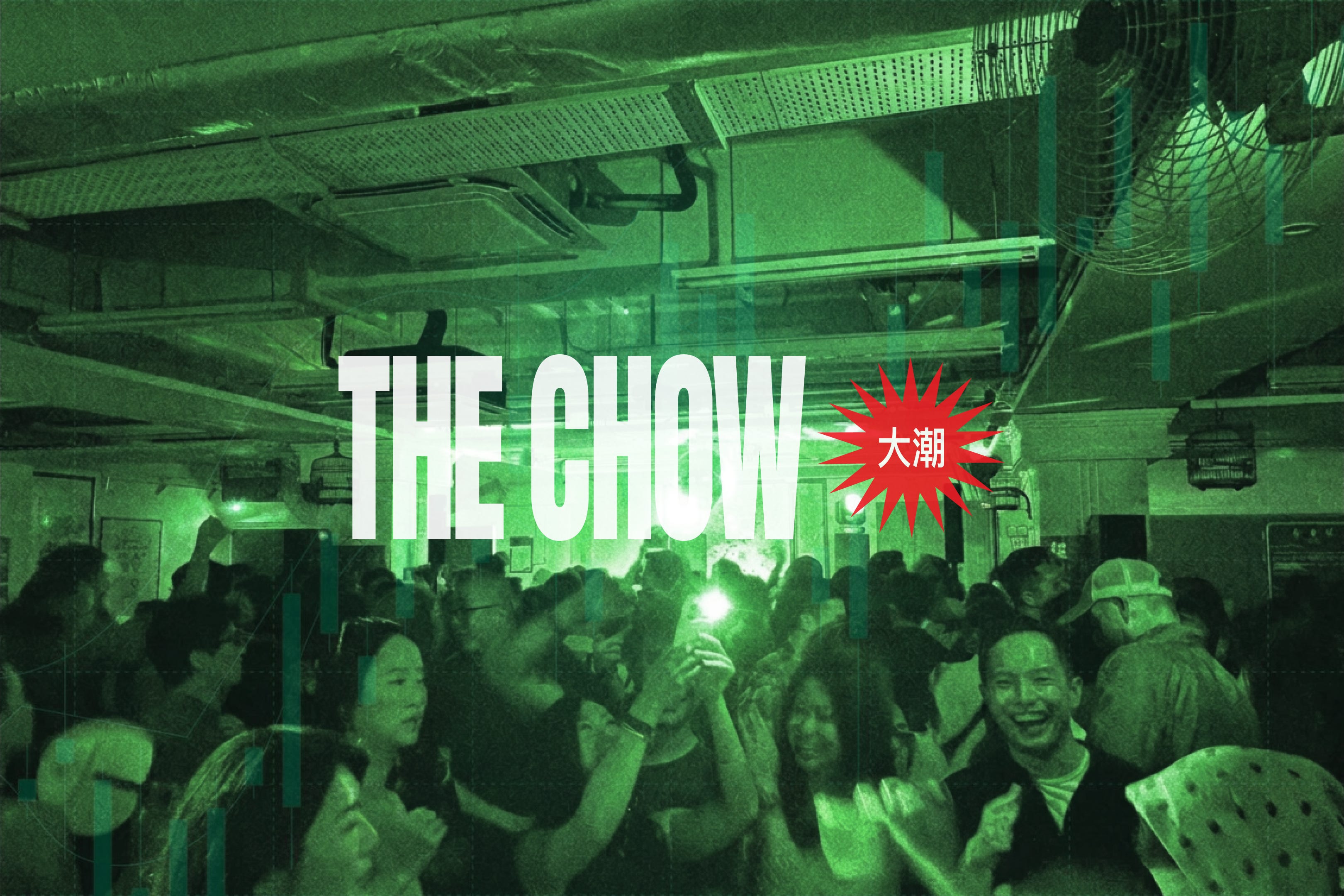
Against the ticking of a clock, Madonna’s voice echoes on the dance floor like a spell: “TIME GOES BY, SO SLOWLY. TIME GOES BY, SO SLOWLY.” The muffled melody, sampled from ABBA’s “Gimme! Gimme! Gimme!,” rises in scales. The Chinese woman in a black qipao; the tanned, lanky white guy, bare-chested in a silk Chinese robe; and the five or six or seven or so British and Indian tourists in navy jorts and black “I <3 HK” T-shirts are all dancing to a glitzy house remix of Madonna’s “Hung Up” at the talk-of-the-town event of the evening: a “rave” at a dim sum restaurant.
Lin Heung Lau, one of Hong Kong’s most historic tea houses, was set to close by the end of April, relocating out of its two-story branch in Wellington Street, where its classic white Chinese tiling and moving dim sum carts had previously stood for nearly half a century. To pay respects, the dining area was stripped of its tables, chairs, and porcelain tea cups. And the empty space made way for a closing party, in the form of a dim sum “rave.”
History was ending, uprooted: the tea house, once featured in classic iconic Hong Kong films like The Longest Summer (1998) and In the Mood for Love (2000), would later move to a nondescript commercial building. And soundtracking its demise were some mid DJs playing nostalgia remix slop: deep house renditions of “Rhythm of the Night”; Gwen Stefani’s “Hollaback Girl,” chorus layered over thwacking bass. The partygoers filling in, I’m told, were offered free drinks in exchange for dressing up in “traditional” Chinese clothing. But the sense of cosplay is much more palpable than any nods to cultural heritage: that woman’s black qipao is paired with thigh-high leather boots; that white guy’s silk Chinese robe is cut to near perversion—the length so short, and the “auspicious” silk almost crimson, that it looks much more like Hugh Hefner’s smoking jacket.
“This is some weird shit man,” my friend, *Terrence, says. “You can get a real sense of homogenization of opinions on what Hong Kong is”: Like a simulacrum, where resemblance is so superficial that the substance of the original disappears.
I’m not qualified to police the limits of what a “rave” is, but I dare say that this was the kind of party that has much more in common with brand activations than actual raves—events with live music that are DIY, community-based, and anti-corporate. Instead, these organizers threw a DJ into an unexpected place (in this case, a Chinese tea house), invited a bunch of influencers, sold expensive tickets, posted “DIM SUM RAVE!!!” on Instagram, and called it a day. Slop incarnated as a party.
Case in point was the sheer amount of marketing at the event. ONLY, a health-conscious vodka soda brand (which, if I’m honest, tastes pretty good), was the drink sponsor of the evening. Plastered on the walls were posters advertising PLVR, an organization ripping off P.L.U.R. (the core of rave philosophy: Peace, Love, Unity, Respect) for its brand name and claiming to be “ASIA’S BIGGEST RAVER COMMUNITY.” A brief glance at their Instagram account, however, will yield plenty of skepticism to this claim: post captions read like AI-generated text and engagement rates are low, reaching levels that you’d only find on accounts where the followers are all bots.
Sitting on a dining table behind the dance floor was a small activation for Lemonbox, a Y Combinator-backed startup selling “AI-generative personalized nutrition,” with vitamin “supplement packs” optimizing recovery for ravers after a long night out. Marketing copy reads: “MADE BY RAVERS. FOR RAVERS.”
All this corporate slop-ification of rave culture makes much more sense when considering who the event’s organizers actually were. Cast on the dance floor was the glow of neon, from a sign shaped like the Eye of Horus. Its gaze peered at the partygoers swimming in the raveslop, and in lighting, carved the logo of the event’s hosts: RaveDAO.
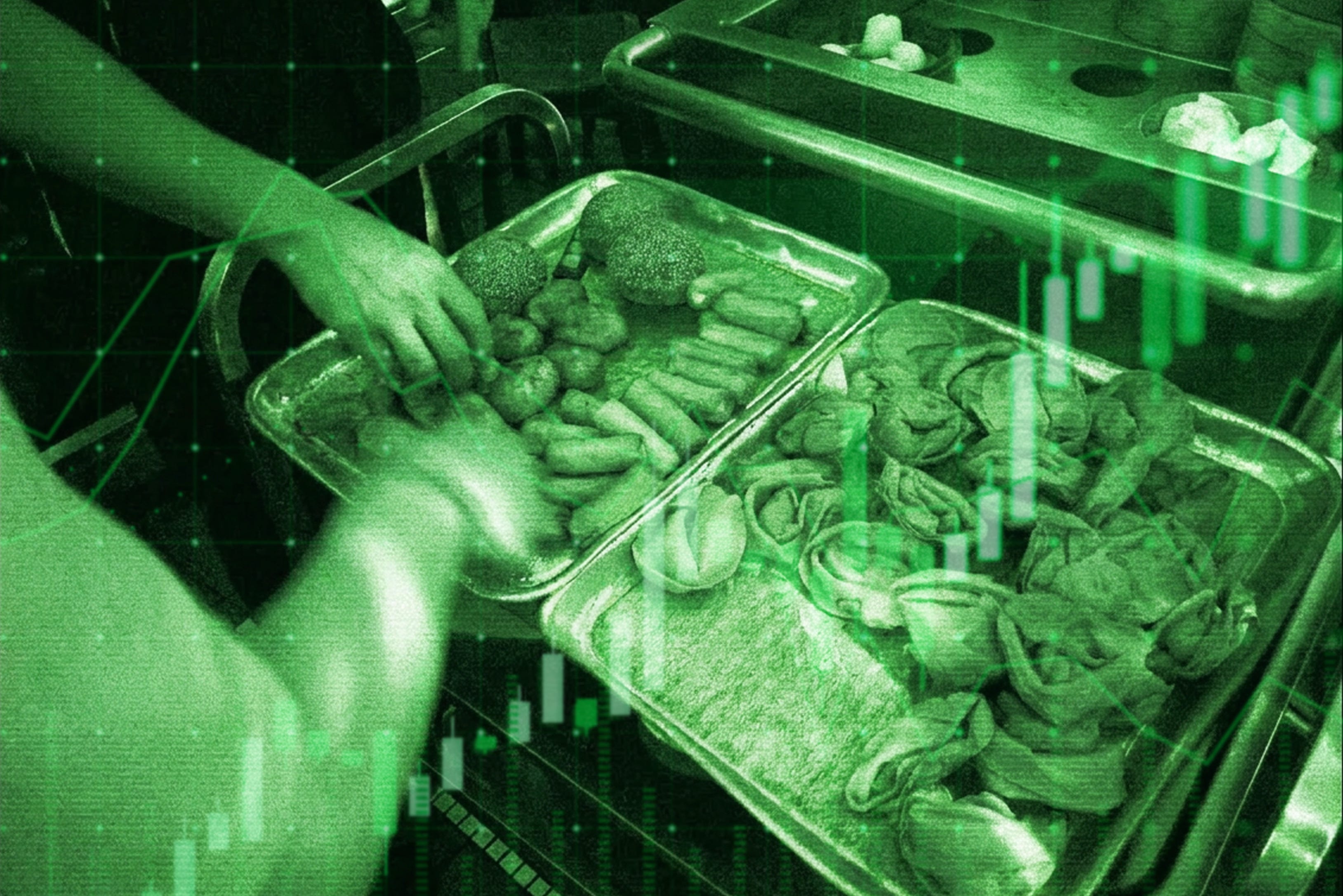
According to their whitepaper, RaveDAO is the “TEDx for [electronic] music.” They connect local nightlife organizers, “whether in Seoul, São Paulo, or San Francisco,” to a global network, creating a unified web of nightlife communities around the world. According to their website, the network throws parties in cities like Singapore, Dubai, and Bangkok, where attendance often surpasses the thousands.
As a decentralized autonomous organization (DAO), RaveDAO uses smart contracts on the blockchain to enable its network for global nightlife. The organization’s social infrastructure is supported by $RAVE, a cryptocurrency like Bitcoin or Ethereum, except it’s for nightlife organizers to purchase in order “to grow the global community” of RaveDAO. A “stake”—or a purchase of the coin—offers nightlife organizers a number of privileges: $RAVE allows for “[franchising] RaveDAO IP”; bestows RaveDAO’s institutional backing upon production, beverage, and experience vendors; and provides artists with the ability to “co-launch digital collectibles, remix rights, or Web3 collaborations under the RaveDAO brand.”
In RaveDAO’s own words: “We are initiating a global movement that onboards millions of electronic dance music lovers to crypto.”
Crypto bros are infiltrating local rave scenes. But what might be more worrying is what they actually do when they arrive.
On Sunday, April 12th, $RAVE coin was valued at less than US$2. Only a few days later, on Wednesday, $RAVE had shot up in value to US$19. $RAVE’s value continued to fluctuate in the days that followed, dropping to around US$10. But during the day of the dim sum rave itself, on Saturday, April 18th, within hours of the party’s opening, the coin’s price had jumped to US$27.32—over ten times its original price at the beginning of the week. By then, it had reached its high. Only twelve hours after this peak, the price of $RAVE dropped to US$3, erasing nearly 90% of the coin’s value overnight.
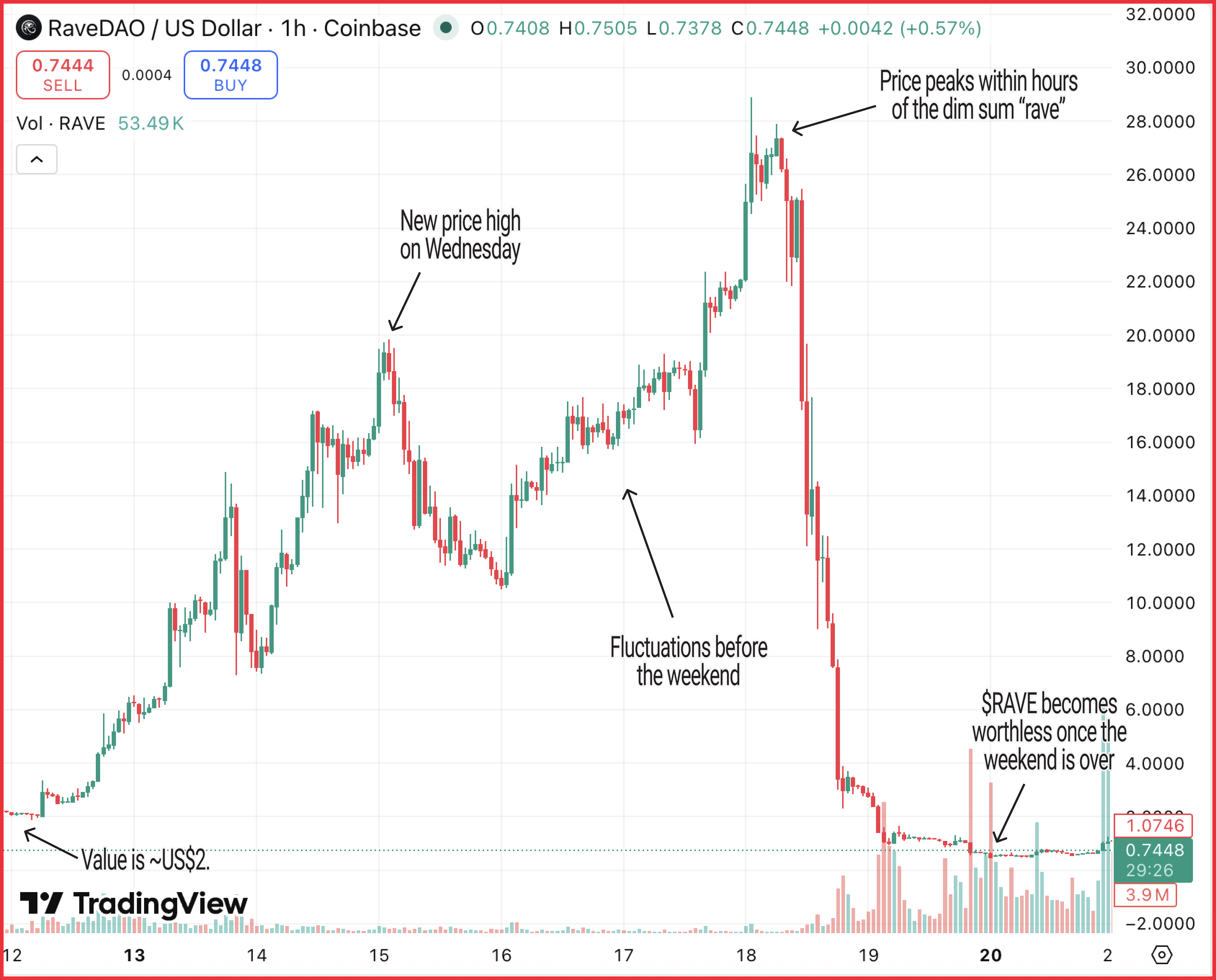
By April 20th, the coin was worthless. As crypto watchdog @Watcher.Guru noted on Twitter, “$RAVE cryptocurrency falls 98% to $0.5, erasing $6.7 billion from its market cap in two days.”


Several accounts on X have called this out as a classic, pump-and-dump scheme—a form of securities fraud where the price of a stock (in this case, $RAVE) is artificially inflated through misleading information (pump), in order for a small group of owners to sell the stock at a higher price (dump). RaveDAO has denied these allegations.
Pump-and-dump schemes have become endemic to cryptocurrency. Some recent high-profile examples include Donald Trump’s $TRUMP and the Hawk Tuah girl’s $HAWK coins. In both cases, the cryptocurrency’s value rapidly shot up through a collection of internet memes, and owners sold near the peaks for quick cashouts.
But what’s especially unique about $RAVE and RaveDAO is that this pump-and-dump scheme is explicitly targeted at local rave scenes and community nightlife organizers.
With $RAVE’s erratic price movements happening at the exact week of the party at Lin Heung Lau, one might imagine the following possibility: A nightlife organizer in Hong Kong hears about the dim sum rave, and purchases $RAVE in order to join RaveDAO’s global community. They may have bought at the peak—on the weekend of the party—only for the coin’s value to drop back down again twelve hours later, and for the nightlife organizer to lose their entire investment.
Thankfully, I haven’t heard of any such thing happening. And most nightlife organizers I know are not easily fooled by scammy meme-coin tactics. But it does highlight an important trend that many organizers are noticing: rave culture is increasingly susceptible to corporatism and capitalist capture.
The party at Lin Heung Lau is one of many “raves” that look more like brand marketing pop-ups than, well, actual raves. Sauna “rave.” Cold plunge “rave.” Raves with Illenium as the headliner and boba-loving striver tech Asians in the crowd. Or raves by John Summit where the target audience is consultants who work at Deloitte. An endless number of mutations of “rave culture” are so far removed from the early versions in derelict warehouses in England. The dim sum “rave” is just one of them.
British music journalist Simon Reynolds reminds us, however, that these are not necessarily alien to the form: “rave culture’s motor has been anarcho-capitalist and entrepreneurial,” even right from its beginnings in the ‘80s. A rave’s scrappiness and aversion to fixed rules are the kind of qualities that can make raves “temporary autonomous zones,” potent spaces for release and collective pleasure. But these exact qualities also make raves easily appropriated by brand marketers and crypto bros.
Our time at the dim sum “rave” is cut short. The DJ barely has enough time to slowly fade out the final track when the lights go on at 1:55 AM, five minutes before the party’s official closing time. The restaurant staff needs to pack up. And the crowd moans, disappointed.
The fixed closing time did feel a bit disruptive to the party. And it was a reminder that, even with greater access to resources, corporate incarnations of rave culture have many more restrictions than actual raves, hosted in shoddy locations and with ending times far beyond two in the morning.
I’m reminded of another quote by Simon Reynolds, that “Even after its co-optation by the record and clubbing industries, rave music’s cutting edge comes from the grass-roots: small labels, cottage-industry producers with home studios, specialist record stores, pirate radio”—places that are immune from attempted hijackery by crypto bros and brand marketers, where rave culture will continue to thrive.
As of Thursday, April 30th, 1;40 PM HKT, $RAVE is valued at US$0.75.

such a fucking good commentary expressing my opinions of the overusage of the word “rave” as a buzzword in HK’s cultural scene !!!! and didn’t know the lore behind raveDAO was so shady lol i was shocked reading this thank you for your investigative journalism
Yes!