


I’m lying stomach-down, chest sinking into hotel-fresh linen sheets, when my eyes begin to shutter—sleepy at ten on a Saturday evening, I think, because of understimulation. I’m in Shanghai for a long weekend trip after spending weeks binge-watching Instagram reels on travel to China. One impulse flight booking later and I’m under the delusion that 2026 is the summer for China-maxxing, for Socialism chic with Chinese characteristics and basking under the Red Sun in the Sky. Time was nigh to rip my gut to shreds with Sichuanese spices, drop a month’s worth of my salary at Chinese “it” brands MASONPRINCE or DOCUMENTS or PANE, and chainsmoke Chunghwa cigarettes—Beijing belly exposed—while inhaling the amount of tar adequate for a five-year-old in a Victorian coal mine.
So I thought. Instead, I am sitting on my ass in a hotel room, zero-for-three. Nothing I’ve eaten has been spicier than my midnight Popeye’s run, at the airport and Hungry On Arrival. I’ve only purchased three t-shirts from COMMON SCENTS, a brand so minimalist an influencer once crowned it the “Chinese A.P.C.” And since I don’t normally smoke I’ve bummed two cigarettes at max, leaving both unfinished. The previous night, Brandon* and Nathan* and I sampled ABYSS, a techno nightclub whose parties Rick Owens famously attended. But even with the DJs playing maximalist 150 BPM bounce bass drops straight from a viral Chinese spin class, somehow I was left wanting more.
Tomorrow, my checkout is at 9AM so it’s time to end my underwhelming trip with a bang, and when Brandon and Nathan finish getting dressed, I order a Didi for three from our hotel in Xintiandi, bound for Fuxing Park, to the final attraction of this trip: INS Land, Shanghai’s most popular nightclub.
Though “nightclub” in the singular may not be the most appropriate descriptor here. Official branding describes INS Land as a “CULTURAL PLAYGROUND.” The venue is not a unified place playing one sound with one DJ at a time. Instead, “INS Land spans seven floors and over 20 venues, bringing together music, dining, and art under one roof, [where] every night tells a new story.”
And in recent months that story has slowly cemented into myth, ranking 12th in DJ Mag’s April 2026 guide to the “Top 100 Clubs in the World.” But long prior, I’d been hearing chatter in industry mixers, or from friends who’d finished months-long stints in Shanghai, that INS Land was the venue to see on a visit to the city: “a place to lose yourself and find yourself all in the course of one night,” writes DJ Mag. So mythic is the club’s status that, in the vernacular of some in Shanghai circles, “INS-ed” is an actual verb: pronunciation: [aɪ.ɛn.ɛst], meaning to be Christened by the club’s interiors, and if time and money allow, to soak oneself in its seven stories, swim through twenty dance floors, drift between Douyin hit mixed with Afrobeats, tracks from Western Pop divas, K-pop with EDM, or hardcore industrial techno.
Tonight, I don’t think we’re as lucky. It’s INS Land’s third anniversary this weekend, and according to a strange man Brandon, Nathan, and I met at a wine bar earlier in the afternoon, the club will be too packed to hop between floors.
Exhibit A: When the Didi pulls into our destination at 11 PM, a park opening under a highway, BYDs and Roewes and blue-tinted taxis and cars with fake fenders blasting C-pop line up bumper-to-bumper, inches from the curb. Women in Douyin face and sparkly, diagonally-cut cropped tops peer into cars—looking for friends or their way back home, I’m not sure, but it’s unlikely the latter because the night is young and, besides a few gay guys with Botox, the partygoers are too: walking in through the tree-shrouded opening, the crowd dons the Global Normie Club Uniform for Under-30s—cropped, low-hanging spaghetti straps for women; for men, baggy-leaning collared shirts or, if appropriately toned, a single black tank top.
If Berghain was once a power plant, sitting near the wall dividing East and West Berlin; if its transformation into a techno nightclub symbolized global capitalism’s victory—an industrial history repurposed for techno music and for modern pleasures—then INS Land was that, an embodiment of an era, except this time for the consumer-driven economy in the supposed “Chinese century.”
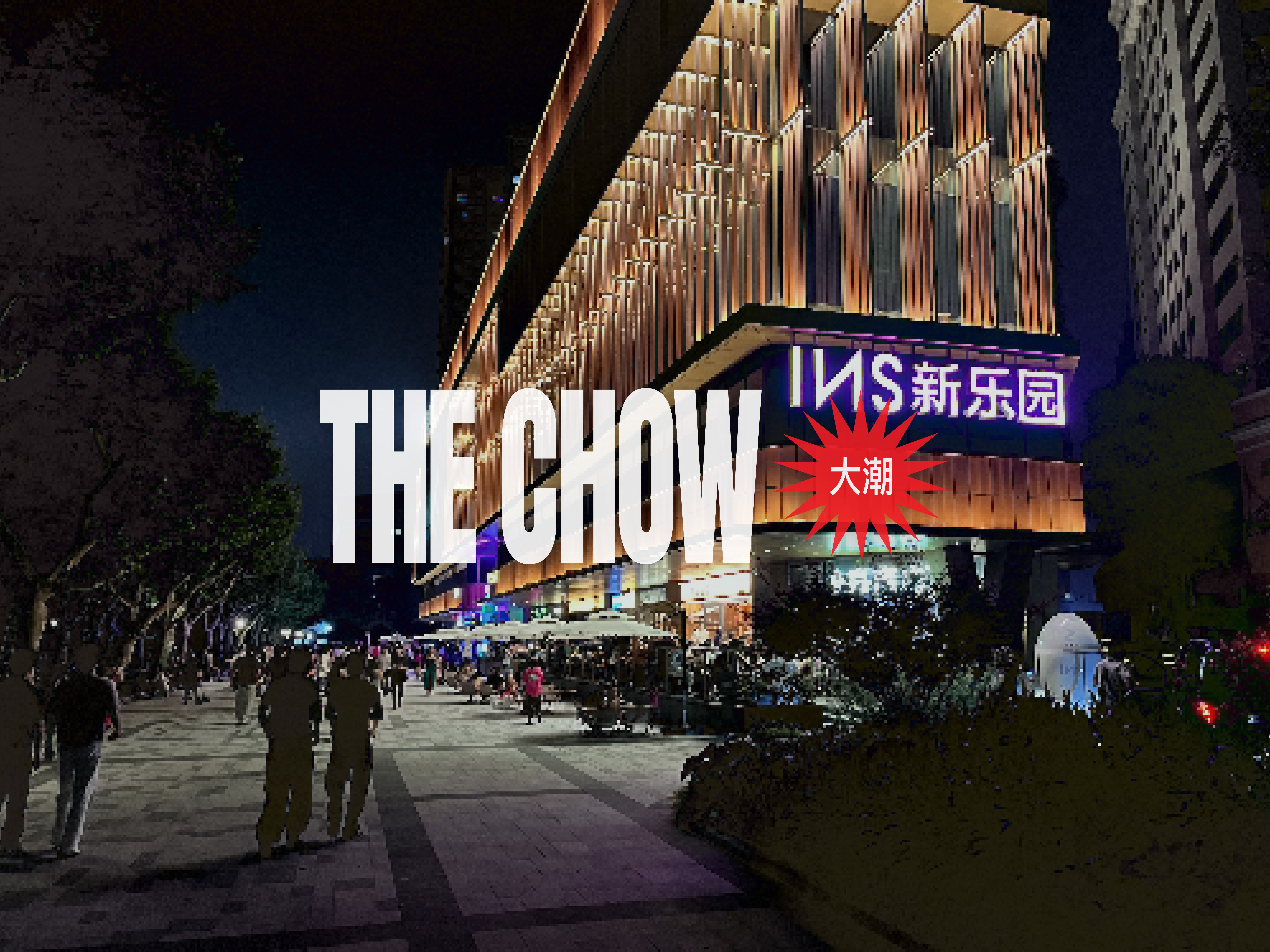
Glimmering pillars of gold fused together into a singular building, which, despite being six stories high, was more wide than tall. “INS新乐园,” reads the logo on the exterior, a “new paradise,” if you follow the word-for-word translation, standing in the heart of the city that writer Dan Wang once described as “China’s bleeding edge of consumption.” Shanghai’s Olympus of experience-for-purchase—a place where you could, theoretically, order Jianghu grill in one hour, grab post-dinner snacks at FuXing Bakery, pre-game your night with Japanese-Western fusion cocktails, and then hit the club right after. You won’t have to walk more than 100 meters. As INS Land’s President, Justin Guan, told Mixmag Asia in late 2025, “[the club] was inspired by the idea of: how can we make a physical place or series of places, feel like a dreamland? How can we create a ‘Disneyland for adults’?” Nearby, a conjoined statue of Marx and Engels and the former residence of Sun Yat-sen (the founder of China’s Nationalist Party) sit in the same 10 hectares of Fuxing Park, but at midnight the building’s golden glow devours any remnants of ideology.
“Wait, guys,” Brandon pauses. “I need to record my Instagram story.” He walks ahead, panning his rearview camera from his feet and then towards the large “INS新乐园” sign in front.
Such a video may soon become a historical artifact, and like in a factory, the core product constantly cycles through reinvention: Visit INS Land again a few months (or weeks, even), Guan told Mixmag Asia, “you are not going to get the same experience—we regularly change up venues, as well as change the theme and design of the main lobby every quarter.”
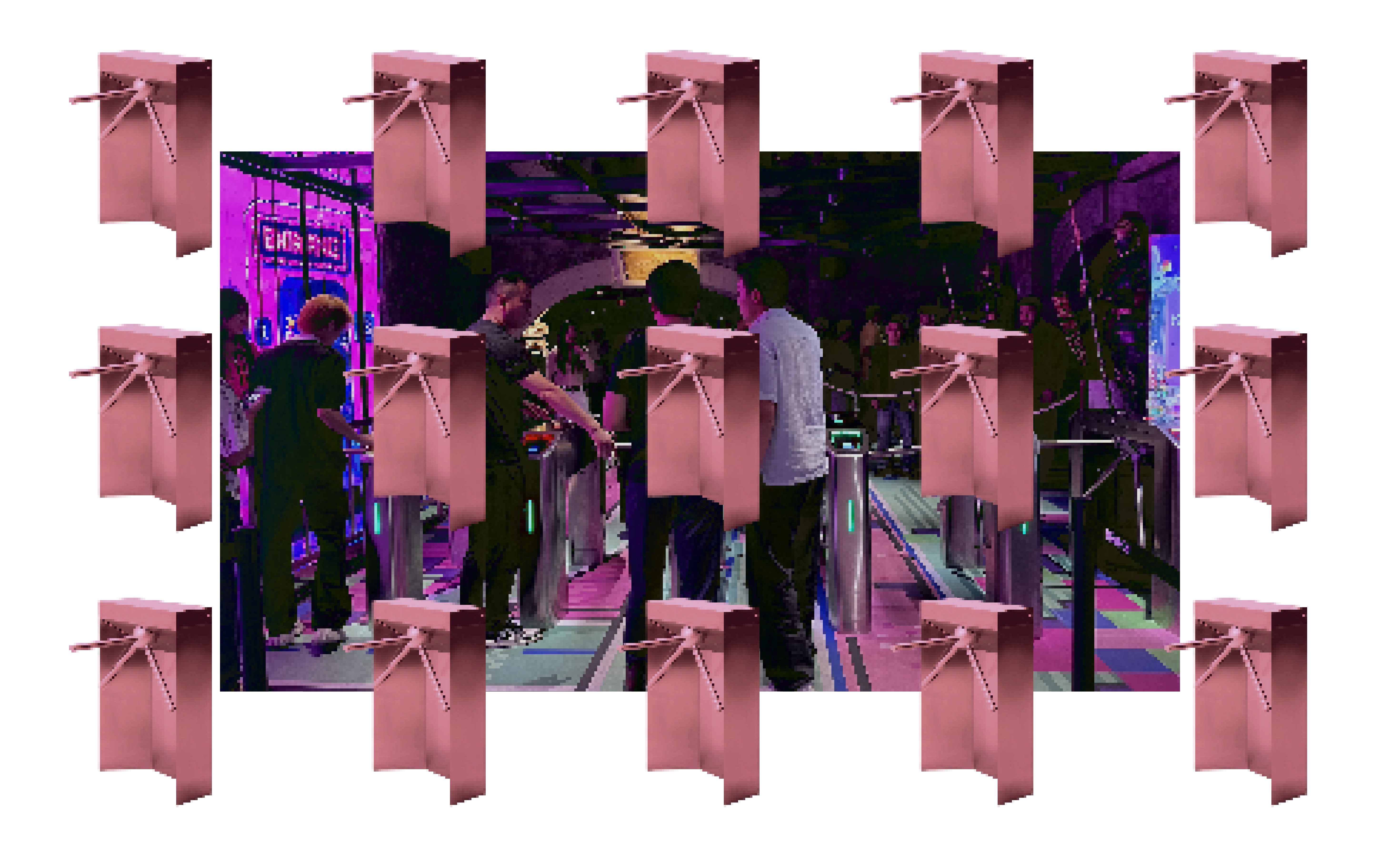
In mid-June, however, the lobby blends Disneyland with a Japanese arcade: an entrance wrapped in LED screens, glowing in pink, purple, and cyan makes way for rotating metal turnstiles impenetrable without a QR code on WeChat or on INS’s official app. Wooden signs, with arrows designed in Neverland-style, offer a directory on the ground floor. Maximalist videogame-style hyperpop emanates from speakers next to a DJ wearing a pink wig and dressed like Hatsune Miku, elevated by a booth built with neon bloxels.
Tonight, Nathan introduces us to Charis, a friend from college, who ushers us into an express elevator, to the top floor: La Fin, what is apparently the “most international” nightclub in the building, and according to official branding, Shanghai’s “home of global pop music.” Near the opening in front, a sphere with the club’s logo plastered in red neon signage spins globe-like above a circular bar counter, with bartenders—rotating, mixing alcohol and cranberry juice and soda and ice—circling left and right to drink-ordering patrons. Hip-hop (the sound of Global Asia) is playing: discs jockeys cycling through Lil Nas X to Central Cee to Ciara’s “Level Up” to Doechii to a heavy-bass remix of “ーアニョハセヨ (Annyeonghaseyo)” by Yuki Chiba & Lil Moshpit, a J-rap song that, over the past few months, had slowly become the meta track for fashion influencers in Hong Kong and Southern China. Sounds swirl and circulate around crowds of people whose presence in Shanghai might surprise you: a sinister-looking Wasian friend group near the bathroom, gossiping about a mutual’s bipolar diagnosis; the extremely American table of African American men in the VIP section; or the two Moroccan dudes, standing hips glued together, under a sign that says “WE ALL BECOME STORIES IN THE END.”


But if the club is an adult Disneyland, stories can feel two-tiered, pay-to-play. Charis pulls us towards the VIP section, blocked by a belly-button-high metal barrier, where girls in skin-tight leopard prints and cat ears, dance limp and unenthusiastically for a table of female clubbers. If you’re not inside, you can’t see the DJ booth—nor the jittery spectacle of blue flashing lights switching into mangled calculus of red-and-black, like the screen of a netrunner playthrough of Cyberpunk 2077, numbers moving in ordered disarray of seance-code. Stand outside the VIP section and you’ll be left to watch the partygoers who paid a little extra.
I slam a few shot glasses and wince right after. A tall man in a suit—chaperone for hire?—is there to manage my discomfort: he offers me a napkin from his chest pocket and flashes me his Alipay code. (I tip him ¥100.) I’m pulled into the smoking room with Nathan and Charis and Bruce (a random guy, not from our party) and he just tells me he wants to visit the Philippines one day. I grow dizzy as his words dissipate into the haze of smoke, while bodies next to him, of people dressed in Chrome Hearts and Comme des Garçons shirts with lipstick stains, vanish under the tar-soaked shimmer of the red overhead lighting.
The club experience feels like a constant negotiation of status, between live player and NPC, between partying in the style of a narrative storytelling game and an MMORPG. “Many partners in [INS Land] come from gaming backgrounds and we wanted to create something in reality that could be as close to the virtual experience,” Justin Guan also told Mixmag Asia in the same interview. “We wanted users to feel like they are a character in a video game going through different levels and each level has its own theme and its own mini universe.”
What’s driving this executive-level decision to bleed in-game, virtual experiences into real life? I’m no expert, but one hypothesis: on the demand side, there’s a post-pandemic desire to Just Hang Out, IRL, among a generation of youths raised on video games; on the supply side, government regulations on video game use are forcing esports businesses to get creative with other mediums and diversify into nightlife… It’s worth mentioning that INS Land’s sister company is Hero Esports, a Chinese esports organization.


By 2:27AM, we get bored of the same hip-hop tracks, take an elevator down to the ground floor, and ascend an escalator, only to arrive at Hush, another hip-hop club on INS’ first floor. We get our new wristbands and enter a long walkway of dim neon orange lights. I’ll be honest and say that by this point in the evening, my head is throbbing, and I’m a little confused by how we’re supposed to enter the club. From here, we can peer into the dance floor through glass windows embedded in the walls and watch “characters” and “users” play along with sounds of Post Malone, as strobe lights blink like bright pixels on the dark 8-bit of an arcade machine.
Bored and equally dazed, Nathan and Brandon race back up to La Fin without entering Hush. I’m left alone watching the orange lighting cast a chiaroscuro on the faces of clubbers along the hallway, glowing in the dark like the keys on a gaming keyboard. I stumble towards the mirror wall facing the bathroom, while twenty-year-olds with American accents ask me to move out of the way because they want to take a mirror selfie. I step aside, bleed into the scene, and see a girl’s camera flash as her game continues to unfold.
![IMG_8492.MOV [video-to-gif output image]](https://substackcdn.com/image/fetch/$s_!S1YP!,f_auto,q_auto:good,fl_progressive:steep/https%3A%2F%2Fsubstack-post-media.s3.amazonaws.com%2Fpublic%2Fimages%2F855a0cd1-e3c7-474a-9639-99656043704f_640x360.gif "IMG_8492.MOV [video-to-gif output image]")

Interesting, thanks for sharing! I might have to try it when I’m in Shanghai. Is it exclusive like Berghain? Only a certain look/age/fitness is allowed in?