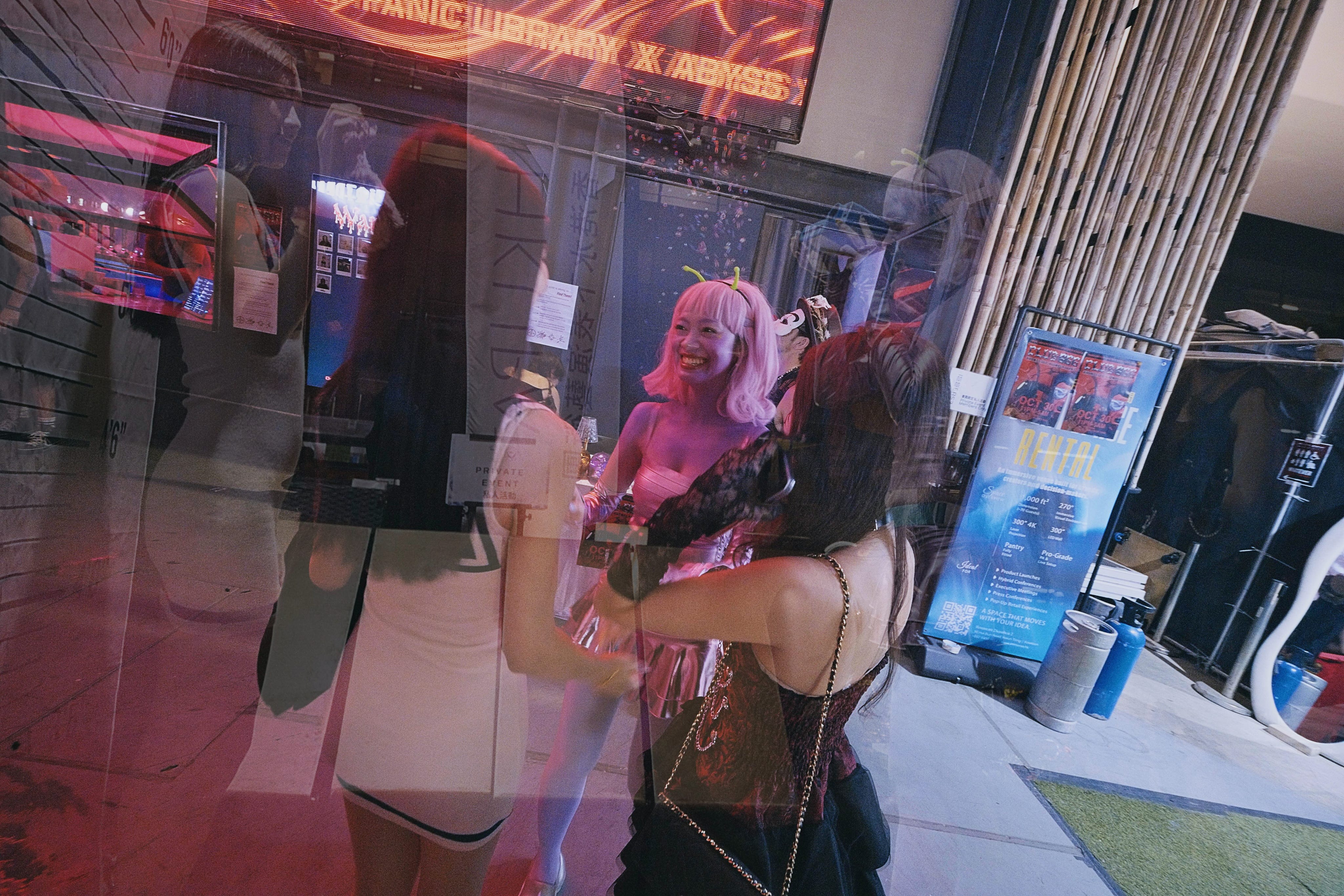

In a deadpan, semi-ironic voice, I tell Lisa* that since I go to Mass and pray the rosary, I have strong defenses against getting hexed.
“Sounds about right.” Fiddling with her tote bag, she continues, “For you, [pause] that should be how it works.”
Measuring her intonation, she’s hinting there’s something else she wants to say about the mechanisms of hexes. But I refuse to prod. It’s around 90 minutes until witching hour in Hong Kong’s Kwun Tong district. We’re walking through a castle of industrial buildings, scrunched together like a Norman fortress with barely a window or entrance in sight, when sound erupts from a keep near the water.
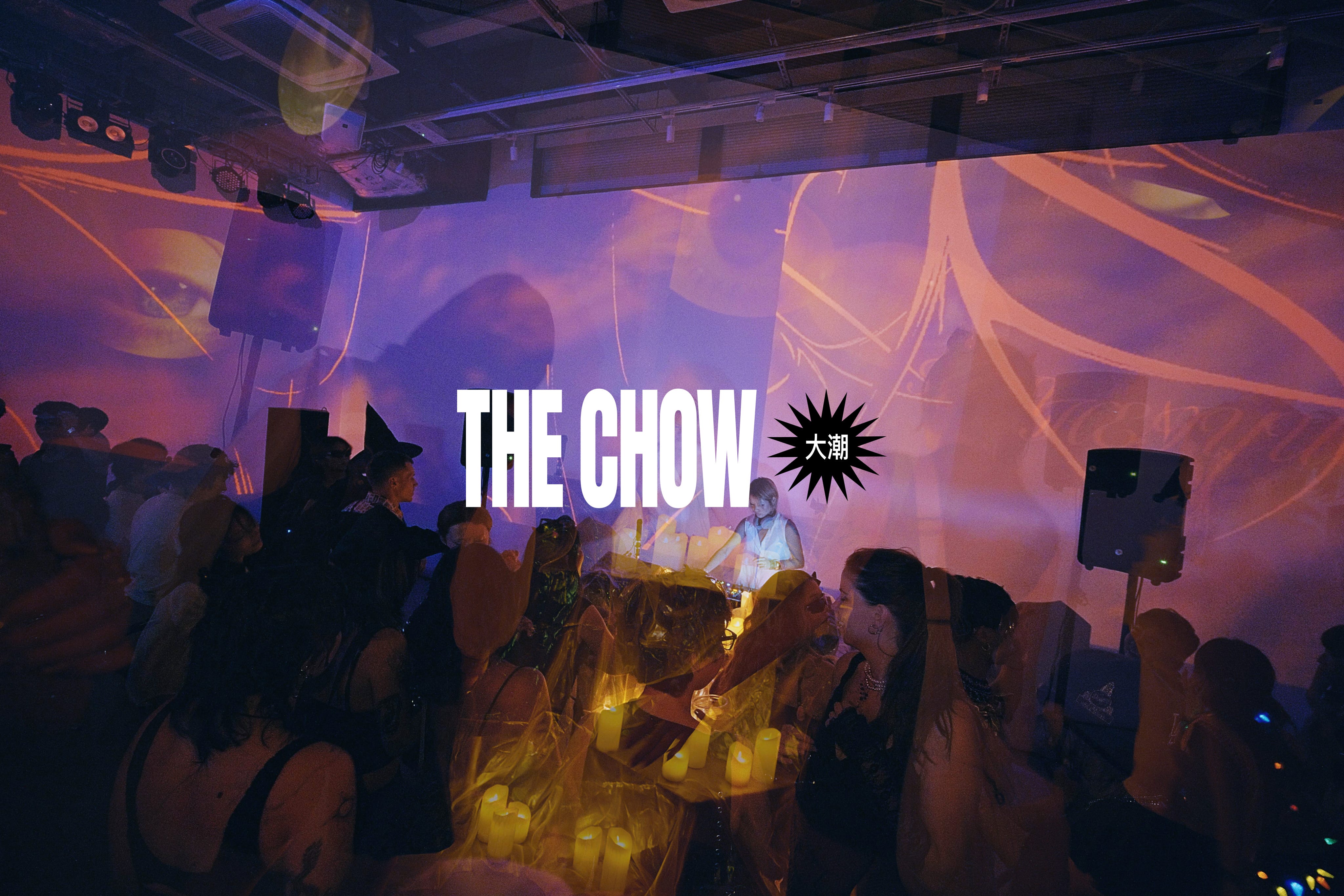
Welcoming us to the party in a fanfare, the DJ is mixing the ringing of church bells with the rising-falling synth-trumpets of EsDeeKid’s “4 Raws” and the slurring, occult incantations of Bladee. When we walk closer, the scene is straight from Shenzhen or Shanghai: low-seated foldable chairs littered next to drink vendors shaped like food trucks.
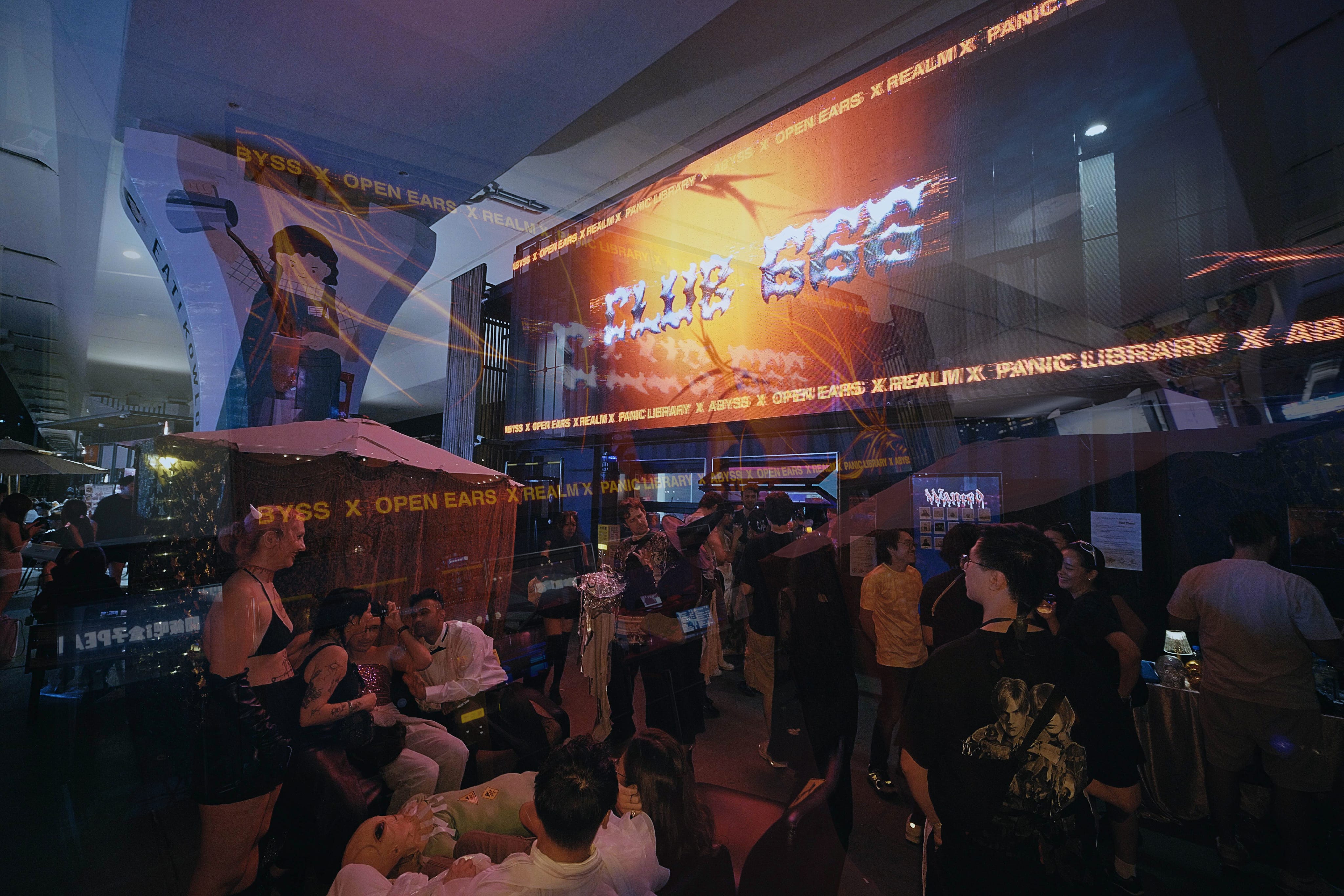
But it’s Halloween. Lisa and I did not commute to the edge of the Kowloon Peninsula to listen to viral rap music. On our agenda instead is the party next door, shrouded in a barrier of opaque black cloth, guarded by two men dressed like friars—loose, flowing brown robes and socks with sandals—wearing masks of the Sanxingdui: supposedly from the Ancient Shu civilization in Sichuan over 3,000 years ago, but widely speculated on the Chinese internet to be the work of aliens. When they let us through, the body of a green extraterrestrial (named “Tony”) is splayed on a coffee table, next to a starry hexagonal tent where over a dozen girls line up for a free tarot card reading. Behind it, a metal fence is collaged with thirty or so news clippings of paranormal encounters in Hong Kong. Translated from Chinese to English, they read, “Mysterious light pillars shockingly appear in the skies above Sai Kung waterfront” and “Hong Kong Observatory received 71 UFO sighting reports in 5 years.”
At the counter a punk with cat-ears and eyeshadow and fishnets straps on our wristbands. Emblazoned on a blood moon red print, in thorny cyber-gothic type, is the name of the event: CLUB 666 (subtitle: “something supernatural”).
The moniker belongs to a Halloween rave jointly hosted by three independent music collectives, each amplifying different genres into the city’s mainstream: Open Ears (ambient), Abyss 852 (techno), and Panic Library (hardcore and deconstructed club). And whether it rings as a warning or good fortune depends on whether you subscribe to Christian superstition or Chinese numerology—the mark of the beast or “fluidity, responsibility, and reaction.” Armed with a rosary in my pocket, Filipino-Catholic style, I’m hoping it’s the latter.
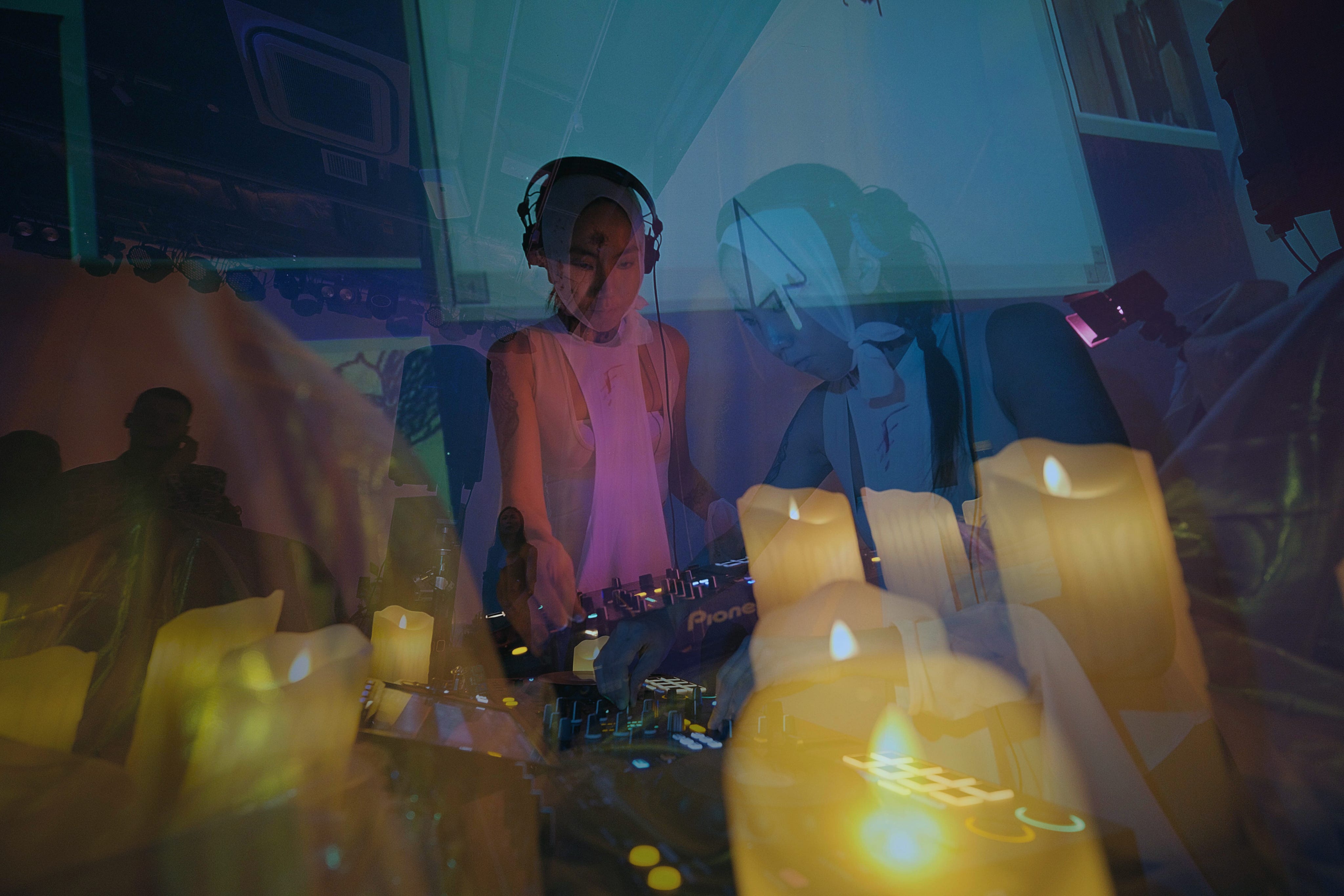
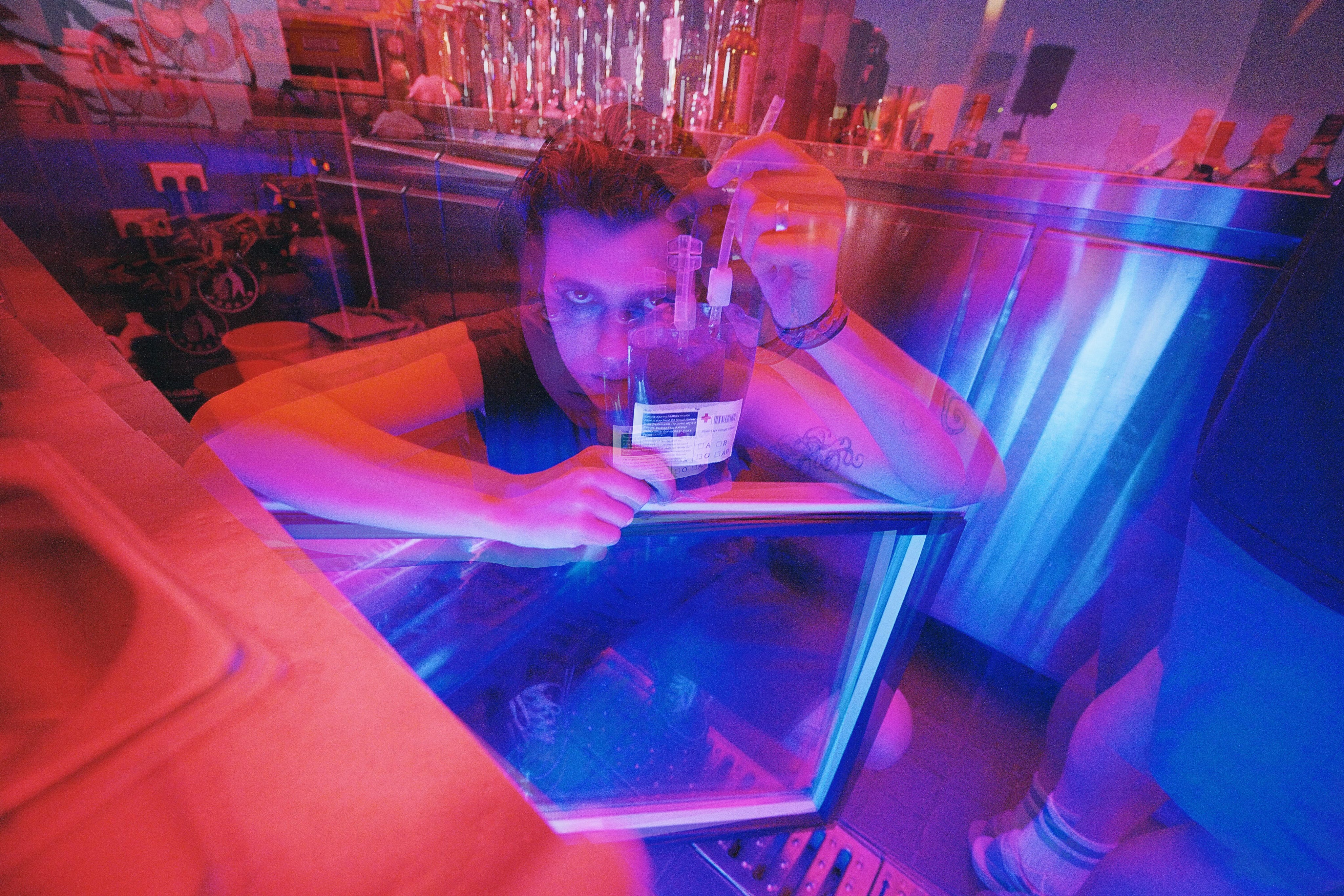
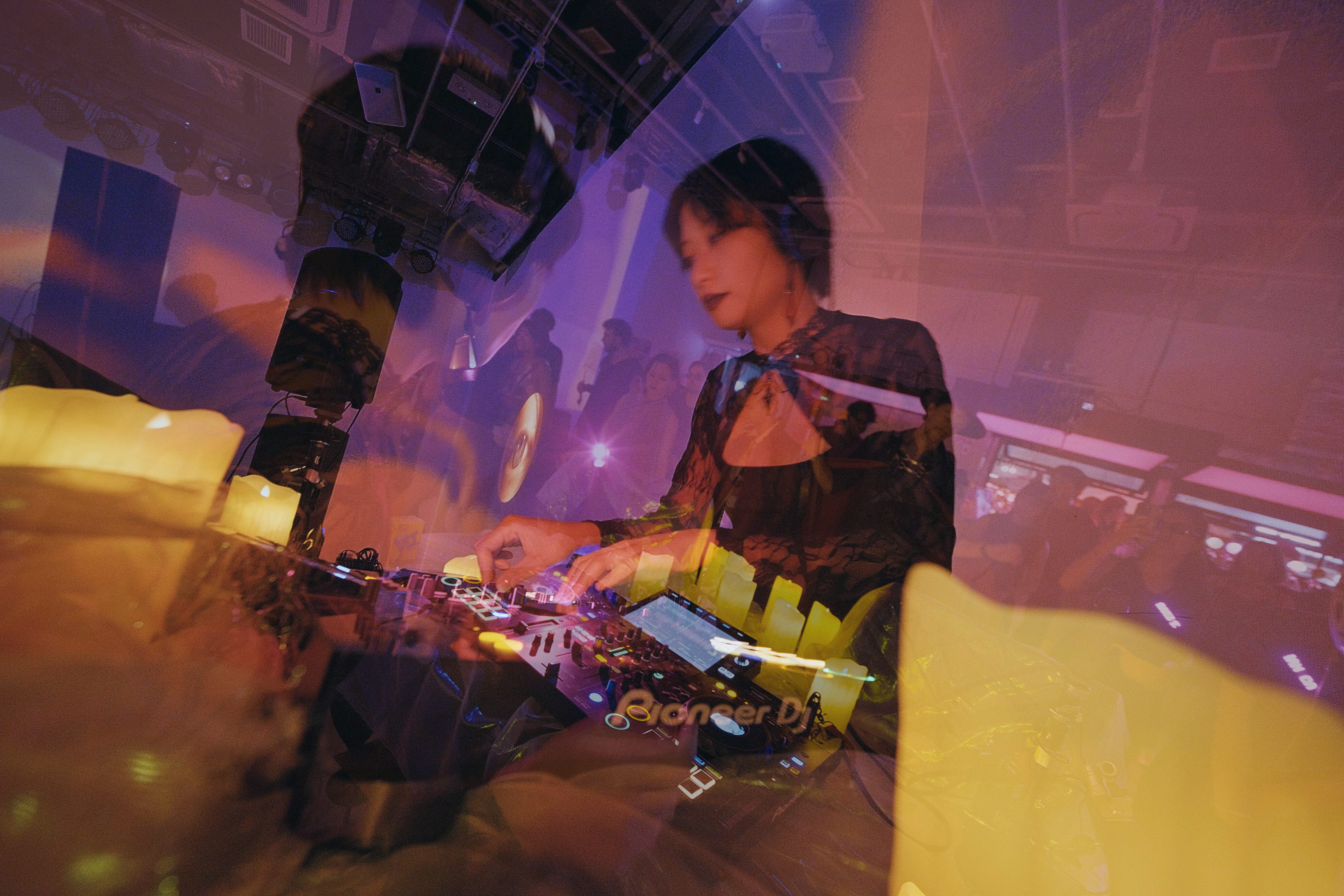
Inside, DJ Vegan Chicken mixes a monstrous gargling and thumping with an angry Baile funk. Manning the bar, two butch women are dressed as vampires—more à la Vampire Diaries than Dracula—with eyeliner and tank tops. A blood-red Ribena-flavored cocktail named “666 Degrees” is being served in blood bags embedded with a PVC straw. Behind the decks, a slurry of Windows 95 pop-ups flashes hydra drawings, runes, and Old English script. Hovering above a sofa stuffed with purses and work backpacks is an Alex Jones-style conspiracy map, connecting ‘MISSING PERSON’ posters from Picnic at Hanging Rock (1975) and David Lynch’s Twin Peaks with frantically scribbled notes on ghost sightings from The Shining and on entities of the Backrooms.
In his book Flying Saucers, Carl Jung closed the distinction between the modern alien encounter or conspiracy theory and the medieval visions of angels and demons: all were deeply spiritual, deeply supernatural phenomena. CLUB 666 was exactly that, but in party form—a rave where all distinctions between gothic folklore and hyper-online mythmaking collapsed.
Contemporary raves involving magical thinking are not new. “Neo-pagan aesthetics have been a part of the dance music fabric for decades, with roots in the free party movement of the late ‘80s and early ‘90s,” as Günseli Yalcinkaya traces in Resident Advisor. As today’s big tech CEOs wield greater power and influence than entire nation-states, the global economy is reviving Middle Age feudalism at a worldwide scale. Downstream of this is a renewed fascination for the medieval and the occult in electronic music scenes. Hence, the “late capitalism fantasyland” of Barcelona’s NeuroDungeon collective, hosting hybrid virtual and physical parties that fuse the mystic and the scientific. Or take the “fantasy gabber raves” of London’s Mordorkore, where “queer nerd culture” and LARPing fuse in parties where ravers dress up as “dwarves and fairies, necromancers and mages, jesters and executioners.”
For Hong Kong, “We’re creating space for fantasy and new rabbit holes,” Open Ears founder Vegan Chicken (legal name: Mildred Cheng) says. “Halloween is the only day you can be a freak, especially in Hong Kong… the only day that you can transform into something else.”
Among the organizers, “we were [asking ourselves], what kind of open-ended theme can we pick?” They landed on the supernatural, which, broadly defined, is “anything that can’t be explained by science.”
So inside, a skittering xylophone breakbeat droops downward and a crowd of more gender-bent vampires, a pharaoh, and three Dr. Seuss Thing No. 6s shakes hips in a descending dance. Sipping my blood-colored cocktail from the blood bag, dressed like Sukuna from Jujutsu Kaisen, I watch a white guy behind me slop around a Chinese lion dance suit made from tape and cutout AC pipes. When I ask him what his costume means, he says, “Does it have to mean anything? My lion’s here to party. It has one night and one night only.”
“Everybody on the team has their own rabbit hole”—different ideas of what “supernatural” even means—“and that takes shape in the party differently,” says Vegan Chicken. That logic translates into a schizophrenic set design, mixing a vast array of references together, but also into the costumes they wear. In Vegan Chicken’s case, “I’ve been watching five seasons of the TV show Supernatural, and I’m so hooked.” She’s dressed as a white ghost-siren with a bullet-hole on her forehead, created with flour and water (an “official expression” of how she felt setting up the party).
Other organizers pull from modern myths outside the West. When I ask about all the UFO news scattered around the party, Jessie Yip, who dressed up as an alien with purple skin, says, “Have you heard about Wah Fu Estate? There was a UFO sighting there before. And in the ‘90s, there was a TV channel called ATV that bought a fake video of an alien body being cut up. They didn’t know it was fake, but they ran it as a program for a week straight.”
“Comparing the techno and rave scenes, there’s a lot of [venues in Hong Kong] that let you live out sexual fantasy,” says Vegan Chicken. “But that’s not the only way of living a fantasy. There are so many others: dressing up, playing with gender, or just… eating.”
“Halloween looks so boring in Hong Kong because everyone dresses like a slut. I don’t blame sluts—I still love them—but [the costumes are] just boring,” Jessie adds. “We can do more.”
Future parties organized by the three collectives plan to experiment with the broad concept of “fantasy.” Ask them how, and they say they won’t give spoilers. Still, “it’s beautiful because each of us have different interpretations of the supernatural,” says Angel Chan, founder of Abyss 852. “And that’s how it comes together.”
The rise of new mysticisms follows our two-pronged, extreme moment in time: the future is simultaneously uncertain—when Jessie speaks, she’s fixated on apocalyptic thinking (“Someone told me that aliens are gonna attack the world in a few years. I’m not sure about that, but anyway,” she says)—but always known and anticipated through algorithms. Reclaiming otherworldly mystery resists this obsession with full knowledge and control: “Something we don’t know exists out there,” says Angel. “Humans always try to make sense of everything—science, data, and, recently, AI. But why would people be afraid of something that’s just unexplainable?”
But the Italian critic Umberto Eco reminds us that the collective yearning for pre-modern fantasies and superstitions is not unique to the 2020s. Humanity has always desired the Middle Ages—even at the very moment it ended, when Renaissance writers like Shakespeare and Cervantes revived castles and magic in Macbeth and Don Quixote. In more recent history, “neomedievalism” rose in the popular imagination after the Cold War, when capitalism’s unabashed victory made possible the multinational corporation, with kingly powers that rivaled the nation-state.
“What is required to make a good Middle Ages?” Eco asks. “A great international power that has unified the world in language, customs, ideologies, religions, art, and technology, and then at a certain point, thanks to its own ungovernable complexity, collapses.” Sound familiar?
That may describe today, when a U.S.-led world order is fragmenting into multipolarity, but Eco was already asking (and answering) that question in the 1970s, when Pax Americana exhibited early signs of decline, when American cities “feudalized,” dividing neighborhoods along racial and cultural lines, segregating either by choice, economics, or law, like neighboring tribes on the verge of war.
Even in the absence of war or conflict, that does resonate in the outside smoking area of CLUB 666, where in between nicotine puffs and bass hammering our consciousness into another realm, the party right next door opens a mysterious, parallel reality.
“They double booked us!” another organizer complained that night. Were we two different parties—English- and Cantonese-speaking on our side and Mandarin on theirs—fighting for the same venue? Or two rival merchant guilds forced to share a tavern in an armed truce by an indifferent landlord?
But the party was always bound to tribalism. “There’s something very, very archaic about a drum and a steady rhythm—and the night and lots of bodies around you,” the German hardstyle DJ HorsegiirL says in a Channel 5 documentary. “That kind of feels like being back [with] a fire pit and some drums.”
Opening the evening at midnight, Angel says her set was “more instinctual.” Channeling sonic energies through twisting and turning of sliders and dials on the decks, “I just play around with the sound, without so much thinking.”
“For the first track, I actually played Massive Attack’s ‘Inertia Creeps,’” Angel adds. “It’s a super classic trip hop track—one of the earliest, apparently. I really like how it sounds a bit creepy. And after the vocal lead in the beginning, when the first percussion starts, it makes a big impact. It slows the whole dance floor down [to the point] where you’re not jumping up and down; you’re flowing with the music.”
For Vegan Chicken, playing in the 2–3 AM slot, “my vibe is always experimental, percussion-heavy. Percussion club, I’d generalize it,” she says. “But to break it down, it’s all different, alternative, non-four-on-four drum and dance beats”: the thumping viral Douyin/brainrot hits, Cantonese footwork by FINGERGAP, or the tiw-tiw of Filipino budots compelling costumed bodies to move as if under a spell.
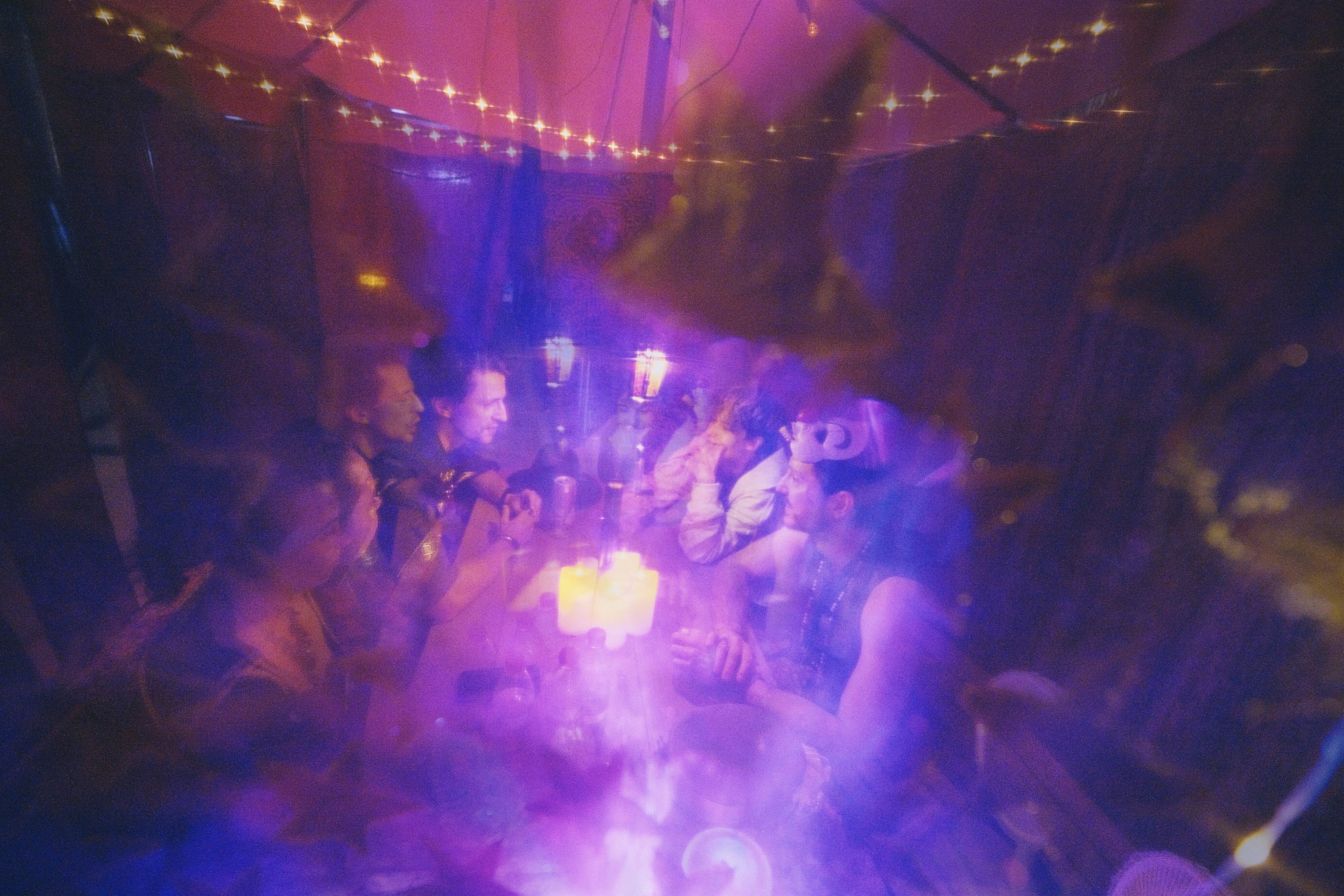
I dance near the front as the throbbing bass continues. Angel explains that there’s a game where people have to find a lost spirit to get a free drink in return, and a woman with a pentagram etched on her chest (scary!) approaches me and asks if I have any leads. I tell her no and go back outside for a smoke break with Lisa. From the small opening of the tarot tent, I see a mutual friend—Mishal*, who leads a popular local radio station—but I don’t say hi.
Speaking to Vegan Chicken, Jessie, and Angel a few days later, I insist that Mishal was there at the party.
“Are you sure?” Angel said. “I don’t think he was there.”
“Maybe he sent his shadow,” Vegan Chicken said. “Maybe you saw a ghost.”