


“You wanna know why people love Shenzhen?” my friend, Andre*, says from the shotgun seat of an electric vehicle. “It feels like GTA. You come here and your dollars are worth double and you live like money doesn’t even exist.”
We’re sitting inside a sleek black BYD, ordered from rideshare app DiDi, accelerating 90 kilometers an hour on a wide, car-less highway at two o’clock in the morning. Andre can’t resist the urge to stick his arm out the window and hang his hand against the breeze. “Nevermind, sorry,” he says. “I sound like a white guy going to the Philippines.”
I don’t think Andre is wrong, though. In droves, people from Hong Kong have been trickling north to the neighboring Chinese city, Shenzhen. In a single week, residents from the former British colony can apply for a Chinese travel permit or tourist visa on a Monday, acquire it before Friday, and then come Saturday, take a 45-minute train north, cross the border on foot, and make an easy weekend vacation in the Mainland. On the weekend of Buddha’s birthday, some friends and I are among them—and our mission is to make use of what China’s manufacturing prowess has to offer: cheaper prices.
You can stuff your face with Xinjiang-style barbecue and Hunanese spicy pork for less than 60 RMB (US$8) a person, or shuttle from one side of the city to the next, get chauffeured in sleek EVs, and the fare could be less than 40 yuan (~US$6). “Nothing beats a Jet2holiday,” so they say. “You can save fifty pounds per person … two hundred pounds off for a family of four.” Try as you might, but you will get dealmogged by a weekend in Shenzhen: slobber your face in the best spicy food in the world and ride around the city in style, because when the costs of food, drink, transport, and the hotel are finally tallied up, the total bill amounts to roughly the price of a pair of New Balances.
After some scolding from the three of us seated in the back, some sense knocks into Andre and he pulls his arm back inside the car. The black BYD turns rightward from the highway, into a long, dark strip, lit up by 7-Elevens and mini charcoal pits from hawkers selling skewers. Four more friends pull in from another DiDi, and our party of eight files in line for Sauce, Shenzhen’s most popular hip-hop nightclub.
It was like a millennial designed a gas station: in a retro Americana typeface read the logo, “Sauce,” plastered on red rectangular roof protruding above the club’s exterior, with walls fully wrapped in a borderless LED screen casting a pink-colored glow in the dark. Pixels forming red and white ball-pit-style balls circled around the main entrance, as if pulling you to sink and swim in the muffled trap emanating from the club’s opening.
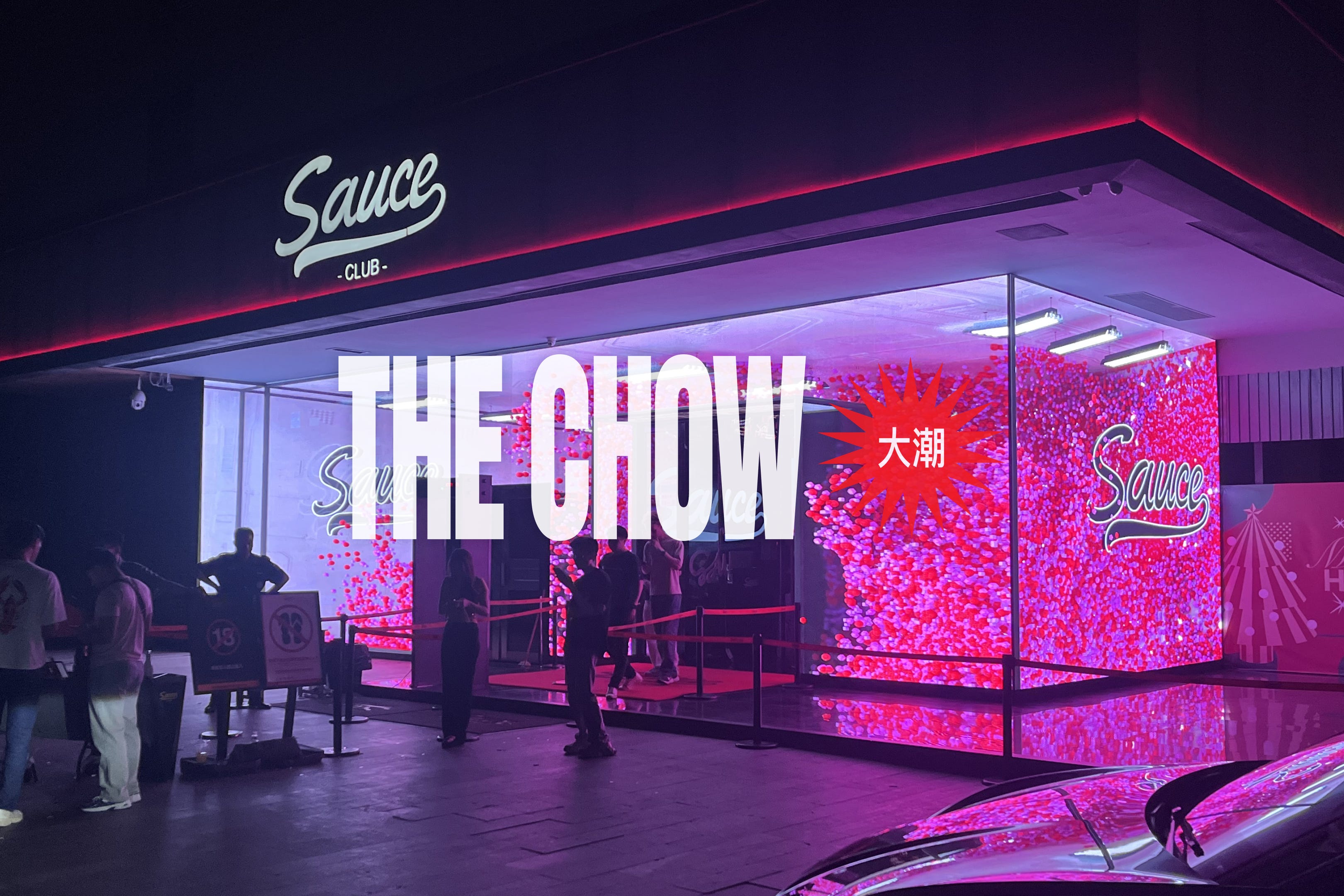
Entry is 100 RMB (~US$15) per person, says the bouncer, a man named Stan with arms fully sleeved in tattoos. Our bill is ¥800 but if we add ¥80, Stan says, we get a table and free tequila too.
“Guys it’s quarter past two,” Wendy* says. “Do we really need this?” Our start is later than usual so we don’t know how long we’ll stay and we’re not quite sure if the man named Stan is offering a scam. Besides, when everything in the city is so cheap, you get spoiled on good prices, and the line between Good Deal and (perceived) Theft grows paper thin. (We paid 800 RMB for a bottle of whiskey and five pitchers worth of green tea over a pre-game; Henry*, who grew up in Beijing, said we were being ripped off; I told him to shut up, that we should shoulder the cost and support the local nightlife industry. I don’t know who’s right).
But because Stan is nice and speaks to us in Cantonese, our verdict is “yes, fuck it, add the ¥80 (~US$12), split it between eight.” And for a hotly debated extra US$1.20 per person we get the table. Once Lauren* scans the AliPay QR code to top off our bill, we collect our wristbands and blitz inside.
The dance floor is packed but I hardly notice—the AC has all the right settings because even wading through the cracks between bodies, I don’t graze on anyone’s sweat. More obvious is the Skrillex mixed with Drake’s 2018 track “Nonstop,” the loud MC chanting with the song’s adlibs, or the dirty-blonde-haired white man I pass by on the walk to the table. He’s wearing skin-tight black jeans and black converse, with hair tied in a man bun over an undercut. At least to me, this does not feel like the culture of the 2020s.
The table’s diameter barely fits the eight of us (scam!). But the extra expense must’ve been essential because there’s about an inch of space between me and the dancers behind me (good deal?). The tequila bottle arrives (good deal?), but servers are too busy to offer shot glasses (scam!). “No one knows how to walk by someone without hitting them,” Alicia*, complains. “Even turning at the right angle, everyone seems to miss that here.” True, but it’s also nice to see that even after Charli XCX declared “the dance floor is dead,” there’s a club in China where the insides are bursting with patrons, the business is (likely) good, and the owners are (hopefully) making money.
Shenzhen is analogous to China’s rapid ascent as a global economic powerhouse. Forty years ago, the city was a poor fishing village, with a population of around thirty thousand. But after being named a “Special Economic Zone” by the CCP, Shenzhen became a manufacturing hub, creating low-end toys, textiles, and electronics in its factories during the 1980s. Later, this industrial might unlocked new opportunities, eventually bringing the headquarters of tech giants like Tencent and Huawei into its limits. Today, Shenzhen’s population is roughly 18 million, its GDP greater than Denmark’s.
A single generation in Shenzhen can witness centuries worth of economic growth compressed into fifty years. “A miracle”—as Xi Jinping once described this rapid development in a 2019 speech—“in the history of world development, created by the Chinese people.” Or, a “dream,” where, thanks to Chinese manufacturing, what once was a poor fishing village now lives in a complete, near-vacuous abundance: “Shenzhen is still the only place in the world with a full-stack metabolism for developing new products,” artist and theorist Gary Zhexi Zhang once wrote of the city in Spike Art Magazine. “Here, it was said that a product could be dreamed up in the morning, its components sourced in an afternoon, and its prototypes ordered by nightfall—the Shenzhen dream.”
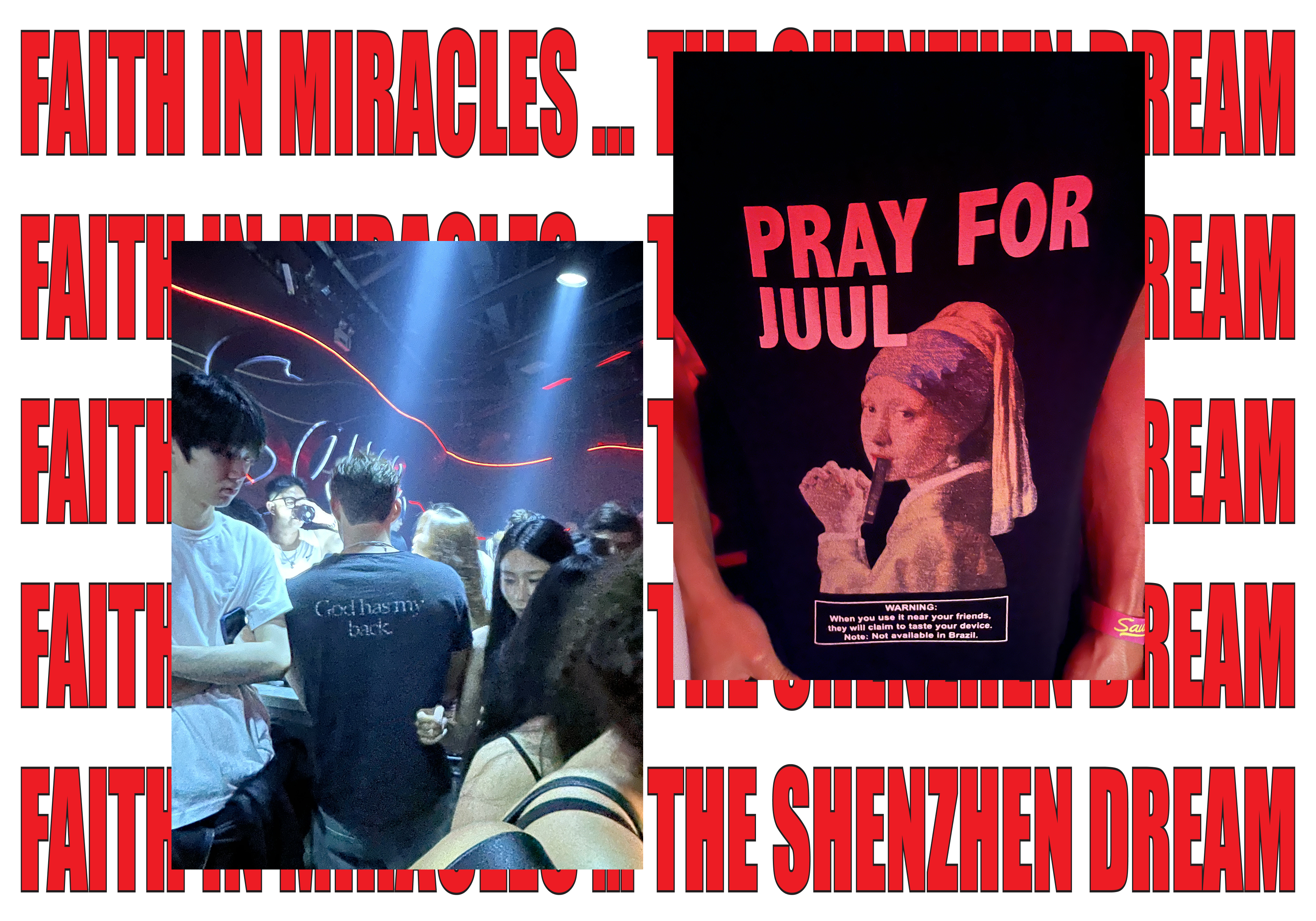
Around the world, nightlife organizers sound the alarm that the clubbing industry is on its last breaths. Hope for the industry is in short supply, but at Sauce there’s faith in miracles: “GOD HAS MY BACK,” reads the words of a faded imprint on the t-shirt of a tall, Germanic man, who (if I wasn’t hallucinating) might’ve been a popular model from the Philippines that I knew from high school. The words “PRAY FOR JUUL” land on the shirt of another man—this time, French—sketched in bold above an image of the Girl with a Pearl Earring taking a hit from a vape. Who was this contraband god commanding his reverence? It is the e-cigarette, outlawed just a few kilometers south in Hong Kong, where sale and use are strictly banned.
Clubbers at nearby tables pass French fries, crumpled tissue paper, and vape smoke by the mouth, with the playfulness reserved for adolescents trying alcohol for the first time. “Why does it feel like the clubs people would sneak into when we were in high school? It’s so 2017,” I say to Alicia. Two TikTok-era classics—Megan Thee Stallion’s “Body” and “OUT WEST” by Jackboys and Travis Scott—mix back to back, triggering a speedy somnambulant sway of the shoulders in the Nepali tourists, dancing heels-off atop the sofa near the wall. Clubbers circle around the curved pillar in the club’s center—rotating, rewinding the spool of “today.” Suddenly, it’s like that magical thinking, the belief in miracles, bleeds and transforms into something else, something that feels like the bubbly optimism of the 2010s.
That’s likely the natural consequence of life in a nation that lifted 800 million out of poverty, where people travel for cheap prices. Chinese manufacturing is creating a new affective experience of “abundance”—an experience of the world that feels nearly identical to the Zero-Interest Rate Policy (ZIRP) era.
In late 2008, right in the middle of the Global Financial Crisis, the United States’ Central Bank set interest rates to zero, and ushered in the Zero-Interest Rate Policy. From then, money was literally free. Easy access to capital spawned some of the world’s most recognizable tech startups: Airbnb in 2008, Uber in 2009, DoorDash in 2013, many of which sought to eliminate friction from travel, transportation, and dining, offering convenient services at a price so low it felt like an inalienable right. As Brad Troemel recalls of the ZIRP era, “easy money gave rise to the Millennial Lifestyle Subsidy: A brief window during which startups, flush with VC funding, offered artificially low prices on goods and services in a race to acquire users and monopolize their markets.” As an additional side effect it created a wave of fake jobs: product managers who spent their entire days playing ping pong in Silicon Valley tech offices, or “journalists” at BuzzFeed getting paid actual salaries to write listicles all day. ZIRP technically ended in 2015-16. But global interest rates remained low, until 2020, when governments reinstated ZIRP as a response to COVID-19.
“Millennial Lifestyle Subsidies” and free money made “abundance” the defining affective experience of the 2010s: You could Uber to work, have a fake, low-effort, high-paying job at a tech startup, arrive home and DoorDash (or Deliveroo or Foodpanda) your dinner for an abysmally low price. Coming of age in this era, even halfway across the world, taught me that opportunities and resources would always be abundant and that through technology, humanity would progress towards a kind of Fully Automated Luxury Communism.
Obviously, I was wrong. ZIRP roughly ended in 2022 to curb pandemic-induced inflation. Now that money is no longer free, tightening company budgets are triggering industry-wide layoffs, and the price of eggs and gas triggers a “vibescession” around the world. But you can still get a picture of ZIRP-era abundance in China, particularly as a tourist riding in 40 RMB DiDis, ordering food delivered by DJI drones, or on weekend vacations that cost less than a sneaker.
For outsiders looking into China, the idea that “Chinese manufacturing” is the new “zero interest rate policy” is particularly apt. “Why travel to China is WAY Cheaper Than You Think” reads a clickbait headline of a YouTube video; on the thumbnail of another, the words “ONLY $2” point towards a Luckin Coffee cup. In a video, Singaporean creator Cayydences parodies this sentiment: “EVERYTHING THERE IS SO CHEAP… CHINA HAS EVERYTHING… I LOVE CHINA,” he says. “THE DRONE THAT CARRIES THE FOOD… OH MY GOD ONLY CHINA HAS THAT.” Where I live in neighboring Hong Kong, branches of Xiao Noodles, HeyTea, and Pop Mart are flooding into local malls. By offering affordable, high-quality food, drinks, and toys en masse, these Chinese brands are comforting a city where consumer sentiment is in slow recovery.
Just as the United States accumulated trillions in debt during ZIRP, China’s current surplus of cheap, high-quality goods is fueled by a similar mountain of credit. The nation’s total social financing—an official metric used by the People’s Bank of China to measure debt—continues to increase at a greater rate than GDP. I’m not qualified to predict how this will pan out, but it’s not clear how long these cheap prices will last for consumers coming from outside the country’s borders. On the weekend of our trip, the exchange rate had shifted in favor of the RMB. A year ago, the U.S. dollar was valued at 7.2 RMB; today, it is worth 6.77. Our Hong Kong dollars—pegged to the American currency—were worth less, and we were paying more out of pocket.
But in the meantime, we enjoy what Chinese manufacturing has to offer.
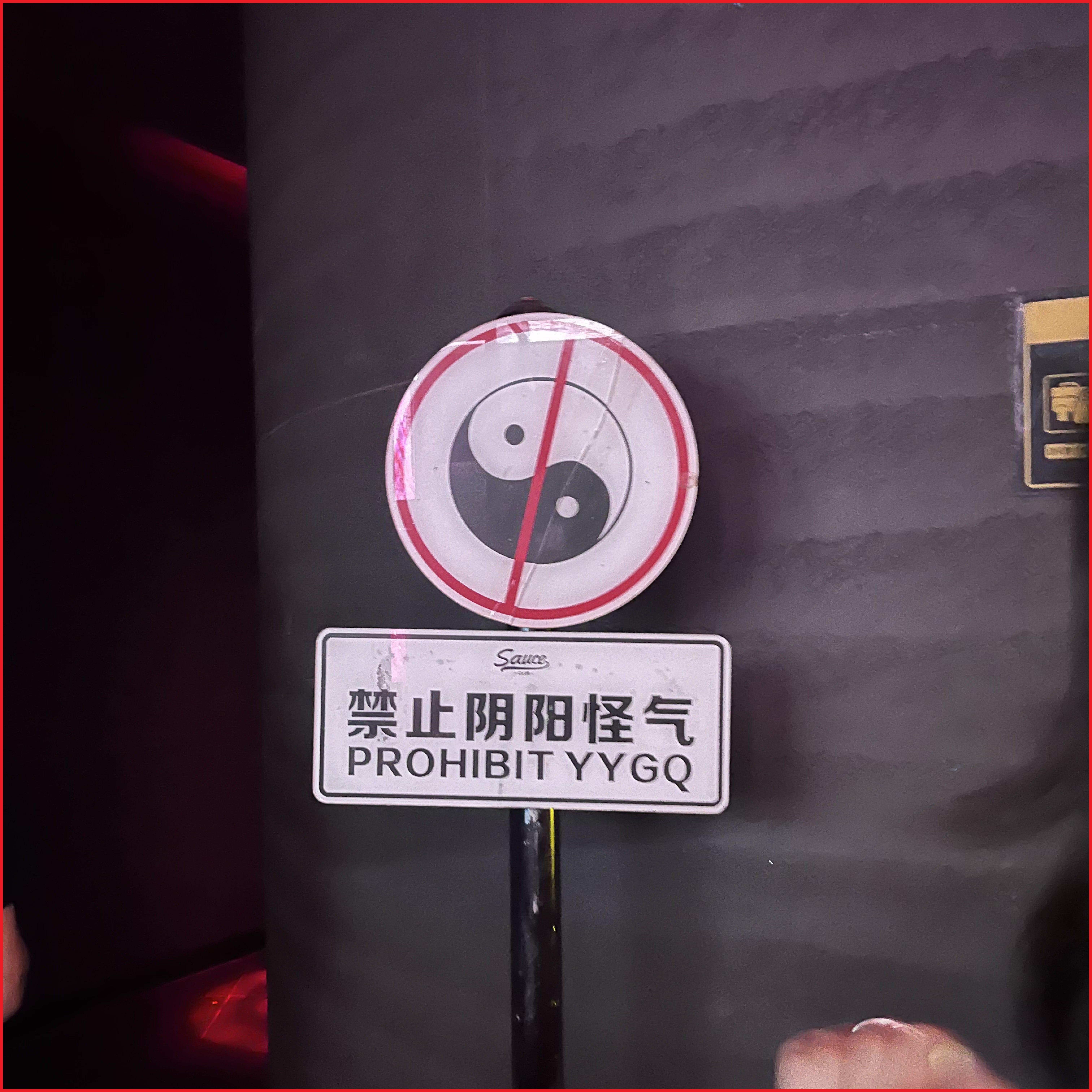
Just before we bounce at four o’clock, Carl* has the violent urge to start doing a bottle flip. Wendy copies him and fails. We finally leave after noticing the thinner crowd and that a different DJ is on the decks. On our way out, I catch a glimpse of the sign at the entrance: “票止阴阳怪气 / PROHIBIT YYGQ.” Directly, the phrase means that a bitchy passive-aggressiveness is unwelcome at the club. I may be wrong, but I imagine a *very distant* and much less literal translation could recall a ZIRP-era maxim that I grew up with, apt for the Shenzhen nightclub’s bubbly optimism and faith in miracles: good vibes only.

Thank you for the pictures of the T-shirts. I just had to know
Fascinating! Thanks for sharing. The notion of a generation seeing all of that happen in their lifetime is wild, I feel like they should be studied for what we’re gonna go through with AI